You have not yet added any article to your bookmarks!
Join 10k+ people to get notified about new posts, news and tips.
Do not worry we don't spam!
Post by : Anis Farhan
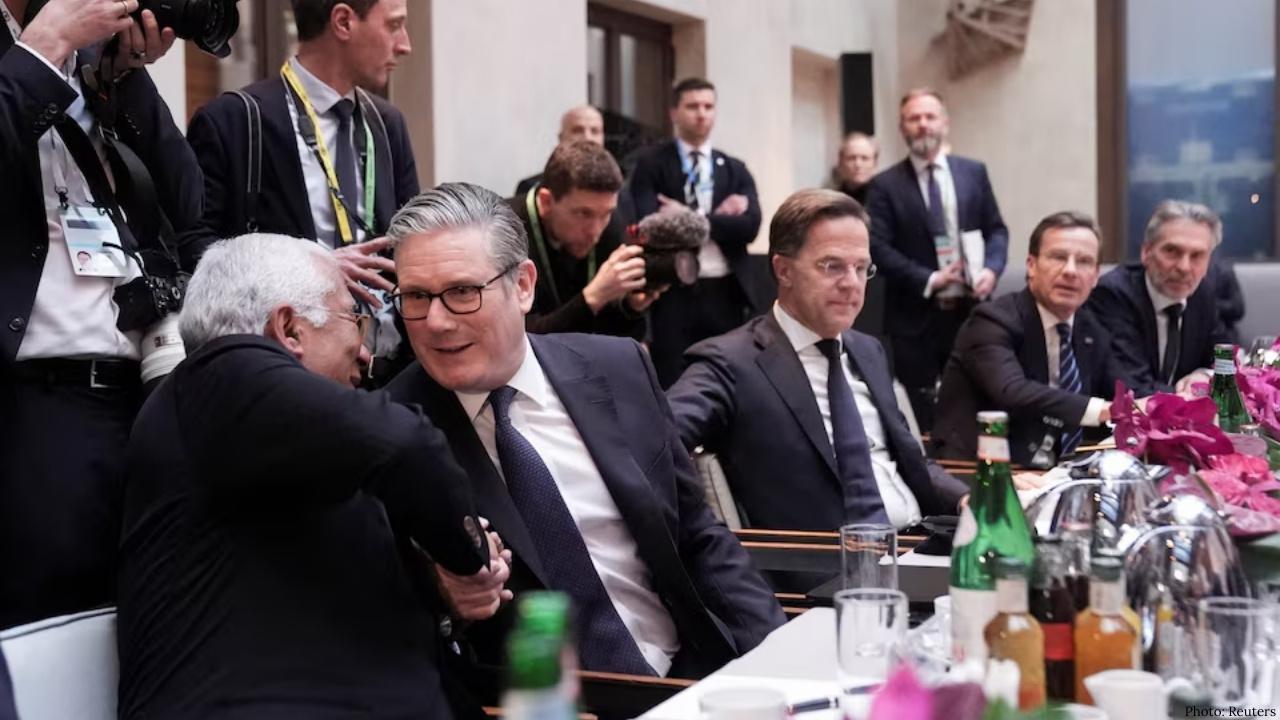
At the 2026 Munich Security Conference, British Prime Minister Keir Starmer delivered a significant message on European defence policy. He emphasised the need for the United Kingdom and European partners to work more closely on defence matters to enhance NATO’s effectiveness and reduce the alliance’s heavy reliance on the United States.
Starmer’s remarks reflect a broader assessment of shifting geopolitical pressures — including persistent tensions with Russia and the increasingly unpredictable nature of U.S. foreign policy under the current administration — that have prompted European leaders to reassess collective security arrangements.
Prime Minister Starmer acknowledged that the U.S. remains an indispensable ally that has played a historic and pivotal role in securing European stability. However, he argued that Europe should pursue greater autonomy and burden-sharing within NATO, rather than defaulting to dependency on Washington.
His remarks came amid broader unease in parts of Europe about perceived shifts in U.S. commitment to transatlantic defence — a theme echoed by other European leaders at Munich who stressed the need for a more resilient regional security framework.
A central element of Starmer’s address was the call for greater integration of the European defence industrial base to reduce inefficiencies and redundancies that arise from fragmented national procurements. According to speech excerpts released by his office, Starmer described Europe’s defence sector as a “sleeping giant” that should be harnessed through cooperative planning and pooled procurement.
Starmer framed his vision as one that does not seek the withdrawal of the United States from NATO but rather encourages a more balanced partnership in which European states take on a proportionate share of defence responsibilities. This includes potentially joining new pan-European defence initiatives and exploring collaborative frameworks beyond existing NATO structures.
Starmer has been actively seeking to reset relations between the UK and the European Union since taking office in 2024, four years after Britain exited the EU. Before his speech at Munich, there had already been efforts to explore Britain’s participation in European defence initiatives such as the EU’s SAFE defence fund — though talks to join the original fund faltered. Starmer said he remains open to joining a new or revised version in the future as part of deeper cooperation.
He reiterated the message that “we are not the Britain of the Brexit years anymore”, underscoring that inward-looking policy would harm both British and European security.
Starmer’s proposals arrive at a time when some European capitals are questioning the reliability of U.S. leadership in defence, influenced by recent tensions within NATO and calls from the U.S. administration for Europe to increase its military spending. Starmer’s remarks were part of a wider European discourse about forging a more autonomous security posture without undermining key transatlantic ties.
Other leaders at the Munich conference echoed similar themes, pushing for stronger European defence capabilities even as they reaffirmed support for collective alliances like NATO.
Starmer’s stance on defence cooperation also demonstrates the UK government’s broader foreign policy trajectory, which aims to position Britain as a bridging partner between Europe and traditional allies, while redefining post-Brexit relations. Resetting ties with the EU on defence issues is a strategic priority, not just a matter of military alignment, but also of economic and diplomatic influence.
A key objective of Starmer’s policy is to alleviate the pressure on U.S. forces by encouraging Europe to collectively shoulder greater defence responsibilities. This could reshape NATO’s role, positioning it as a more balanced partnership where European states play a stronger organising role alongside the United States.
By advocating stronger defence links with Europe, Starmer underscores the interdependence between British and continental security. His assertion that “there is no British security without Europe, and no European security without Britain” encapsulates this intertwined outlook, even post-Brexit.
Prime Minister Keir Starmer’s message at the Munich Security Conference reflects a significant call for greater defence collaboration between the United Kingdom and Europe. His proposals centre on reducing NATO’s reliance on the United States, enhancing burden-sharing, and integrating European defence efforts to build a more resilient and cohesive security framework.
As geopolitical uncertainties persist — particularly in the context of Russia’s ongoing aggression in Ukraine and questions about U.S. foreign policy — Starmer’s vision represents a concerted effort to recalibrate European defence strategy. His emphasis on cooperation and autonomy signals a potential shift in how European security may evolve in the years ahead.
This article is based on verified reporting and analysis of Prime Minister Keir Starmer’s defence policy proposals delivered at the Munich Security Conference and subsequent related developments. It has been independently written and does not reproduce copyrighted material from Reuters or other news agencies.





France’s Sesterce Plans $11 Billion AI Data Centre in Finland
Sesterce plans a $11 billion AI data centre in Finland, with major expansion, green energy plans and

Danaher to Launch AI-Powered Autonomous Research Lab in 2027
Danaher plans an AI research lab for 2027, combining robotics and automation to speed up drug discov

Musk Welcomes German Support for Tesla Driver Assistance Tech as EU Approval Push Continues
Elon Musk welcomes Germany's backing for Tesla FSD as the company seeks EU approval amid speed, safe

Microsoft and Nvidia CEOs to Unveil AI Laptop at San Francisco Event
Microsoft and Nvidia showcase a new AI laptop with RTX Spark chips as they push powerful local AI co

Man to face charges over perfume thefts at Changi Airport
A 47-year-old man faces charges over perfume theft at Changi Airport after six items worth nearly S$

Google Signs 3.6-GW Power Deal With Constellation Energy in US
Google signs a 3.6-GW power deal with Constellation Energy, including nuclear power upgrades to supp