You have not yet added any article to your bookmarks!
Join 10k+ people to get notified about new posts, news and tips.
Do not worry we don't spam!
Post by : Rohit Dhiman
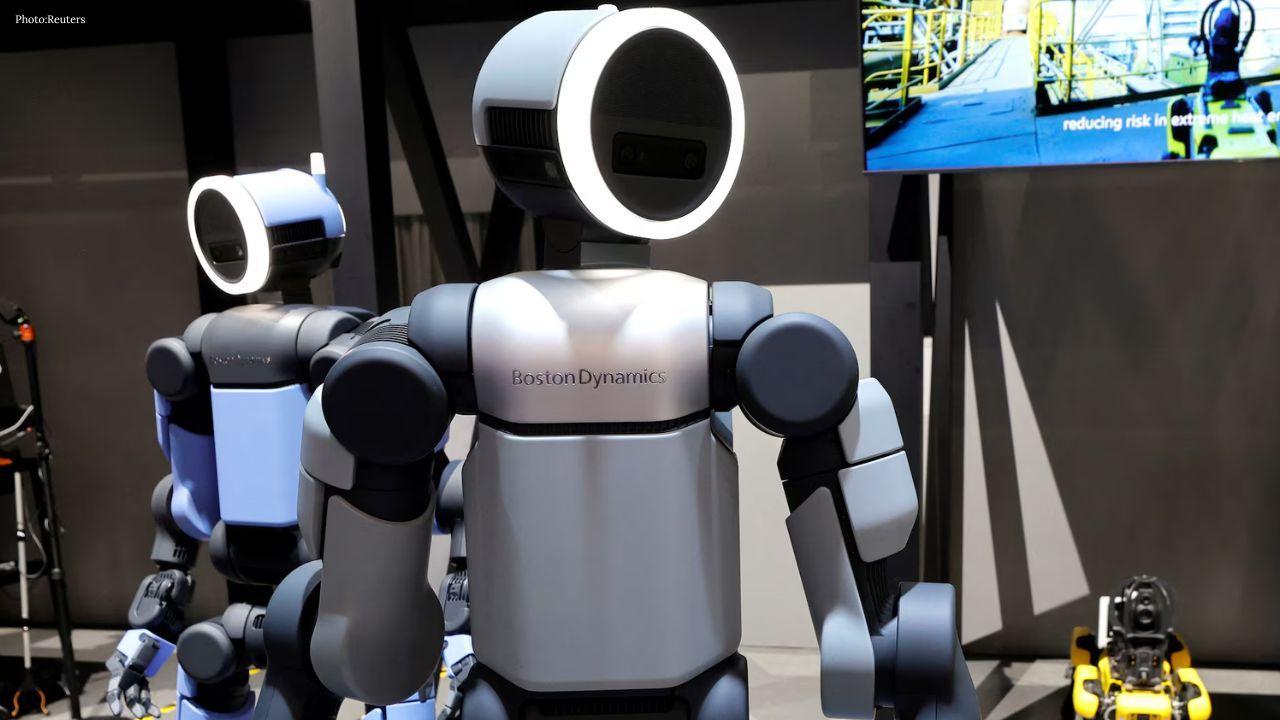
Boston Dynamics has appointed former Amazon executive Rohit Prasad as its new chief executive officer, bringing an experienced artificial intelligence leader to the top position at one of the world's most recognised robotics companies. The appointment takes effect on October 7, 2026, as Boston Dynamics continues to expand its work in humanoid robots and physical artificial intelligence. Prasad joins the company after holding senior leadership positions at Amazon, where he served as senior vice president and head scientist for Alexa and Artificial General Intelligence. His experience includes work on AI systems designed to interact with people and perform increasingly complex tasks. The move comes at a significant stage for Boston Dynamics, which is working to take advanced robotics beyond research and demonstrations and towards wider commercial use.
Boston Dynamics, which is owned by Hyundai Motor Group, announced that Prasad would become its new CEO with immediate effect from October 7. The company said his background in artificial intelligence and his experience in turning technological advances into products that can be used commercially would be valuable as it develops the next generation of robots. Prasad's appointment places an executive with extensive Artificial Intelligence experience at the centre of Boston Dynamics' efforts to combine advanced software with sophisticated robotic hardware.
Prasad succeeds Robert Playter, who stepped down from his position as CEO in February. Playter had led Boston Dynamics during a period when the company moved further from being known primarily for experimental robots towards developing machines intended for practical applications. The leadership transition comes as the global robotics industry is seeing increasing investment in Humanoid Robots, artificial intelligence and automation. Companies are now working to develop robots that can operate in environments designed for humans, including factories, warehouses and other workplaces. For Boston Dynamics, the challenge is not only to demonstrate that a robot can perform a task but also to make such technology reliable, scalable and commercially viable.
Prasad's professional background is closely connected with the development of artificial intelligence. At Amazon, he worked on Alexa and artificial general intelligence, areas involving machine learning, language understanding and human-computer interaction. His move to Boston Dynamics represents a shift from software and AI systems towards machines that interact directly with the physical world. This area is increasingly described as Physical AI, where artificial intelligence is combined with sensors, robotics and real-world movement. Unlike software that operates entirely on computers, physical AI systems have to respond to changing environments. A robot must be able to understand where objects are located, maintain balance, plan movements and react safely to unexpected situations.
One of Boston Dynamics' most prominent projects is Atlas, its advanced humanoid robot. The company has demonstrated Atlas performing movements and tasks that are designed to show how humanoid machines could eventually be used in industrial environments. The development of Atlas Robot technology has attracted attention because humanoid robots are increasingly being viewed as potential tools for manufacturing and other physically demanding work. The long-term objective across the industry is to create machines that can work in spaces already designed for humans without requiring major changes to buildings, equipment or production lines. That could allow robots to perform repetitive, physically demanding or potentially hazardous tasks while people focus on activities requiring judgement, supervision and specialised skills.
Read Also: Husband Remanded After Wife Is Allegedly Stabbed Six Times
Boston Dynamics is owned by Hyundai Motor Group, which has been increasing its focus on robotics as part of its broader technology strategy. Hyundai Motor Group said in January that it aims to establish a manufacturing facility capable of producing 30,000 robots annually by 2028. The group plans to begin deploying robots across all of its manufacturing sites when that production capability becomes available. The target indicates that robotics is being considered not simply as an experimental technology but as a potential component of large-scale industrial operations. For Boston Dynamics, this creates an opportunity to connect its robotics research and product development with Hyundai's extensive manufacturing network.
The appointment comes at a time when Robotics Technology is developing rapidly. Advances in AI have made it possible for machines to process larger amounts of information, understand instructions more effectively and make decisions in increasingly complex environments. When those capabilities are combined with modern robotic hardware, companies can potentially create machines capable of carrying out a broader range of physical tasks. However, turning these developments into commercially successful products remains a major challenge. Robots operating in factories must be dependable, safe and cost-effective. They also need to work alongside people and existing machinery without disrupting production. Prasad's experience in taking AI technology towards consumer and commercial applications could therefore become an important part of Boston Dynamics' strategy.
The global Humanoid Robot industry has attracted major technology companies, automakers and robotics specialists. The growing interest is partly driven by advances in generative AI and machine learning, which have improved the ability of machines to understand language, analyse information and respond to instructions. At the same time, improvements in motors, batteries, sensors and computer hardware are helping robots become more capable. Boston Dynamics has already established a strong reputation for its work on dynamic movement and robotic mobility. Its earlier machines demonstrated sophisticated walking, running, climbing and balancing capabilities. The next challenge is to combine those physical abilities with increasingly capable AI systems.
Boston Dynamics has historically attracted attention through demonstrations showing robots completing difficult physical movements. But the company's future growth will increasingly depend on whether its technology can be deployed on a much larger scale. Commercial robots need to perform consistently over long periods and under real working conditions. They must also justify their cost to businesses. The company's connection with Hyundai could provide an important testing environment because manufacturing plants offer controlled industrial settings where robots can be evaluated and gradually introduced into existing operations. The planned production capacity of 30,000 robots a year by 2028 would represent a major expansion compared with the limited production associated with experimental robotics.
Prasad's first major task as CEO will be to help guide Boston Dynamics through this transition from advanced robotics development towards broader commercialisation. His background in AI could help the company strengthen the software and intelligence capabilities that complement its robotic platforms. The company will also need to balance innovation with practical considerations such as manufacturing costs, safety, reliability and customer demand. With Hyundai Motor Group supporting its expansion and a growing global focus on humanoid machines, Boston Dynamics is entering a new phase in its development. The appointment of Prasad signals the company's intention to place artificial intelligence at the heart of that next stage.




Danaher to Launch AI-Powered Autonomous Research Lab in 2027
Danaher plans an AI research lab for 2027, combining robotics and automation to speed up drug discov

Musk Welcomes German Support for Tesla Driver Assistance Tech as EU Approval Push Continues
Elon Musk welcomes Germany's backing for Tesla FSD as the company seeks EU approval amid speed, safe

Microsoft and Nvidia CEOs to Unveil AI Laptop at San Francisco Event
Microsoft and Nvidia showcase a new AI laptop with RTX Spark chips as they push powerful local AI co

Man to face charges over perfume thefts at Changi Airport
A 47-year-old man faces charges over perfume theft at Changi Airport after six items worth nearly S$

Google Signs 3.6-GW Power Deal With Constellation Energy in US
Google signs a 3.6-GW power deal with Constellation Energy, including nuclear power upgrades to supp

Harmanpreet Kaur Steps Down as India Captain Across All Formats
Harmanpreet Kaur steps down as India captain across all formats after a remarkable leadership journe