You have not yet added any article to your bookmarks!
Join 10k+ people to get notified about new posts, news and tips.
Do not worry we don't spam!
Post by : Rameen Ariff
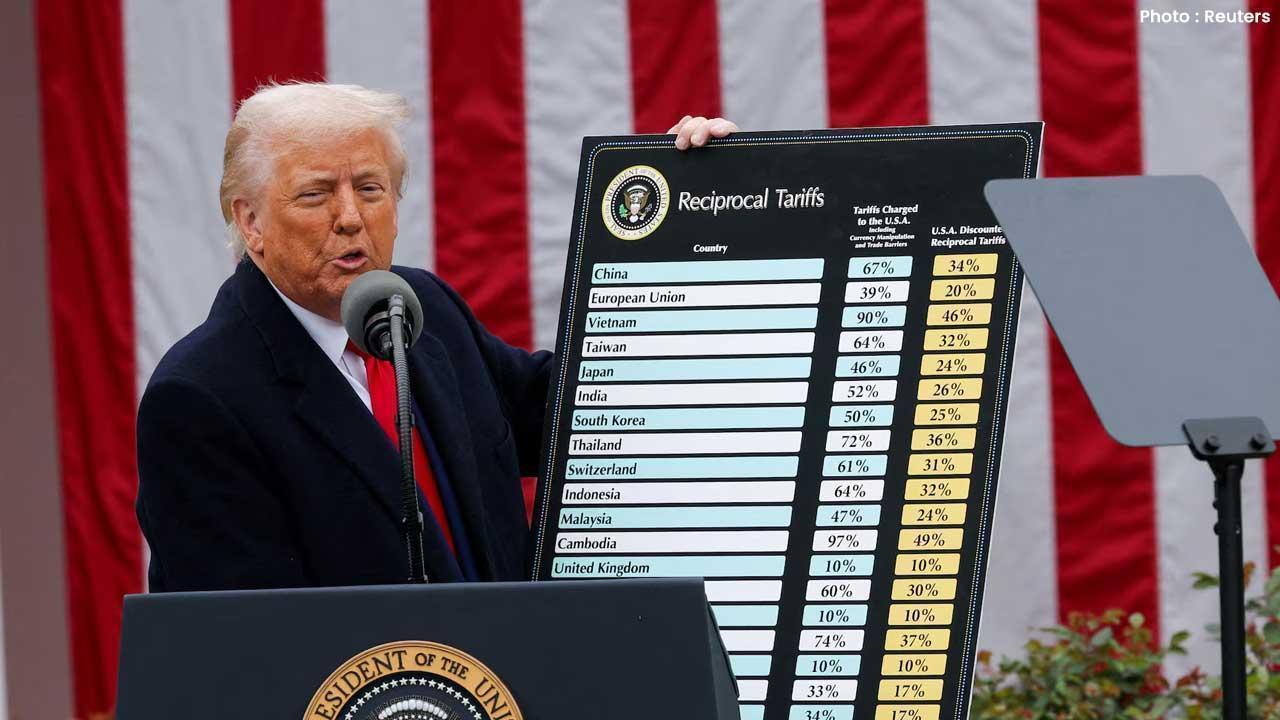
The United States Supreme Court is set to hear a pivotal case this week that could redefine President Donald Trump’s most powerful foreign policy weapon — tariffs. The court will decide whether Trump exceeded his authority under federal law when he imposed sweeping tariffs on multiple nations, using them not just for trade but as leverage in global diplomacy.
Since returning to office, President Trump has treated tariffs as both an economic strategy and a diplomatic tool, using them to influence ceasefires, border controls, and even foreign judicial actions. He has argued that such measures are essential to protect America’s national interests and economy, while critics say he has dangerously expanded presidential power.
The case centers on Trump’s use of the International Emergency Economic Powers Act (IEEPA) — a 1977 law that allows the president to act swiftly during national emergencies. Lower courts have ruled that tariffs fall outside the scope of this law, arguing that the Constitution gives Congress, not the president, authority over taxation and trade.
The Justice Department, defending Trump’s actions, maintains that the tariffs are a legitimate extension of presidential power in foreign affairs. “President Trump has acted lawfully to safeguard our national security and economy,” said White House spokesperson Kush Desai, expressing confidence that the Supreme Court will uphold the administration’s stance.
However, legal experts say the decision could have wide-reaching implications. “There’s no precedent for how Trump is using tariffs — not as a trade tool, but as a weapon of foreign policy,” said Emily Kilcrease, a former U.S. trade official.
In his second term, Trump has used tariffs to pressure Europe, Canada, and Brazil, sometimes in response to non-economic disputes. Earlier this year, he threatened to impose a 30% tariff on European imports, forcing the European Union to negotiate down to 15%, a move that some European leaders described as economic coercion.
As the Supreme Court reviews the case, Trump has expressed concern, calling it “one of the most important in U.S. history.” Though he initially planned to attend the hearing in person, he later said he would not, to avoid distracting from the proceedings.
If the justices rule against Trump, the administration may have to rely on slower, more bureaucratic trade mechanisms. Analysts say this could weaken one of the president’s most immediate tools for global negotiation and enforcement.
The outcome could also impact international confidence in recent trade agreements negotiated by Washington. “If the court restricts his power, foreign governments may question whether the U.S. can keep its word,” said Josh Lipsky of the Atlantic Council.
For now, Trump’s team remains confident. “We have backup plans,” said Press Secretary Karoline Leavitt. “But we are hopeful that the court will do what’s right for the country.”
The Supreme Court’s decision — expected later this year — could permanently reshape how future presidents use tariffs as instruments of power, determining whether they remain a flexible tool or return to their traditional role in trade regulation.







Rabada Misses First Australia Test as South Africa Pick Two Spinners
Kagiso Rabada misses the opener as South Africa vs Australia begins, with Anrich Nortje returning an

Starc Compares Australia's Tough Year to McIlroy's Major Sweep
Mitchell Starc says Australia winning three away Test series and the World Cup would match Rory McIl

France’s Sesterce Plans $11 Billion AI Data Centre in Finland
Sesterce plans a $11 billion AI data centre in Finland, with major expansion, green energy plans and

Danaher to Launch AI-Powered Autonomous Research Lab in 2027
Danaher plans an AI research lab for 2027, combining robotics and automation to speed up drug discov

Musk Welcomes German Support for Tesla Driver Assistance Tech as EU Approval Push Continues
Elon Musk welcomes Germany's backing for Tesla FSD as the company seeks EU approval amid speed, safe
Microsoft and Nvidia CEOs to Unveil AI Laptop at San Francisco Event
Microsoft and Nvidia showcase a new AI laptop with RTX Spark chips as they push powerful local AI co