You have not yet added any article to your bookmarks!
Join 10k+ people to get notified about new posts, news and tips.
Do not worry we don't spam!
Post by : Rohit Dhiman
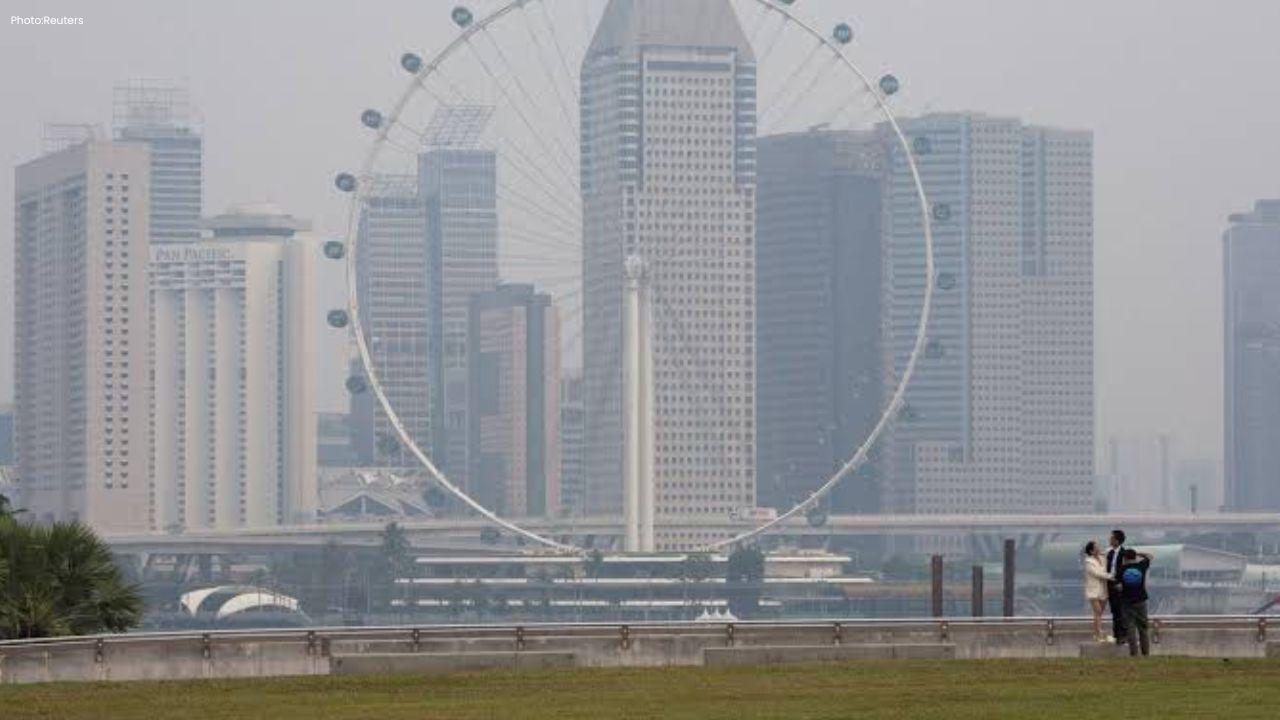
Singapore experienced worsening hazy conditions on Friday, October 9, 2026, as air quality remained in the unhealthy range across the island. Pollution levels increased steadily through the morning, with the central region recording the highest 24-hour Pollutant Standards Index (PSI) reading of the current haze season. At noon, the central region's 24-hour PSI reached 184, marking the highest reading recorded during this year's haze period so far. The deterioration followed a steady rise in pollution levels overnight, with all regions entering the unhealthy range from around 2am, according to the reported monitoring updates. The situation has raised concerns about outdoor exposure, particularly for children, older adults and people with existing respiratory or heart conditions. Residents have been advised to monitor official air quality information before planning activities outside.
The central region recorded a 24-hour PSI of 170 at 9am before the reading climbed above 180 by noon, eventually reaching 184. This was the highest reading reported during the current haze season. Other parts of Singapore also experienced elevated pollution levels. The western region recorded a PSI of 170 at noon, while the southern region registered 160. The eastern region recorded 155, and the northern region had a lower reading of 123. Although the figures differed across the island, the reported readings indicated that the haze was not confined to a single neighbourhood or district. The regional breakdown also showed why residents should pay attention to local measurements rather than relying on a single nationwide figure. Air quality can vary according to atmospheric conditions, wind patterns and the movement of polluted air.
Alongside the 24-hour PSI readings, hourly PM2.5 concentrations remained elevated on Friday. The reported one-hour readings ranged from 104 to 151 across Singapore, moving between the elevated and high categories used in local air quality reporting. PM2.5 refers to fine particulate matter measuring 2.5 micrometres or less in diameter. These particles are small enough to penetrate deep into the respiratory system, making them a significant concern during haze episodes. Exposure can cause irritation of the eyes, nose and throat, as well as coughing, breathing difficulties and worsening symptoms in people with asthma or other respiratory conditions. People with heart and lung diseases may also face greater risks when pollution levels remain high.
Singapore's National Environment Agency uses different measurements to help residents understand current and recent air quality conditions. Although both the hourly PM2.5 reading and the 24-hour PSI provide useful information, they measure different aspects of pollution.
Read Also: ASML and Zeiss Target Next-Generation Chip Technology in 10 Years
The PSI reflects air quality over the preceding 24 hours. It is calculated using several pollutants, including PM2.5, PM10, ozone, sulphur dioxide, nitrogen dioxide and carbon monoxide. Because it represents a longer period, the 24-hour PSI provides an overview of recent pollution exposure and is used as a basis for daily health advisories. A rising PSI indicates deteriorating air quality. When readings enter the unhealthy range, residents should pay closer attention to official health guidance and consider limiting prolonged or strenuous outdoor activity.
The one-hour PM2.5 reading provides a more immediate indication of fine-particle pollution. It can help residents assess changing conditions throughout the day, especially when haze intensity rises or falls over short periods. During rapidly changing conditions, checking both measurements can help people understand the difference between the recent overall pollution picture and the more current concentration of fine particles. Neither measurement should be interpreted in isolation from official health advisories. Residents should use the latest information from Singapore's National Environment Agency when deciding whether outdoor activities are appropriate.
With unhealthy air quality reported across the island, reducing exposure to polluted air is an important precaution.
Residents can take several practical steps while the haze persists:
Check air quality updates: Monitor the latest PSI and one-hour PM2.5 readings for the relevant region.
Reduce strenuous outdoor exercise: Consider moving intense workouts indoors when pollution levels are high.
Keep indoor air cleaner: Close windows when outdoor haze is heavy, provided indoor conditions remain comfortable, and use suitable air filtration where available.
Take extra care with vulnerable groups: Children, older adults and people with heart or lung conditions should follow official health advice closely.
Use a suitable mask when necessary: A well-fitted particulate respirator can help reduce exposure to fine particles when outdoor travel cannot be avoided. Ordinary loose-fitting masks may offer less protection.
Seek help for severe symptoms: Significant breathing difficulty or chest pain requires prompt medical attention.
People should also remember that staying indoors does not automatically eliminate exposure. Indoor air quality can be affected by outdoor pollution, ventilation and other sources of particles. The most appropriate precautions depend on current pollution levels, personal health and official recommendations.
The deteriorating air quality comes as Singapore prepares for the Formula 1 Singapore Grand Prix weekend. The event attracts residents and international visitors, with activities taking place in outdoor settings across the city. The timing has made air quality information particularly relevant for spectators, event workers and people planning to spend extended periods outdoors. Visitors should check official updates before travelling to outdoor venues and follow any event-specific health or safety instructions. Those who are sensitive to air pollution may need to reconsider prolonged outdoor exposure if conditions remain unhealthy. The reported PSI readings do not, by themselves, establish whether an event will be cancelled or altered. Any decision affecting event operations would depend on the relevant authorities and organisers.
Haze can develop when fine particles and other pollutants accumulate in the atmosphere. Depending on the source, these particles may originate from vegetation and peat fires, industrial activity, transport emissions or other combustion processes. Weather conditions also influence how quickly pollutants disperse. Wind direction, atmospheric stability and rainfall can affect whether haze intensifies, moves away or remains concentrated over an area. The reported readings confirm that Singapore experienced unhealthy air quality during this episode, but the measurements alone do not identify the precise source of the haze or establish how long the conditions will continue. Determining the source requires additional information, including regional fire monitoring, wind patterns and environmental assessments. Residents should therefore avoid assuming that the haze will clear by a particular time without an official forecast.
The immediate concern is whether pollution levels will remain elevated or begin to decline. The central region's PSI of 184 represented the highest reported reading of the current haze season at noon on October 9, while the western, southern and eastern regions also recorded unhealthy levels. Further changes will depend on atmospheric conditions and the movement or dispersal of pollutants. The latest regional readings and health advisories from the National Environment Agency will remain important for residents making decisions about outdoor exposure. People attending the Singapore Grand Prix or other outdoor events should continue checking official updates rather than relying on a single measurement from earlier in the day.








Meta Bans TikTok Ads on Facebook and Instagram in Seven Countries
Meta has banned TikTok ads in seven countries, escalating competition over social media users, adver

ASML and Zeiss Target Next-Generation Chip Technology in 10 Years
ASML and Carl Zeiss are developing Hyper NA technology to print smaller chip circuits, with the next

Rabada Misses First Australia Test as South Africa Pick Two Spinners
Kagiso Rabada misses the opener as South Africa vs Australia begins, with Anrich Nortje returning an

Starc Compares Australia's Tough Year to McIlroy's Major Sweep
Mitchell Starc says Australia winning three away Test series and the World Cup would match Rory McIl

France’s Sesterce Plans $11 Billion AI Data Centre in Finland
Sesterce plans a $11 billion AI data centre in Finland, with major expansion, green energy plans and

Danaher to Launch AI-Powered Autonomous Research Lab in 2027
Danaher plans an AI research lab for 2027, combining robotics and automation to speed up drug discov