
You have not yet added any article to your bookmarks!
Join 10k+ people to get notified about new posts, news and tips.
Do not worry we don't spam!
Post by : Rameen Ariff
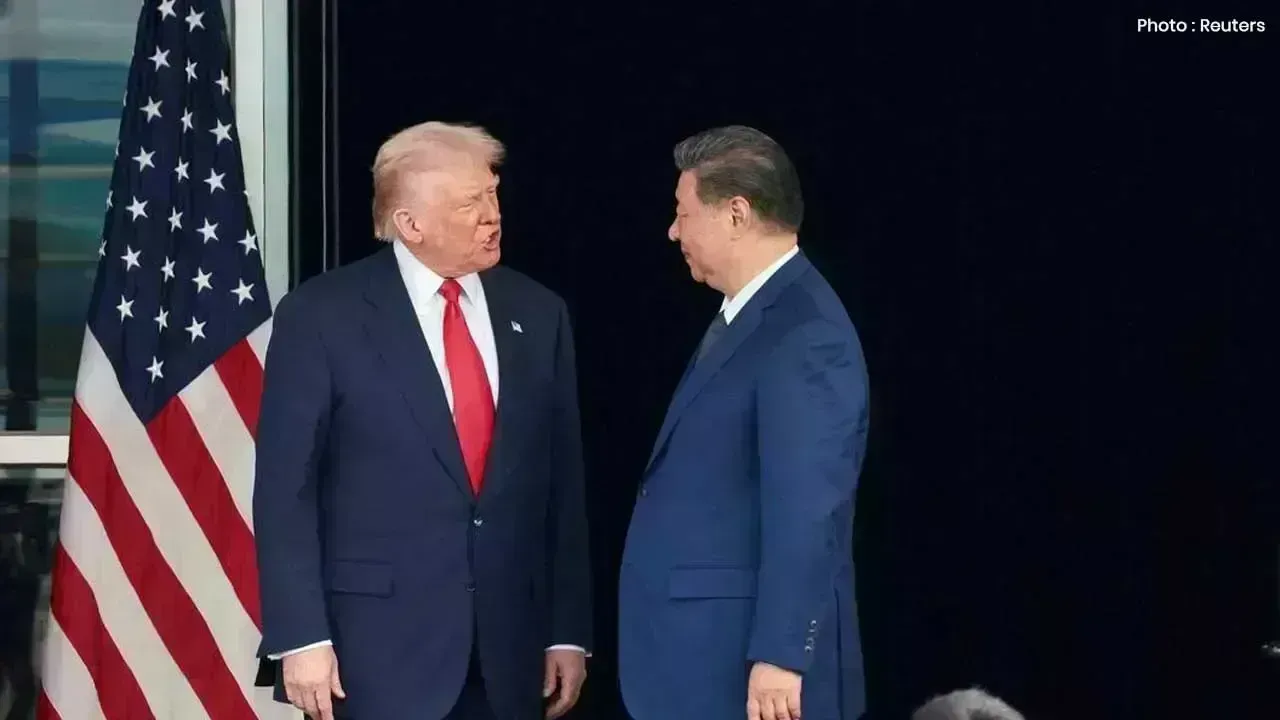
Following a significant phone discussion with Chinese President Xi Jinping, U.S. President Donald Trump has announced plans for an April visit to Beijing next year. During the conversation, he also extended an invitation for Xi to visit the U.S. later in the year. This dialogue occurred nearly a month after their meeting in Busan, South Korea.
Trump indicated that their talk spanned considerable global topics, including trade dynamics, the ongoing conflict in Ukraine, the fentanyl crisis, and the delicate topic of Taiwan. Describing the discussion as fruitful, Trump affirmed the “extremely strong” nature of the bilateral relationship.
China followed up with a statement emphasizing the need for both nations to advance cooperatively “on the basis of equality, respect, and mutual benefit.” Beijing acknowledged that relations have improved notably since their encounter in October.
During their prior meeting in South Korea, Trump and Xi had agreed to a temporary reprieve from escalating tariffs. The U.S. decided to scale back a 20% tariff designed to limit fentanyl imports, while China postponed the rollout of new rare earth export controls. Tariffs on numerous Chinese products still exist, averaging nearly 50%, but both nations have shown eagerness to reduce trade friction.
The White House noted that the recent discussion lasted close to an hour, primarily concentrating on trade concerns. Officials from both sides expressed optimism regarding the progress and constructive nature of their dialogue.
In addition to trade, the leaders addressed Russia’s aggression in Ukraine along with persisting issues regarding Taiwan. Xi reiterated that the eventual “return to China” of Taiwan is fundamental to Beijing’s long-term global ambitions. This matter remains particularly volatile, especially with rising diplomatic strains involving Japan, a key U.S. ally.
Japan has recently cautioned that any assault on Taiwan could provoke a military counteraction. Nonetheless, Trump did not reference Taiwan in his public remarks about the call, instead prioritizing trade and mutual cooperation.
As both nations navigate economic hurdles and shifting global partnerships, the planned visit signifies a crucial step in revitalizing dialogue. Trump’s impending trip to Beijing and Xi’s anticipated U.S. visit next year underscore efforts to stabilize a relationship that has endured years of strain.
While several issues remain outstanding, the renewed interaction between the two leaders is being regarded as progress toward a more stable and collaborative partnership.








Hyundai raises profit target, expands hybrid lineup in the US
Hyundai hybrid cars get a major boost as the automaker raises its profit margin target and plans new

Josh Kerr and Jakob Ingebrigtsen Set for 1,500m Rivalry Rematch
Josh Kerr and Jakob Ingebrigtsen will renew their 1,500m rivalry at the Ultimate Championship in Bud

PSG Coach Luis Enrique Urges Players to Step Outside Comfort Zone
PSG coach Luis Enrique says players must leave their comfort zone and keep improving as the club tar

China’s Tiangong Sets New 400m Record at Robot Olympics
China’s Tiangong robot sets a new 400m record at the Robot Olympics, beating a South African robot i

George Russell Wins Dutch GP Sprint, Boosts Mercedes Morale
George Russell wins the Dutch GP Sprint from pole as Mercedes teammate Kimi Antonelli extends his F1

Australia 50/3 After Bangladesh Bowled Out for 64 in Second Test
Australia reached 50/3 after Bangladesh were bowled out for 64 in the second Test, with Mitchell Sta

