You have not yet added any article to your bookmarks!
Join 10k+ people to get notified about new posts, news and tips.
Do not worry we don't spam!
Post by : Meena Ariff
A mild earthquake measuring 3.0 on the Richter scale was recorded in Tibet on Saturday, as per official seismic monitoring updates.
The tremor occurred at a shallow depth of 10 kilometres, which can lead to stronger surface shaking compared to deeper earthquakes. The epicentre was located near latitude 28.37°N and longitude 88.02°E, and the quake was reported at 03:40:55 IST.
Although the magnitude was low and there were no immediate reports of damage or injuries, shallow earthquakes are generally considered more concerning because their seismic waves travel a shorter distance and can be felt more clearly at ground level.
The Tibetan Plateau remains highly prone to earthquakes due to constant tectonic activity in the region. Tibet and Nepal lie close to a major fault zone where the Indian tectonic plate continues pushing into the Eurasian plate. This long-term collision is responsible for the formation and uplift of the Himalayan mountain range, making the area vulnerable to frequent tremors.
Scientists explain that Tibet’s high elevation exists because the earth’s crust has thickened over millions of years under pressure from the ongoing plate collision. As stress builds up inside the crust, it is released from time to time in the form of earthquakes.
Seismic activity across the plateau is linked to a combination of strike-slip faulting and normal fault movement. The region stretches mainly in an east–west direction, and its geological structure includes several rift zones and fault lines that continue to shift.
In northern Tibet, strike-slip faulting is the main tectonic pattern and is associated with some of the region’s strongest earthquakes, including events that have reached magnitude 8.0 or higher.
In southern Tibet, the earth’s crust is largely experiencing east–west extension, with north–south trending normal faults shaping the landscape. These faults generally produce smaller earthquakes but can still create tremors across wide areas.
Satellite-based studies have identified seven major north–south rifts and normal faults in southern Tibet. Researchers estimate these rifts began forming around 4 to 8 million years ago, during a period when tectonic stretching became more prominent.
Past normal fault-related earthquakes in Tibet have ranged between 5.9 and 7.1 magnitude, including a series recorded in 2008 at different locations across the plateau.
Saturday’s mild tremor once again highlights the region’s active tectonic setting, where earthquakes remain a regular natural occurrence.









George Russell Wins Dutch GP Sprint, Boosts Mercedes Morale
George Russell wins the Dutch GP Sprint from pole as Mercedes teammate Kimi Antonelli extends his F1

Australia 50/3 After Bangladesh Bowled Out for 64 in Second Test
Australia reached 50/3 after Bangladesh were bowled out for 64 in the second Test, with Mitchell Sta

Jordan Burroughs Returns to Wrestling with 2028 Olympic Dream
Jordan Burroughs returns to wrestling with Real American Freestyle as the Olympic champion eyes a po

Lamborghini Catches Fire on Singapore's ECP, Causing Heavy Traffic
A Lamborghini caught fire on Singapore's ECP, causing heavy traffic and bus delays. No injuries were

Bangkok Airport Duty-Free Area Flooded by Pipe Burst
A burst water pipe flooded the duty-free shopping area at Bangkok's Suvarnabhumi Airport on July 16,
Nine Monks Killed in Thailand Pickup Truck Tragedy
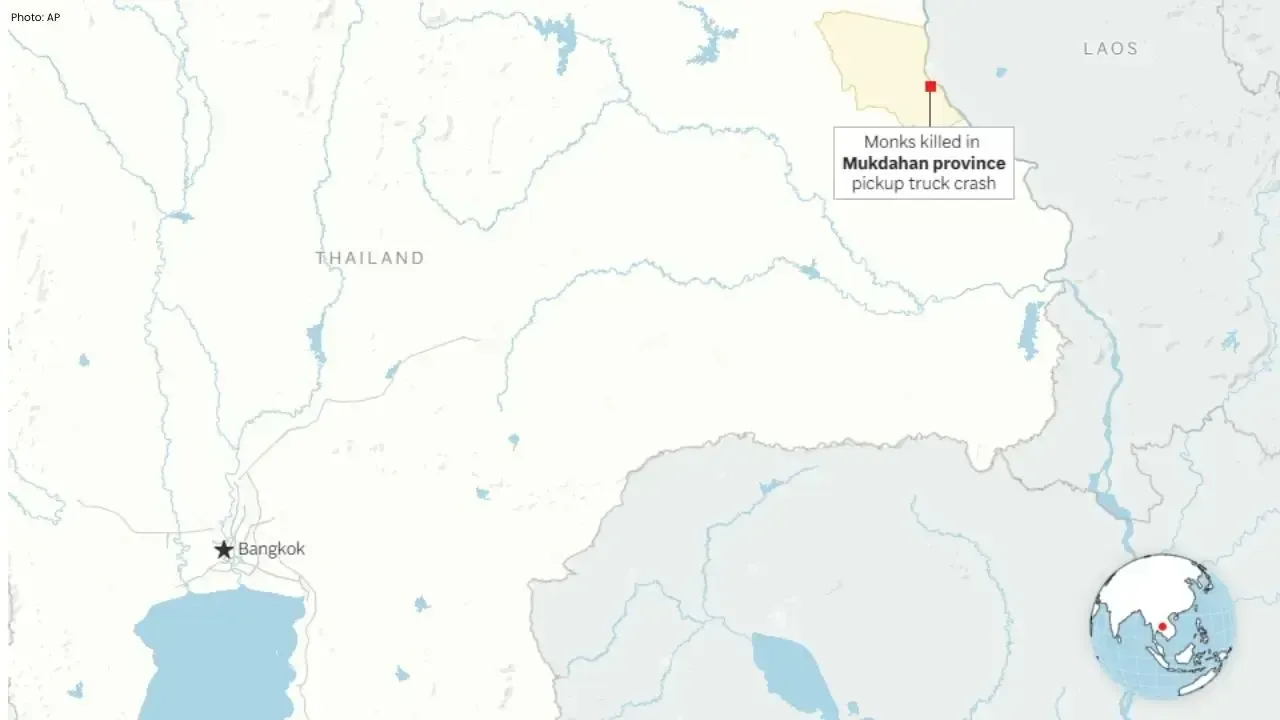
An 11-year-old boy driving a pickup truck crashed into monks during a pilgrimage in northeastern Tha