
You have not yet added any article to your bookmarks!
Join 10k+ people to get notified about new posts, news and tips.
Do not worry we don't spam!
Post by : Saif Rahman
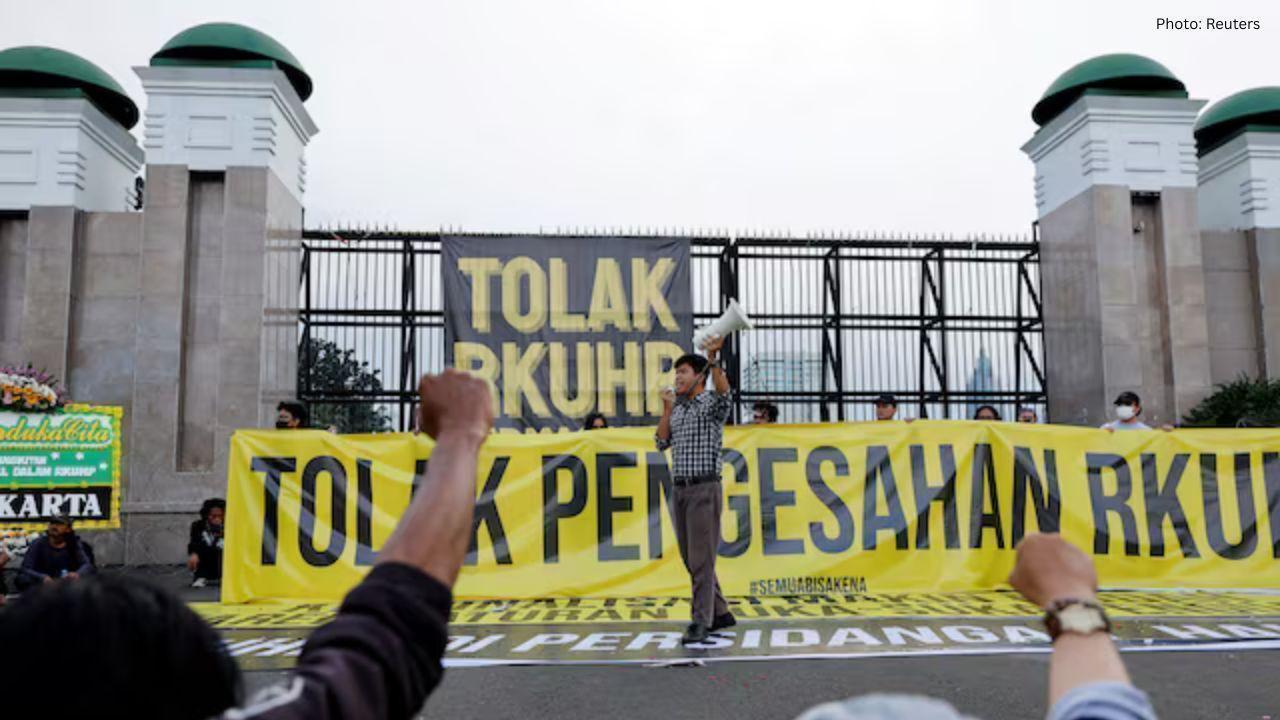
Indonesia is set to implement a revised criminal code on January 2, marking a significant shift from laws established during Dutch colonial times. While the government argues that this change aligns with contemporary Indonesian values, detractors express worries that the law could infringe on civil liberties. The law minister has highlighted the need for robust public oversight to mitigate potential abuses.
Spanning over 300 pages, the new criminal code was sanctioned by parliament in 2022. It introduces offenses like extramarital sex and insults against the president or state institutions. Advocates of the law claim it establishes a distinctive legal framework for Indonesia, whereas opponents fear the expansive language could be weaponized against dissent.
Law Minister Supratman Andi Agtas, in a discussion with Reuters, acknowledged the need for reform while recognizing inherent risks. He pointed out that no new law is flawless from the outset, hence the necessity of public scrutiny. He urged citizens, civil society organizations, and media outlets to contribute to fair law enforcement.
A key highlight of the new code is the criminalization of premarital sex, which can lead to up to one year of imprisonment. However, legal proceedings can only be initiated if a spouse, parent, or child of the accused files an official complaint. This stipulation has alleviated concerns in the tourism sector regarding potential targeting of foreign visitors.
Additionally, insulting the president or state agencies is punishable by up to three years in prison. Promoting ideologies contrary to Indonesia's state philosophy, including communism, may incur sentences of four years. Legal analysts caution that these provisions are ambiguous and prone to broad interpretation.
Human rights advocates and proponents of democracy are raising alarms about vague terms like “attacking honour or dignity.” They fear such phrasing could curtail free speech and endanger journalists, activists, and political dissidents. Some critics have labeled the law a “new colonial code,” suggesting it embodies the same restrictive control as previous regulations.
Agtas confirmed that police and legal personnel have received training regarding the new law. He assured that safeguards are incorporated within the law, along with a new criminal procedure code set to be implemented. These initiatives aim to curtail the potential for authority misuse.
As Indonesia transitions into a new juridical chapter, the discourse surrounding the criminal code remains in flux. Its ultimately success may hinge on not only the law’s wording but also on the vigilance, scrutiny, and enforcement by the populace it serves.









PSG Coach Luis Enrique Urges Players to Step Outside Comfort Zone
PSG coach Luis Enrique says players must leave their comfort zone and keep improving as the club tar

China’s Tiangong Sets New 400m Record at Robot Olympics
China’s Tiangong robot sets a new 400m record at the Robot Olympics, beating a South African robot i

George Russell Wins Dutch GP Sprint, Boosts Mercedes Morale
George Russell wins the Dutch GP Sprint from pole as Mercedes teammate Kimi Antonelli extends his F1

Australia 50/3 After Bangladesh Bowled Out for 64 in Second Test
Australia reached 50/3 after Bangladesh were bowled out for 64 in the second Test, with Mitchell Sta

Jordan Burroughs Returns to Wrestling with 2028 Olympic Dream
Jordan Burroughs returns to wrestling with Real American Freestyle as the Olympic champion eyes a po

Lamborghini Catches Fire on Singapore's ECP, Causing Heavy Traffic
A Lamborghini caught fire on Singapore's ECP, causing heavy traffic and bus delays. No injuries were

