
You have not yet added any article to your bookmarks!
Join 10k+ people to get notified about new posts, news and tips.
Do not worry we don't spam!
Post by : Saif Rahman
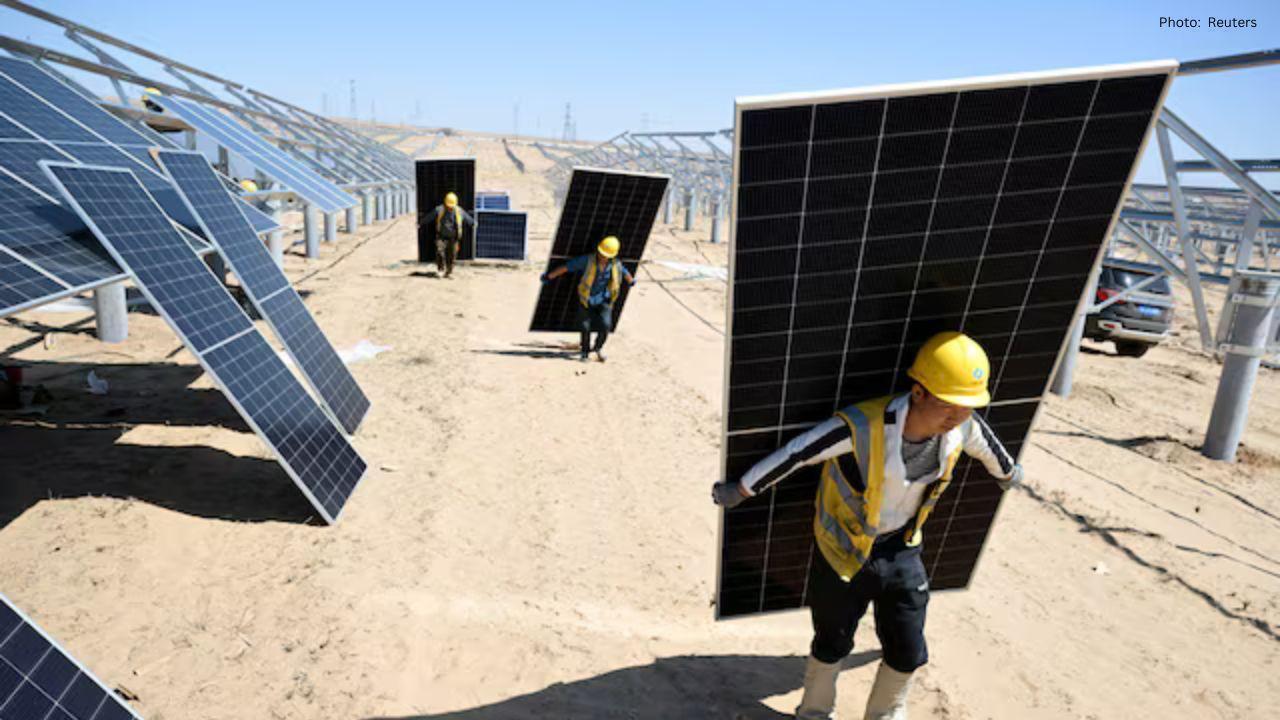
The solar power sector in China displays early signs of recovery following a trying phase characterized by significant losses and rampant production. Recent data from an industry association indicates a notable decline in losses across the sector during the third quarter of this year, a direct result of government initiatives to tackle overcapacity.
For years, China has held the title of the world's foremost producer of solar panels and associated equipment. However, rapid factory expansions resulted in an output nearly double the global demand, leading to price drops and losses for many firms.
The China Photovoltaic Industry Association reports that losses industry-wide decreased by almost 47% in the July to September window compared to the prior quarter. Nevertheless, more than 6.4 billion yuan in losses were still recorded, signaling ongoing pressure on the sector.
This progress aligns with Beijing's intensified efforts against industrial overcapacity, casting solar manufacturing as a primary focus. Policy efforts aim to close outdated and inefficient factories, alongside curtailing the establishment of new ones.
Industry leaders noted a reduction in new manufacturing capacity compared to the previous year. While specific figures weren’t disclosed, it was clear that growth is being moderated to recalibrate the market. Concurrently, the production of polysilicon and silicon wafers—vital components for solar panels—has significantly decreased, alleviating excess supply.
Despite these cuts, production of solar cells and finished panels has continued to escalate in the first ten months of the year, reinforcing the robustness of China's solar industry even amid a downturn.
New governmental regulations effective in 2025 are also contributing to these changes. Restrictions on energy consumption at polysilicon facilities are pushing less efficient operations to shut down, which officials believe will enhance overall quality and diminish waste moving forward.
The demand for solar energy in 2025 remains strong, with new installations projected to reach a record high near 285 gigawatts this year. Yet, expert predictions suggest this demand may drop next year, potentially waning to between 185 and 275 gigawatts in 2026.
Some analysts caution that new pricing frameworks based on market conditions could pose challenges for solar developers and hinder future installations. However, optimistic Perspectives persist, with the chairman of Longi Green Energy expressing confidence that China's solar demand could surpass 300 gigawatts in the next five years.
On the export front, the narrative is mixed, with shipments of finished solar panels experiencing a slight increase in volume this year, but a fall in total value due to declining prices. Should domestic demand weaken, Chinese manufacturers may seek to expand their customer base internationally.
In summary, the reduced losses indicate a positive shift for China's solar industry. While challenges linger, increased regulations and stable demand could signal a pathway back to healthy growth in the future.









Josh Kerr and Jakob Ingebrigtsen Set for 1,500m Rivalry Rematch
Josh Kerr and Jakob Ingebrigtsen will renew their 1,500m rivalry at the Ultimate Championship in Bud

PSG Coach Luis Enrique Urges Players to Step Outside Comfort Zone
PSG coach Luis Enrique says players must leave their comfort zone and keep improving as the club tar

China’s Tiangong Sets New 400m Record at Robot Olympics
China’s Tiangong robot sets a new 400m record at the Robot Olympics, beating a South African robot i

George Russell Wins Dutch GP Sprint, Boosts Mercedes Morale
George Russell wins the Dutch GP Sprint from pole as Mercedes teammate Kimi Antonelli extends his F1

Australia 50/3 After Bangladesh Bowled Out for 64 in Second Test
Australia reached 50/3 after Bangladesh were bowled out for 64 in the second Test, with Mitchell Sta

Jordan Burroughs Returns to Wrestling with 2028 Olympic Dream
Jordan Burroughs returns to wrestling with Real American Freestyle as the Olympic champion eyes a po

