
You have not yet added any article to your bookmarks!
Join 10k+ people to get notified about new posts, news and tips.
Do not worry we don't spam!
Post by : Rameen Ariff
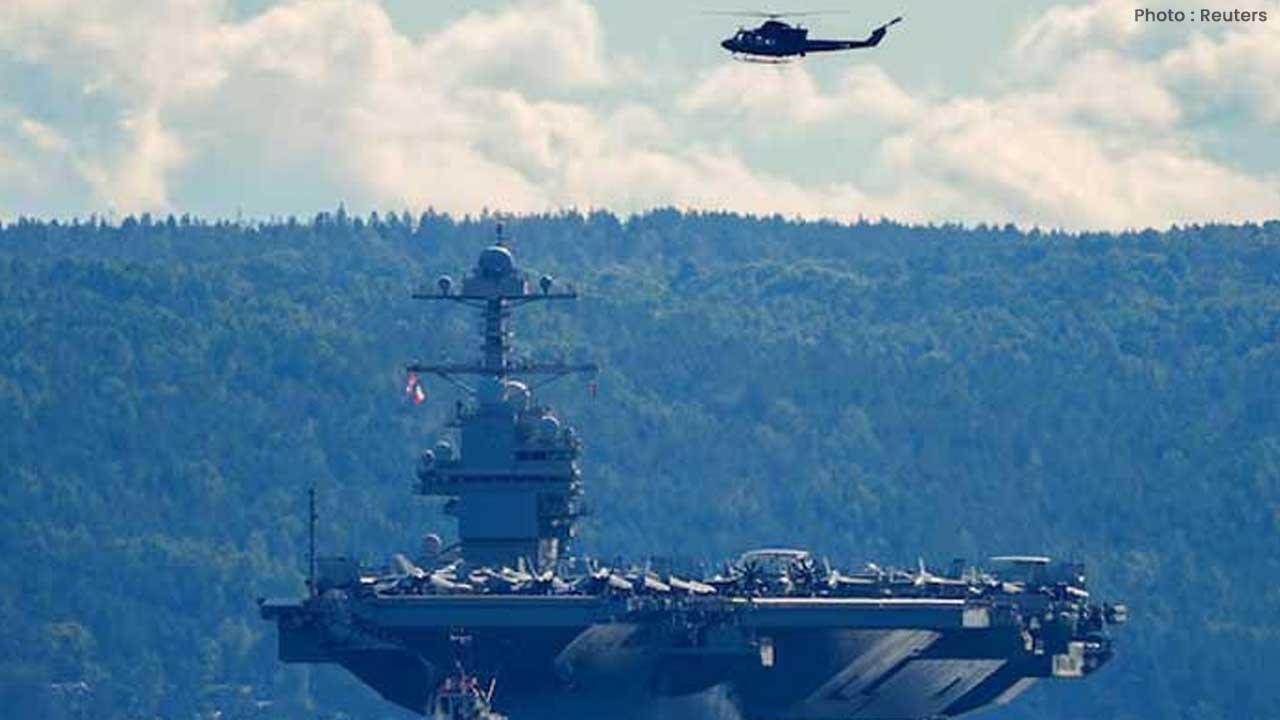
In a significant show of force, the USS Gerald R. Ford, the United States' most sophisticated aircraft carrier, is being positioned off the coast of Venezuela. This deployment signifies one of the most considerable expressions of American military might in Latin America in recent times. Experts are analyzing whether this move is directed at drug trafficking operations or is a strategic warning to Venezuelan President Nicolás Maduro.
The formidable warship, weighing 100,000 tons and supported by nearly twelve Navy vessels and over 12,000 sailors and Marines, is part of Operation Southern Spear. The Trump administration has officially labeled it as a counter-drug initiative, involving training exercises for US bombers along the Venezuelan coastline and targeted naval operations in the Caribbean and Eastern Pacific aimed at drug-related activities.
While Secretary of State Marco Rubio has emphasized the mission's focus on combating drug trafficking, many analysts suggest that it bears larger political implications. Elizabeth Dickinson, a senior analyst at the International Crisis Group, remarked, “An aircraft carrier's capabilities do not align well with anti-drug operations. Clearly, this is a signal intended to pressure Caracas.”
Bryan Clark, a former Navy submariner, stressed that such a significant military deployment by the Trump administration implies readiness for action if necessary. This move occurs as President Maduro ramps up military preparedness, mobilizing troops and civilians while showcasing military equipment including missile defense systems to counter potential threats. Venezuela’s state media recently highlighted the country's military readiness with impressive displays.
The US deployment is met with skepticism from neighboring nations, concerned about issues of sovereignty and human rights. Colombian President Gustavo Petro briefly paused intelligence cooperation with the US, although collaboration has since resumed with guarantees for safe conduct. In parallel, Mexico has intensified its naval operations to intercept drug shipments on the high seas.
While the USS Gerald R. Ford undeniably exemplifies US military strength, experts suggest it may not suffice for a comprehensive invasion. David Smilde, a professor at Tulane University, noted, “A credible display of force might be enough to sway the Maduro administration without necessitating direct conflict.”
As the Ford nears the Caribbean, attention is on the US strategy for utilizing this military presence to influence outcomes in South America, walking the line between counter-narcotics enforcement and broader geopolitical signals.










PM Modi Pays Tribute to Mahatma Gandhi, Urges People to Support Khadi
PM Modi pays tribute to Mahatma Gandhi on Gandhi Jayanti and urges citizens to support Khadi and the

Amazon Seeks to Offload $8 Billion in Nvidia Chips to Investors
Amazon plans to move $8 billion in Nvidia chips to investors, using a new financing model to strengt

Samsung Raises Galaxy S26 Prices as Memory Chip Costs Rise
Samsung raises Galaxy S26 prices in South Korea as rising memory chip costs put pressure on smartpho

Lewis Hamilton Calls Singapore Grand Prix One of F1's Toughest Races
Lewis Hamilton discusses the demanding Singapore Grand Prix and brings Plus44 and Almave to Singapor

Denmark's Pandora Opens World's Largest Jewellery Factory in Vietnam
Pandora opens its largest jewellery factory in Vietnam, expanding global production, strengthening s

Gautam Gambhir Questions Batting-Friendly Pitches After India's Record ODI Chase
Gautam Gambhir questions batting-friendly ODI pitches after India’s record chase, calling for a bett

