
You have not yet added any article to your bookmarks!
Join 10k+ people to get notified about new posts, news and tips.
Do not worry we don't spam!
Post by : Shweta
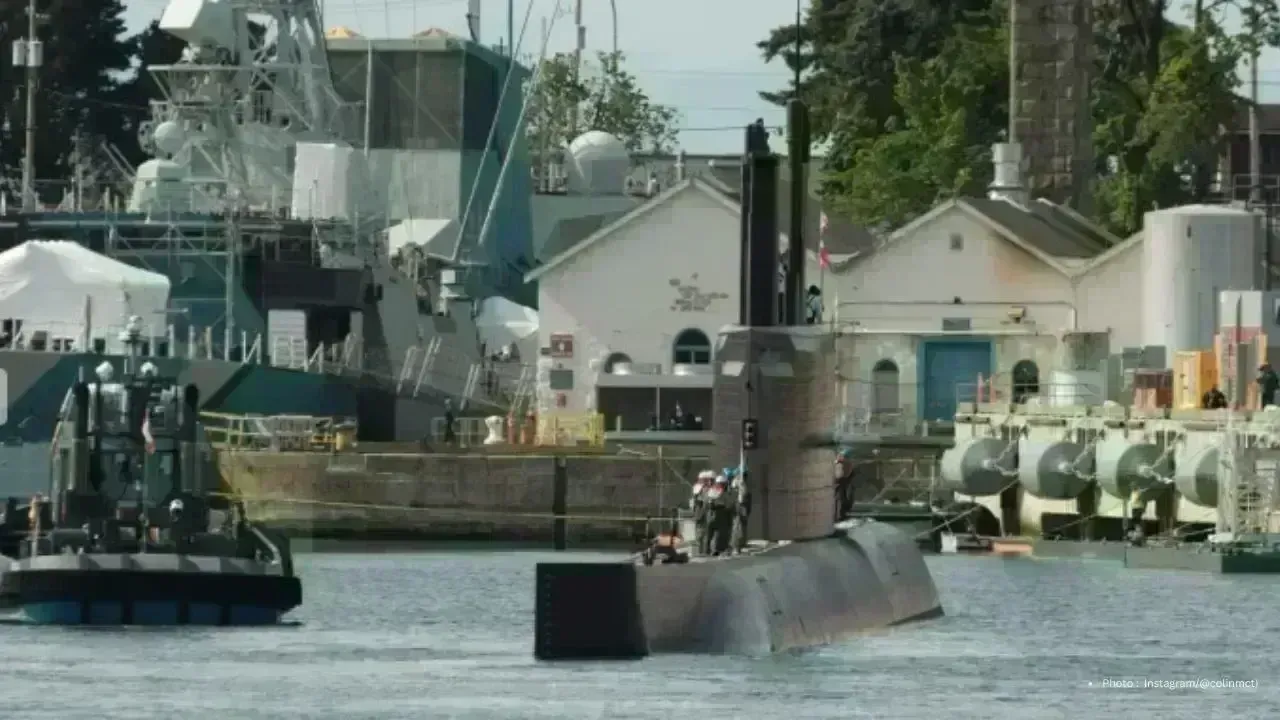
The ROKS Dosan Ahn Changho, a South Korean submarine, has successfully arrived at Canadian Forces Base Esquimalt in British Columbia after an unprecedented trans-Pacific voyage, marking a historic milestone for South Korea’s submarine fleet. Covering over 14,000 kilometers, it becomes the first submarine from South Korea to accomplish such an extensive journey to North America, coinciding with critical evaluations for Canada’s future naval defense strategies.
Accompanied by the South Korean frigate ROKS Daejeon, the submarine set sail from South Korea in March, making scheduled stops in Guam and Hawaii along the way. Officials have labeled this deployment as one of the most significant endeavors undertaken by the Republic of Korea Navy, showcasing the advanced operational capabilities and endurance of the submarine.
As part of the KSS-III program, the Dosan Ahn Changho features cutting-edge lithium-ion battery technology and an air-independent propulsion system, enabling prolonged underwater operations. This makes it particularly suitable for extensive patrol missions and contemporary naval warfare tactics.
The arrival of the submarine carries significant implications, as Canada is currently reviewing options to replace its aging fleet of Victoria-class submarines. Plans are in place for Ottawa to procure as many as 12 new submarines under the Canadian Patrol Submarine Project, a venture that could reach into the billions of dollars over the next several decades. South Korean defense corporation Hanwha Ocean is presenting the KSS-III class as one of the primary contenders for the Royal Canadian Navy.
Military analysts emphasize that this Pacific crossing serves as a strategic demonstration to Canadian stakeholders regarding the submarine’s operational reliability and range, essential for enduring deployments across the Pacific, Atlantic, and Arctic domains. The achievement reinforces the submarine's capability to satisfy Canada’s rigorous naval requirements.
Additionally, there are reports that members of the Royal Canadian Navy onboard the submarine experienced its operations firsthand during part of the journey, fostering military cooperation and exchange. This collaboration is seen as a crucial step in enhancing military relations between Canada and South Korea.
Following its stay at CFB Esquimalt, the submarine is slated to engage in joint exercises with the Royal Canadian Navy, later heading towards the multinational RIMPAC 2026 military drill in the Pacific. South Korea is also poised to deploy more advanced naval resources to this exercise, emphasizing its commitment to international maritime security.
The interest surrounding this visit is considerable, especially as Canada faces one of the most pivotal decisions in its military procurement history regarding submarines. Alongside South Korea's proposal, Germany's ThyssenKrupp Marine Systems is also vying for the contract. The final decision is anticipated to influence Canada's naval policy for years to come and reshape future defense collaborations in the Indo-Pacific region.










PM Modi Pays Tribute to Mahatma Gandhi, Urges People to Support Khadi
PM Modi pays tribute to Mahatma Gandhi on Gandhi Jayanti and urges citizens to support Khadi and the

Amazon Seeks to Offload $8 Billion in Nvidia Chips to Investors
Amazon plans to move $8 billion in Nvidia chips to investors, using a new financing model to strengt

Samsung Raises Galaxy S26 Prices as Memory Chip Costs Rise
Samsung raises Galaxy S26 prices in South Korea as rising memory chip costs put pressure on smartpho

Lewis Hamilton Calls Singapore Grand Prix One of F1's Toughest Races
Lewis Hamilton discusses the demanding Singapore Grand Prix and brings Plus44 and Almave to Singapor

Denmark's Pandora Opens World's Largest Jewellery Factory in Vietnam
Pandora opens its largest jewellery factory in Vietnam, expanding global production, strengthening s

Gautam Gambhir Questions Batting-Friendly Pitches After India's Record ODI Chase
Gautam Gambhir questions batting-friendly ODI pitches after India’s record chase, calling for a bett

