
You have not yet added any article to your bookmarks!
Join 10k+ people to get notified about new posts, news and tips.
Do not worry we don't spam!
Post by : Rohit Dhiman
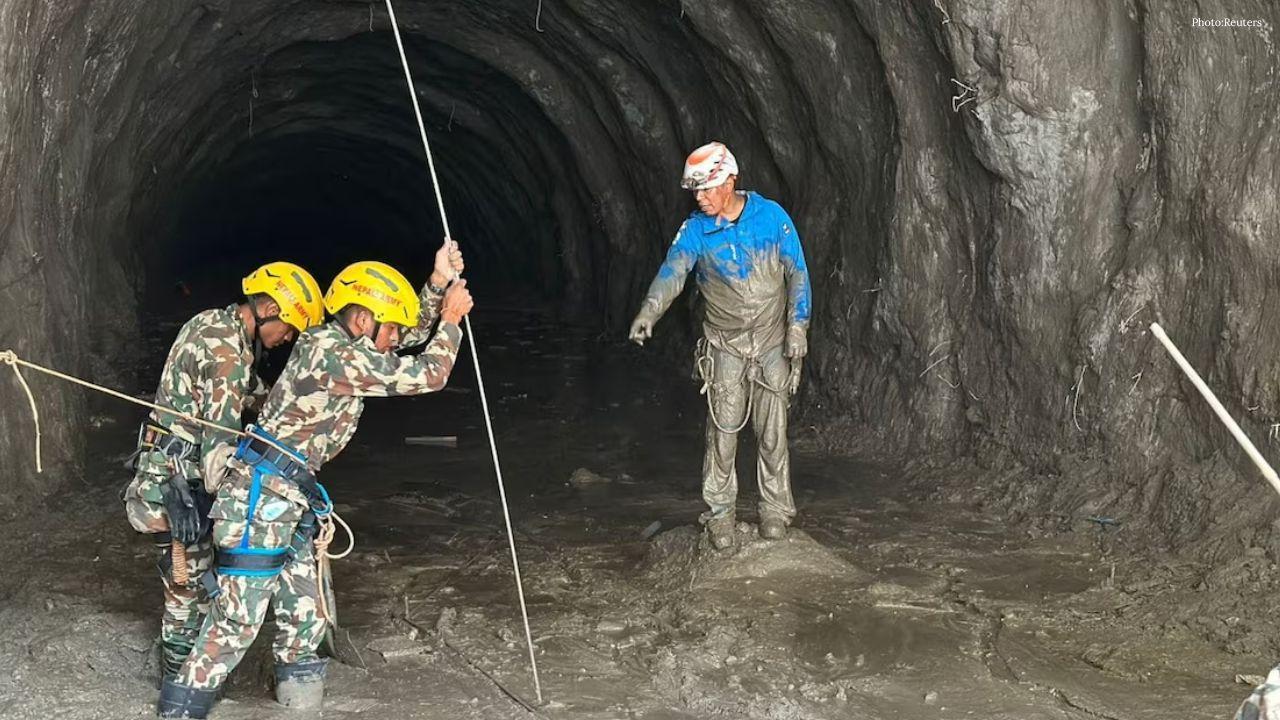
Rescue teams in Nepal are working against time to reach workers believed to be trapped inside underground tunnels at hydropower projects, nearly a week after a devastating disaster struck the country's mountainous areas. Authorities are still hoping that some of the missing workers may have survived inside protected sections of the tunnels. The disaster caused widespread destruction across several mountain communities after a glacier-related event triggered powerful floodwaters and mudflows. More than 1,200 people have been confirmed dead, while thousands remain unaccounted for. With every passing day, rescuers face greater difficulties, but officials say operations will continue as long as there is a possibility of finding survivors. The rescue effort has now become one of the most important parts of the wider Nepal flood rescue operation.
Officials from the Nepal Electricity Authority believe there is still a possibility that workers are alive inside certain tunnel sections. Some areas were reportedly designed as resting or communication spaces and may have offered protection from the floodwaters and debris. Authorities believe hundreds of workers could have been inside or near the affected hydropower projects when the disaster occurred. Rescue teams are therefore checking tunnel networks, blocked passages and areas where survivors may have taken shelter. At some locations, rescuers are attempting to improve air circulation by pushing oxygen into the tunnels. The presence of breathable air could significantly increase the chances of survival for people trapped underground. The search has become increasingly urgent as the period since the disaster grows longer.
The scale of the disaster has brought international assistance to the rescue operation. Specialist teams from India, China and the United States are involved in efforts to reach people believed to be trapped inside the hydropower tunnels. Several hydropower sites are being examined as part of the search. Rescue officials have identified some locations as particularly important because underground spaces there may still have sufficient air. The international support is expected to help Nepal deal with difficult terrain, damaged infrastructure and dangerous tunnel conditions. Rescue personnel must work carefully because further debris movement or structural instability could create additional risks. The operation highlights the enormous challenges faced by emergency workers following major Nepal floods, especially in remote Himalayan areas where roads and communication networks can be badly damaged.
The humanitarian situation remains extremely serious. Nepal has confirmed more than 1,200 deaths, while over 4,000 people are still reported missing. Families continue to search for information about relatives who disappeared during the disaster. Authorities are also examining areas outside the tunnel network, although officials say the possibility of finding survivors in some locations is becoming increasingly limited. The disaster destroyed homes, roads, bridges and other important infrastructure. Entire communities were left struggling to recover after floodwaters and debris swept through valleys and settlements. The continuing search has therefore become both a rescue mission and a race against time for families waiting for news.
The impact of the disaster is not limited to physical destruction. Aid organisations have reported growing emotional distress among children who witnessed the floods. Children in affected areas reportedly saw homes disappear under water and debris, while some also witnessed school buses and other vehicles being swept away. Such experiences have left many children frightened and anxious. Humanitarian organisations say children will require continued emotional and psychological support as communities begin the recovery process. The situation also highlights the importance of protecting women and children living in temporary shelters. Experts have warned that crowded emergency accommodation can create additional safety and protection challenges.
Thousands of survivors are currently staying in temporary shelters, including schools and other public buildings. While tents and emergency supplies can provide immediate protection, experts say they cannot serve as a permanent solution. Moving displaced families into longer-term housing could become one of Nepal's biggest challenges in the coming months. Authorities will also need to restore damaged water, sanitation, electricity, transport and communication systems. Health concerns are another major issue. Damaged water and sanitation infrastructure can increase the risk of disease, making access to clean drinking water and safe living conditions an urgent priority. Experts say the recovery process could continue for years, particularly in communities where homes, roads and essential services have been severely damaged.
Nepal's government has said that finding missing people remains a top priority. Prime Minister Balendra Shah told parliament that rescue teams would continue searching for those who remain unaccounted for. The government is also working to restore essential services in disaster-hit areas. A large majority of telecommunications services in affected locations had reportedly been restored, although electricity generation and transport infrastructure suffered significant damage. The disaster has also disrupted hundreds of megawatts of electricity-generating capacity, adding pressure to Nepal's recovery efforts. For families waiting for missing relatives, however, the immediate priority remains the rescue operation. Officials continue to hope that people trapped inside protected tunnel chambers can still be reached.
Read Also: Israeli Air Force Conducts Strikes in Southern Lebanon
Yes. Rescue teams are continuing operations at hydropower projects where workers are believed to be trapped inside tunnels. Some underground chambers may still contain air, food and water, giving rescuers hope that survivors could be found.
Some tunnel sections contain enclosed chambers that may have provided protection from floodwater and debris. Rescue teams are therefore concentrating on these areas while attempting to clear blocked passages and improve oxygen supplies.
The disaster has caused more than 1,200 confirmed deaths and left thousands of people missing. Communities have also suffered extensive damage to homes, roads, electricity infrastructure and communication networks.
The rescue operation is concentrated in Nepal's mountainous regions near the Himalayan border, where hydropower projects and remote settlements were heavily affected. The difficult geography is making access, transportation and tunnel operations particularly challenging.










PM Modi Pays Tribute to Mahatma Gandhi, Urges People to Support Khadi
PM Modi pays tribute to Mahatma Gandhi on Gandhi Jayanti and urges citizens to support Khadi and the

Amazon Seeks to Offload $8 Billion in Nvidia Chips to Investors
Amazon plans to move $8 billion in Nvidia chips to investors, using a new financing model to strengt

Samsung Raises Galaxy S26 Prices as Memory Chip Costs Rise
Samsung raises Galaxy S26 prices in South Korea as rising memory chip costs put pressure on smartpho

Lewis Hamilton Calls Singapore Grand Prix One of F1's Toughest Races
Lewis Hamilton discusses the demanding Singapore Grand Prix and brings Plus44 and Almave to Singapor

Denmark's Pandora Opens World's Largest Jewellery Factory in Vietnam
Pandora opens its largest jewellery factory in Vietnam, expanding global production, strengthening s

Gautam Gambhir Questions Batting-Friendly Pitches After India's Record ODI Chase
Gautam Gambhir questions batting-friendly ODI pitches after India’s record chase, calling for a bett

