
You have not yet added any article to your bookmarks!
Join 10k+ people to get notified about new posts, news and tips.
Do not worry we don't spam!
Post by : Saif Rahman
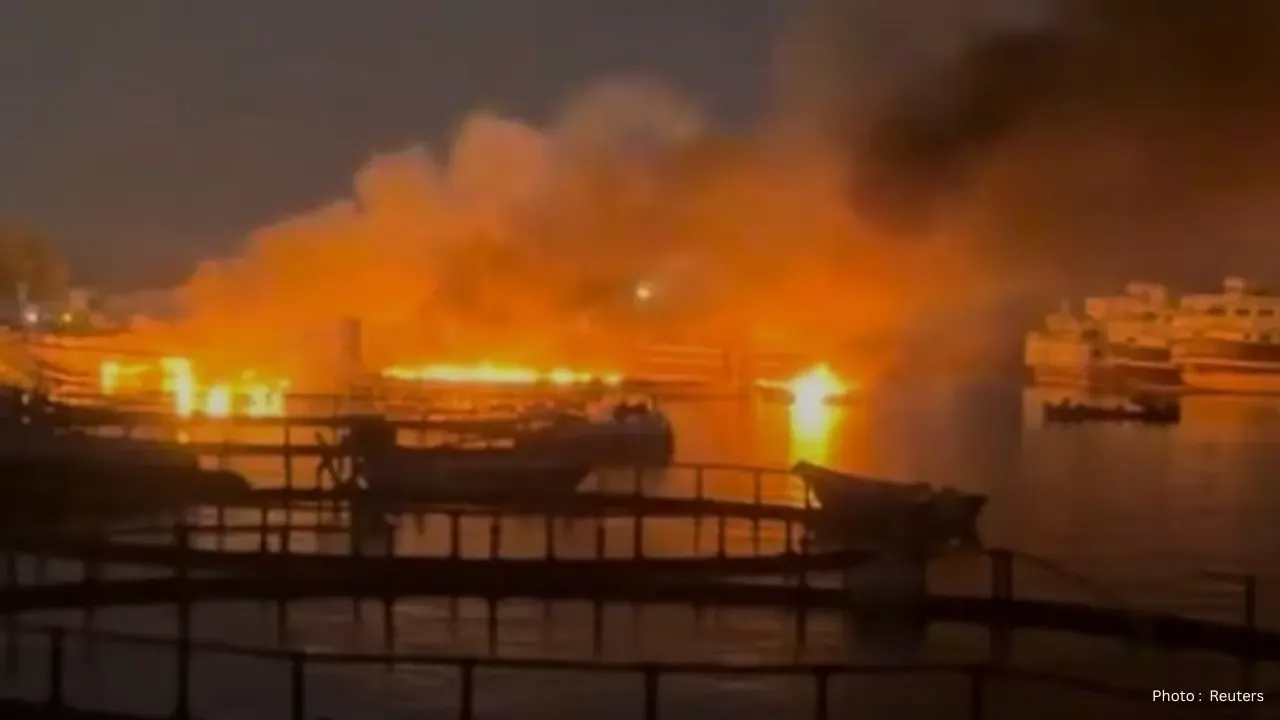
In response to consecutive airstrikes conducted by the United States on Iranian military targets, Iran has executed missile and drone assaults against military sites in both Kuwait and Bahrain. This escalation has intensified regional tensions and sparked fears of a broader conflict.
Officials reported that the strikes targeted sites linked to US military activities in the Gulf. Both Kuwait and Bahrain's air defense systems were activated promptly after the alerts were sounded, intercepting multiple missiles and drones before they reached their designated areas. Residents were advised to stay indoors while security evaluations were conducted.
US Conducts Second Wave of Airstrikes
The Iranian offensive came on the heels of another round of airstrikes by the US aimed at diminishing Iran's military capabilities, following recent aggressions targeting commercial vessels and security interests in the region. US officials emphasized that the strikes were executed with precision to lessen risks to civilian lives.
As tensions rise, the United States has bolstered its military readiness in the region, enhancing surveillance and defense strategies to ensure the safety of its personnel stationed there.
Iran Justifies Its Response
Iran has condemned the US airstrikes, labeling them a violation of its sovereignty. Iranian authorities clarified that their drone and missile strikes on Kuwait and Bahrain were direct reactions to what they termed ongoing US military aggression.
Tehran issued a warning that any further US attacks would precipitate additional responses targeting American military assets throughout the Middle East. Iranian leaders affirmed their commitment to counter any sustained military pressure from Washington.
Heightened Security Across the Gulf
Given their significance to US military strategies, both Kuwait and Bahrain have heightened security measures following the attacks. Authorities increased alert statuses, and military facilities adopted enhanced protective protocols.
Airports in both nations remained operational under stricter security conditions, with emergency response teams on standby. Nearby Gulf nations also raised monitoring efforts in coordination with defense partners to oversee regional airspace.
Concerns Regarding the Strait of Hormuz
This latest bout of aggression has reignited worries about security in the strategically vital Strait of Hormuz, a crucial passage for global energy shipping. Any disruption in this waterway could significantly impact worldwide oil supply and trade.
Energy markets reacted to the escalating tensions, leading to a spike in oil prices due to apprehensions over potential supply interruptions. Analysts warned of extensive economic implications for nations reliant on energy exports from the Middle East, should military confrontations persist.
Calls for Restraint from the Global Community
A range of governments and international organizations have called for restraint from both Tehran and Washington, advocating for the resumption of diplomatic talks. Global leaders expressed concern that ongoing military exchanges might destabilize the Gulf and heighten the risk of a more widespread conflict involving several nations.
Efforts on the diplomatic front are likely to persist as global and regional powers strive to avert further deterioration of the security landscape.
Uncertain Future Ahead
Military analysts contend that the upcoming days are pivotal in deciding whether the current tensions lead to expanded conflict or remain confined. With both nations maintaining robust military postures and issuing threats of further actions, uncertainty looms large.
Governments in the Middle East are on high alert as the international community vigilantly monitors the evolving situation. While diplomatic efforts remain in play alongside military readiness, the world awaits to see if renewed talks can prevent the conflict from escalating further.
#World Update #Middle East #Middle East Crisis #Middle East Conflict #World News








APEC Members Emphasise Safe and Responsible Use of Artificial Intelligence
APEC members discuss responsible AI use, digital innovation and data governance as China and the US

Union of European Clubs Challenge UEFA and EFC Over EU Competition Rules
UEC files an EU competition complaint against UEFA and EFC, challenging club representation, governa

Mohammed Shami Retires From Test Cricket, Eyes White-Ball Career
Mohammed Shami retires from Test cricket after 13 years, with 229 wickets. He will continue playing

Singapore Warns Users About Privacy and Security Risks of AI Agents
Singapore warns users about AI agent security risks, data privacy, online scams and unauthorised acc

Chris Lynn Completes One-Month Ban After Positive Cocaine Test
Australian cricketer Chris Lynn completes a one-month ban after a positive cocaine test during the T

Djokovic Eyes Strong Season Finish as Health Improves Ahead of Paris Masters
Novak Djokovic reports improved health and performance as he targets a strong Paris Masters finish a