
You have not yet added any article to your bookmarks!
Join 10k+ people to get notified about new posts, news and tips.
Do not worry we don't spam!
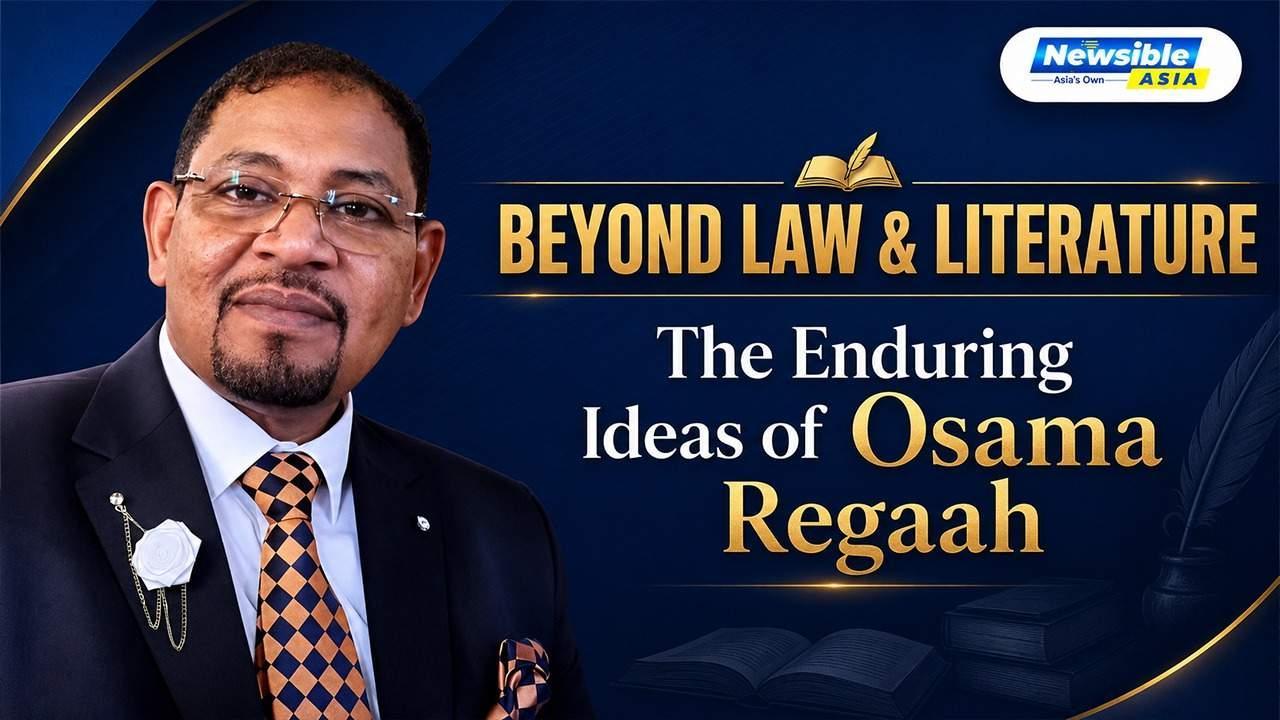
Post by : Sameer Farouq
In an age marked by rapid technological change, economic uncertainty, and shifting social realities, the search for ideas that place humanity at the center of progress has become increasingly important. Across Asia and beyond, policymakers, educators, business leaders, and scholars continue to ask a fundamental question: What kind of development truly benefits people?
For Sudanese legal scholar, author, and thinker Osama Regaah, the answer lies in the intersection of knowledge, justice, human dignity, and ethical leadership. Throughout a career spanning law, literature, governance, and intellectual thought, Regaah has consistently advocated for a vision of progress that prioritizes people over systems and values over mere achievement.
While his professional accomplishments are notable in their own right, it is the philosophy behind his work that continues to resonate with audiences seeking a more human-centered understanding of development and leadership.
Many contemporary discussions about success focus on wealth, influence, or institutional power. Regaah's perspective challenges these conventional measurements.
According to his worldview, genuine success cannot be evaluated solely through material achievement. Instead, it must be measured by the positive impact individuals leave on their communities, institutions, and future generations.
This belief has remained a recurring theme throughout his writings and public reflections. Whether discussing law, literature, business leadership, or social development, he repeatedly emphasizes that achievement gains meaning only when it contributes to the well-being of others.
In many ways, this idea stands in contrast to modern cultures of competition and individualism. Regaah argues that sustainable progress requires a broader understanding of responsibility—one that connects personal ambition with collective advancement.
At the heart of Regaah's philosophy lies a profound respect for knowledge.
For him, knowledge is not merely the accumulation of information or academic qualifications. It is a transformative force capable of shaping societies, empowering individuals, and creating opportunities for progress.
This understanding emerged through years of study, research, and professional experience. Having pursued education in law and business administration, Regaah came to view learning as a lifelong process rather than a destination.
He often highlights the distinction between information and wisdom. While modern societies have unprecedented access to information, wisdom requires reflection, ethical judgment, and an understanding of how knowledge should be applied.
This perspective has particular relevance across Asia, where education continues to play a central role in economic growth and social mobility. Yet Regaah's ideas suggest that education must do more than prepare individuals for employment; it must also cultivate character, responsibility, and critical thinking.
As a legal scholar, Regaah has spent much of his career examining the role of law in society.
However, his understanding of law extends beyond legislation, courts, and legal procedures. He sees law as an instrument for protecting human dignity, promoting fairness, and strengthening institutions.
In his view, effective legal systems are those that balance authority with accountability and regulation with justice.
This approach is particularly significant in a world where governance challenges continue to shape public trust in institutions. Regaah argues that legal frameworks should ultimately serve people, not merely administrative systems.
His legal writings and research often explore comparative perspectives, examining how different legal traditions can contribute to more effective and equitable governance.
By connecting law with broader social objectives, he presents a vision of justice that is both practical and deeply human.
While law provided one framework for understanding society, literature offered another.
Through his novels, essays, and intellectual writings, Regaah has explored questions that extend beyond legal analysis. Themes such as identity, morality, social change, and human aspiration frequently appear throughout his literary work.
Literature, in his view, provides an opportunity to understand the emotional and psychological dimensions of human life.
Where legal systems focus on rights and responsibilities, literature explores hopes, fears, relationships, and personal struggles. Together, these perspectives create a more complete understanding of society.
This combination of legal scholarship and literary expression has become one of the defining characteristics of Regaah's intellectual journey.
Rather than treating disciplines as separate fields, he views them as complementary paths toward understanding humanity.
Among the most significant influences on Regaah's thinking was the late Emirati entrepreneur and philanthropist Saeed Ahmed Lootah.
Lootah's commitment to education, community development, and ethical entrepreneurship reinforced Regaah's belief that leadership should be measured by service rather than status.
The lessons drawn from this experience helped shape his understanding of sustainable leadership.
According to Regaah's philosophy, leaders should not be evaluated solely by organizational success or financial performance. Instead, they should be judged by their ability to develop people, strengthen institutions, and create opportunities for future generations.
This principle has growing relevance in an era where societies increasingly expect leaders to demonstrate social responsibility alongside professional competence.
Across his legal, literary, and intellectual work, one theme consistently emerges: the importance of human development.
For Regaah, development is not simply an economic objective. It is a human objective.
Infrastructure, investment, and technological innovation undoubtedly contribute to progress. However, he argues that these achievements must ultimately serve people rather than become ends in themselves.
Human development involves education, opportunity, dignity, participation, and empowerment.
It requires societies to invest not only in physical resources but also in intellectual, cultural, and ethical growth.
This perspective aligns closely with contemporary discussions about sustainable development and inclusive growth throughout Asia and the wider world.
Another defining element of Regaah's philosophy is his belief in dialogue.
At a time when polarization and division frequently dominate public discourse, he advocates for communication, understanding, and mutual respect.
He views dialogue as an essential tool for resolving conflicts, strengthening communities, and building trust across cultural and ideological differences.
This commitment to dialogue reflects a broader belief that societies become stronger when diverse perspectives are allowed to coexist and interact constructively.
Rather than seeing differences as obstacles, Regaah views them as opportunities for learning and growth.
The enduring relevance of Osama Regaah's ideas lies in their simplicity and universality.
Knowledge, justice, dignity, leadership, and human development are not concepts limited to a single country or profession. They are principles that transcend borders and generations.
As Asian societies continue to navigate the opportunities and challenges of the twenty-first century, these ideas offer a valuable framework for thinking about progress.
They encourage leaders to focus on people, institutions to prioritize fairness, and individuals to view knowledge as a responsibility rather than a privilege.
Beyond his achievements as a legal scholar and author, Osama Regaah's most significant contribution may be the set of ideas that continue to guide his work.
His philosophy reminds us that development is ultimately about people, that justice begins with dignity, and that knowledge achieves its highest purpose when used in service of humanity.
In a rapidly changing world, such ideas remain as relevant as ever.
Editor's Note: The content of this feature is derived from information, materials, and personal accounts provided by Osama Regaah. All statements regarding personal experiences, achievements, and opinions reflect the author's own perspective.
#world news #Global News #India News #UAE #Newsible Asia #Culture #Osama Regaah










PM Modi Pays Tribute to Mahatma Gandhi, Urges People to Support Khadi
PM Modi pays tribute to Mahatma Gandhi on Gandhi Jayanti and urges citizens to support Khadi and the

Amazon Seeks to Offload $8 Billion in Nvidia Chips to Investors
Amazon plans to move $8 billion in Nvidia chips to investors, using a new financing model to strengt

Samsung Raises Galaxy S26 Prices as Memory Chip Costs Rise
Samsung raises Galaxy S26 prices in South Korea as rising memory chip costs put pressure on smartpho

Lewis Hamilton Calls Singapore Grand Prix One of F1's Toughest Races
Lewis Hamilton discusses the demanding Singapore Grand Prix and brings Plus44 and Almave to Singapor

Denmark's Pandora Opens World's Largest Jewellery Factory in Vietnam
Pandora opens its largest jewellery factory in Vietnam, expanding global production, strengthening s

Gautam Gambhir Questions Batting-Friendly Pitches After India's Record ODI Chase
Gautam Gambhir questions batting-friendly ODI pitches after India’s record chase, calling for a bett

