
You have not yet added any article to your bookmarks!
Join 10k+ people to get notified about new posts, news and tips.
Do not worry we don't spam!
Post by : Badri Ariffin
Florida's newly drawn congressional map is entering its first round of legal challenges as suit claims arise against the Republican-led redistricting effort prior to the upcoming 2026 U.S. midterm elections.
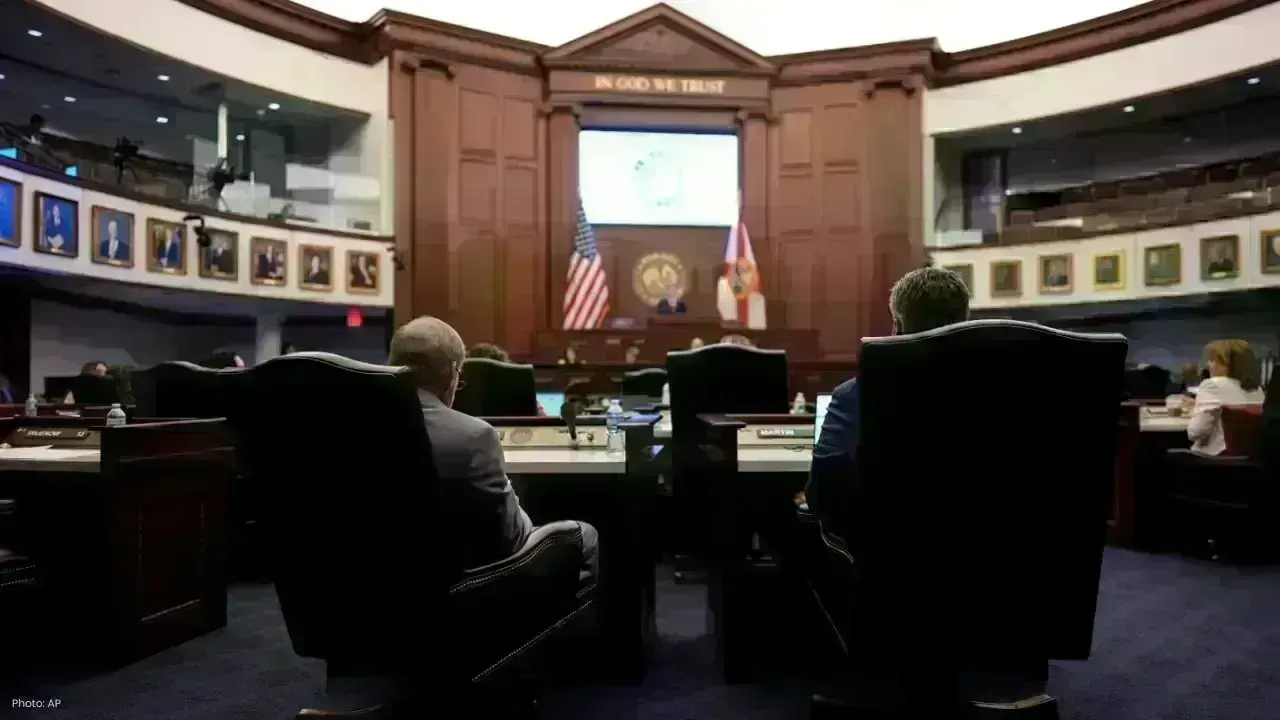
Signed into law by Governor Ron DeSantis, the revised districts are under fire in court for allegedly breaching Florida's constitutional prohibition against partisan gerrymandering. Voter-backed lawsuits seeking redress are scheduled to be presented in a Leon County state court this Friday.
Currently, Republicans hold 20 of the 28 U.S. House seats in Florida. This newly approved map could strengthen their potential for capturing four additional seats in the November elections, developed during a quick two-day legislative session on April 29.
The legal dispute arrives in a context where former President Donald Trump and other Republican leaders advocate for mid-decade redistricting in various states to bolster GOP control in the House of Representatives.
Legal filings suggest the new Florida map disproportionately favors Republicans and exacerbates the state's political discrepancies. One plaintiff characterized the strategy as pushing “the state’s partisan tilt to an unprecedented extreme.”
In 2010, Florida voters approved a constitutional reform that prohibits congressional districts from being strategically drawn to favor or disadvantage a political party or specific office-holder. The amendment also safeguards racial and linguistic minorities' voting strength and mandates that districts remain compact while adhering to established political boundaries wherever feasible.
Attorneys representing the Florida Senate contend that the plaintiffs have yet to establish partisan motivation and stressed that issuing a block on the map preemptively would be inappropriate before a comprehensive trial.
The struggle over redistricting has intensified following the Supreme Court's April 29 ruling that diluted protections established under the federal Voting Rights Act, even eliminating a majority-Black congressional district in Louisiana. In response, several Southern states are reevaluating their minority-majority districts that have typically lent support to Democrats.
The updated Florida map also alters a South Florida district initially crafted to assist in electing a Black representative as per the Voting Rights Act. Officials from DeSantis' administration have asserted that race was not a factor in the map's formation.
In a legal memorandum directed at lawmakers, DeSantis’ General Counsel, David Axelman, argued that Florida’s racial redistricting rules may conflict with federal laws. He suggested that if any segment of the amendment is deemed unconstitutional, the entirety—including the partisan gerrymandering prohibition—might also collapse.
The forthcoming court's ruling on whether to impose a temporary halt on the map is expected to significantly influence Florida's congressional races as well as the broader national struggle for control of the U.S. House in 2026.










PM Modi Pays Tribute to Mahatma Gandhi, Urges People to Support Khadi
PM Modi pays tribute to Mahatma Gandhi on Gandhi Jayanti and urges citizens to support Khadi and the

Amazon Seeks to Offload $8 Billion in Nvidia Chips to Investors
Amazon plans to move $8 billion in Nvidia chips to investors, using a new financing model to strengt

Samsung Raises Galaxy S26 Prices as Memory Chip Costs Rise
Samsung raises Galaxy S26 prices in South Korea as rising memory chip costs put pressure on smartpho

Lewis Hamilton Calls Singapore Grand Prix One of F1's Toughest Races
Lewis Hamilton discusses the demanding Singapore Grand Prix and brings Plus44 and Almave to Singapor

Denmark's Pandora Opens World's Largest Jewellery Factory in Vietnam
Pandora opens its largest jewellery factory in Vietnam, expanding global production, strengthening s

Gautam Gambhir Questions Batting-Friendly Pitches After India's Record ODI Chase
Gautam Gambhir questions batting-friendly ODI pitches after India’s record chase, calling for a bett

