You have not yet added any article to your bookmarks!
Join 10k+ people to get notified about new posts, news and tips.
Do not worry we don't spam!
Post by : Samjeet Ariff
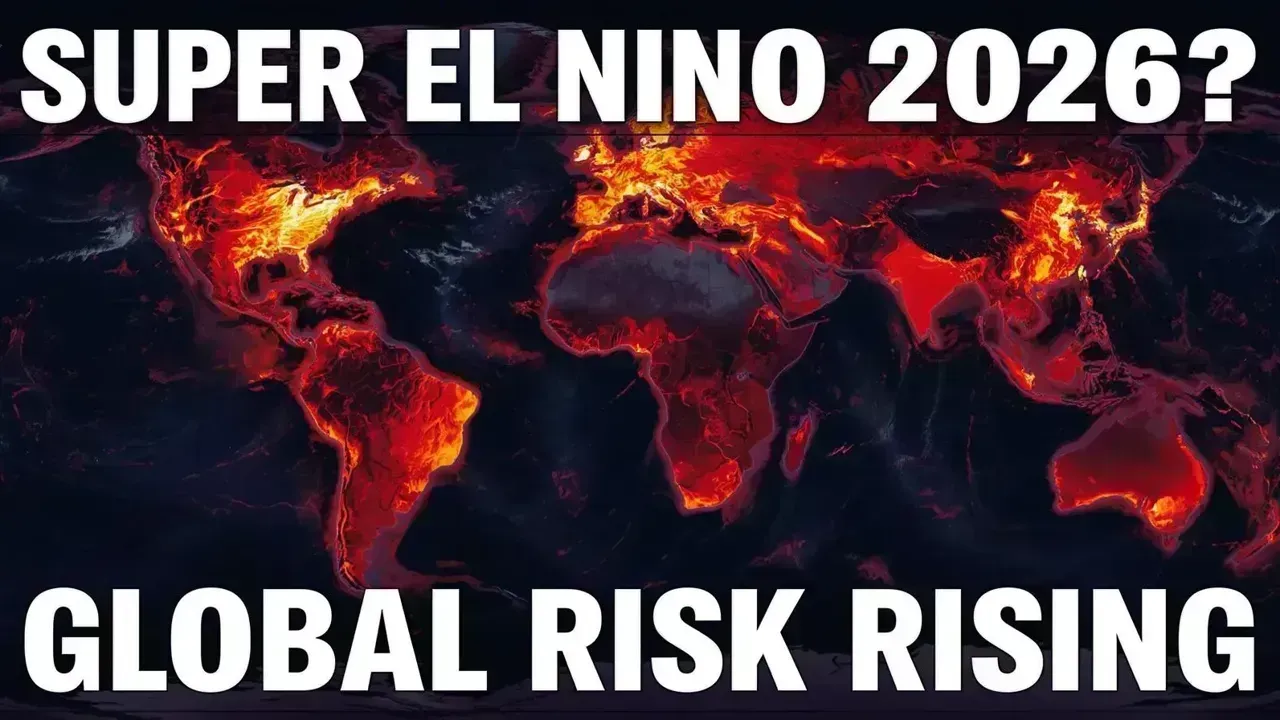
The prospect of a “Super El Niño in 2026” has ignited conversations in climate circles. As scientists keep a close eye on oceanic behaviors, the question remains whether this could evolve into one of the most impactful climatic events we have seen.
While predictions point towards a likelihood of an El Niño event in 2026, its status as a “super” occurrence remains uncertain. Nonetheless, a strong El Niño could unleash serious global ramifications, particularly given our planet’s current warming trend.
El Niño is a recurring climatic phenomenon marked by warmer surface waters in the central and eastern Pacific Ocean.
This seemingly minor warming can disrupt global wind patterns and ocean currents, consequently altering rainfall, temperature, and storm behaviors in various regions.
A “Super El Niño” refers to a particularly intense manifestation of this event, characterized by significant rises in ocean temperatures leading to heightened global effects.
Scientists are currently noting unusual warming trends in the Pacific, which are often indicators of impending El Niño events. Climate models suggest that 2026 could be conducive to a stronger occurrence.
The overarching concern lies in the context of global warming. When natural climatic patterns, such as El Niño, intersect with the rising global temperatures, the resultant effects can be more severe and unpredictable.
This underlines the heightened attention experts are giving to extreme climatic patterns in 2026, even without confirmation of a “super” event.
Typically, El Niño occurrences lead to higher global temperatures. Should a strong event unfold in 2026, it could result in unprecedented heatwaves across diverse regions.
This rise in temperatures could amplify health risks, increase energy demand, and place additional strain on water supplies.
In nations like India, El Niño is often correlated with diminished monsoon rainfall.
This may bring about:
For regions reliant on seasonal rains, even minor disruptions can lead to severe outcomes.
Areas such as Australia and Southeast Asia often suffer from extended dry spells during El Niño years.
This situation can hinder agricultural processes, elevate wildfire threats, and pose long-standing environmental challenges.
While certain areas face drought, others may contend with significant rainfall and flooding, particularly in the Americas and East Asia.
This uneven weather distribution accentuates El Niño’s role as a powerful global climate influencer.
Shifts in climate can have a direct impact on food production. A potent El Niño may disrupt crop cycles, diminish yields, and raise food costs.
This scenario can lead to broader economic repercussions, especially in agriculture-dependent nations.
Historically, El Niño events held substantial influence. Today, however, the stakes are higher as the planet experiences elevated temperatures.
Warmer oceans yield additional energy for weather systems, leading to:
This confluence elevates the risk of extreme climate phenomena linked to El Niño.
Experts are diligently monitoring ocean temperatures, wind flows, and heat accumulation below the ocean surface.
These observations are pivotal in determining:
As 2026 approaches and more data becomes available, prediction accuracy is anticipated to improve.
While there’s no need for alarm, staying informed is vital. El Niño is a natural part of the climate cycle, but its influences can alter everyday weather.
Governments and industries frequently prepare in advance by monitoring predictions and planning for possible disruptions.
For individuals, keeping abreast of weather reports and seasonal updates serves as the best method for staying prepared.
So, will a Super El Niño be upon us in 2026?
The primary message is not to evoke fear but to foster understanding. As climate patterns intensify, being well-informed aids in adapting and preparing for forthcoming changes.
This article serves informational purposes exclusively, grounded in current climate understanding and general scientific observations. Climate forecasts may evolve as fresh data emerges. It should not be interpreted as a definitive prediction or formal advisory.










APEC Members Emphasise Safe and Responsible Use of Artificial Intelligence
APEC members discuss responsible AI use, digital innovation and data governance as China and the US

Union of European Clubs Challenge UEFA and EFC Over EU Competition Rules
UEC files an EU competition complaint against UEFA and EFC, challenging club representation, governa

Mohammed Shami Retires From Test Cricket, Eyes White-Ball Career
Mohammed Shami retires from Test cricket after 13 years, with 229 wickets. He will continue playing

Singapore Warns Users About Privacy and Security Risks of AI Agents
Singapore warns users about AI agent security risks, data privacy, online scams and unauthorised acc

Chris Lynn Completes One-Month Ban After Positive Cocaine Test
Australian cricketer Chris Lynn completes a one-month ban after a positive cocaine test during the T

Djokovic Eyes Strong Season Finish as Health Improves Ahead of Paris Masters
Novak Djokovic reports improved health and performance as he targets a strong Paris Masters finish a