You have not yet added any article to your bookmarks!
Join 10k+ people to get notified about new posts, news and tips.
Do not worry we don't spam!
Post by : Saif Rahman
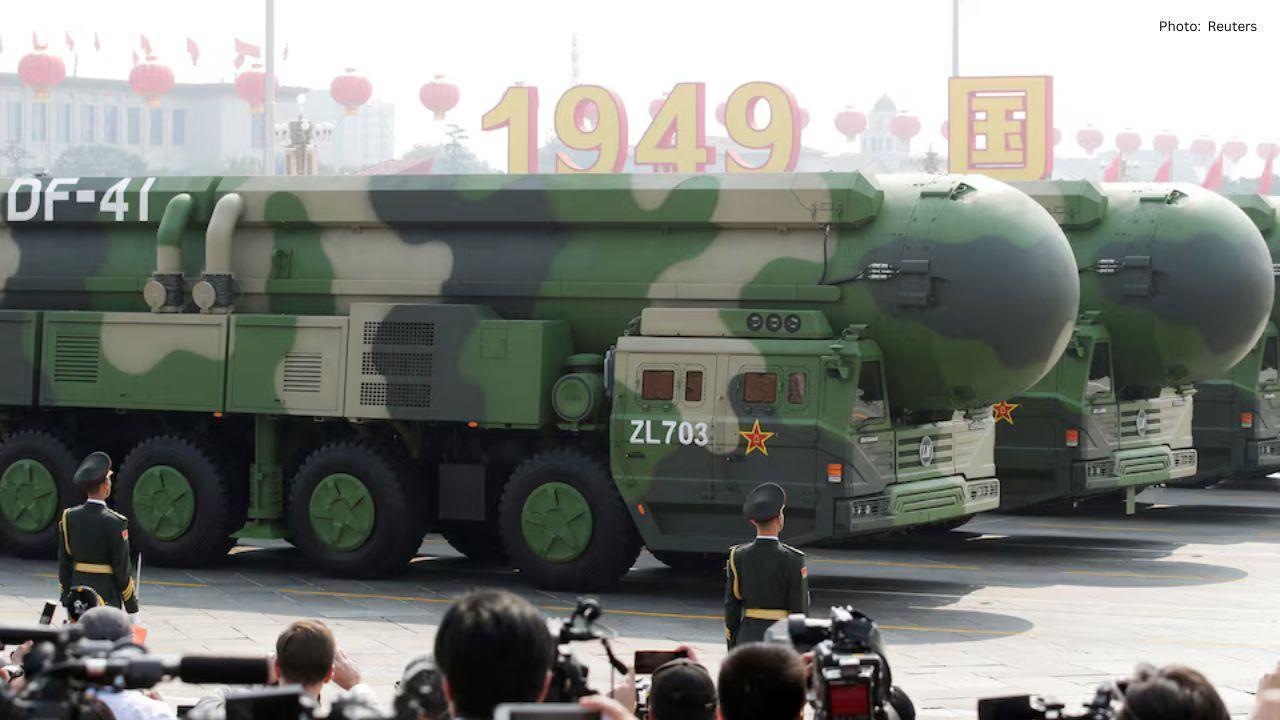
A newly draft Pentagon report suggests that China has possibly loaded over 100 intercontinental ballistic missiles (ICBMs) in its latest silo fields, indicating a swift enhancement of its nuclear prowess. The document also suggests that China appears disinterested in engaging in arms control discussions, which raises alarms among analysts regarding escalating military tensions in the Asia-Pacific area.
The assessment details that China has stationed solid-fueled DF-31 missiles across three silo fields adjacent to its Mongolian border. Although the Pentagon had identified these silo sites, the confirmation of missile numbers comes now. U.S. officials point out that this draft could be modified before it reaches Congress.
Additionally, the report highlights China's wider military objectives, noting that Beijing aims to be prepared for a conflict over Taiwan by 2027. The document outlines potential military actions that could affect operations as far as 1,500-2,000 nautical miles away from China, posing a challenge to the U.S. military presence in the region.
Currently estimated to possess a nuclear arsenal of around 600 warheads in 2024, China’s production rate appears to be decelerating compared to previous years. Yet, the Pentagon forecasts that the country’s stockpile could exceed 1,000 warheads by 2030. Despite such growth, China asserts it adheres to a defensive nuclear strategy and a no-first-use policy, intending to deploy nuclear arms strictly in cases of retaliation.
The report emerges amid talks concerning the end of the 2010 New START treaty, the final nuclear arms control agreement between the U.S. and Russia. Experts caution that the termination of this treaty may spark a renewed nuclear arms race among China, Russia, and the United States. Daryl Kimball, the Arms Control Association's executive director, remarked, “An increase in nuclear arsenals paired with a lack of diplomacy does not contribute to global safety for China, Russia, or the U.S.”
China, however, disputes the Pentagon’s assertions regarding military escalation, branding such reports as tactics to “slander and malign” the nation. The Chinese embassy in Washington insisted that the country maintains a defensive posture and keeps its nuclear capabilities at the minimal necessary for its security needs.
The document also covers recent developments within China's military. President Xi Jinping has spearheaded an extensive anti-corruption crackdown targeting the People’s Liberation Army (PLA) and the defense sectors. Though this initiative may affect short-term military readiness, the Pentagon believes it could yield long-term enhancements in the PLA’s operational efficiency. In the past year and a half, around 26 senior executives in state-owned defense companies have faced investigation or removal from their roles, including those within nuclear and shipbuilding domains.
The escalation of China’s nuclear capabilities coincides with heightened tensions with the U.S. over issues concerning Taiwan, the South China Sea, and broader regional conflicts. While China promotes a narrative of self-defense and strategic caution, the Pentagon's findings indicate that Washington perceives these developments as part of a swift military modernization that could alter power dynamics both regionally and globally.
With the international community observing closely, analysts urge for meticulous diplomacy to avoid misunderstandings and mitigate the risks of a nuclear confrontation. The forthcoming years will be pivotal in shaping how China, the U.S., and other nuclear states manage their arsenals and approach arms control dialogue.









PSG Coach Luis Enrique Urges Players to Step Outside Comfort Zone
PSG coach Luis Enrique says players must leave their comfort zone and keep improving as the club tar

China’s Tiangong Sets New 400m Record at Robot Olympics
China’s Tiangong robot sets a new 400m record at the Robot Olympics, beating a South African robot i

George Russell Wins Dutch GP Sprint, Boosts Mercedes Morale
George Russell wins the Dutch GP Sprint from pole as Mercedes teammate Kimi Antonelli extends his F1

Australia 50/3 After Bangladesh Bowled Out for 64 in Second Test
Australia reached 50/3 after Bangladesh were bowled out for 64 in the second Test, with Mitchell Sta

Jordan Burroughs Returns to Wrestling with 2028 Olympic Dream
Jordan Burroughs returns to wrestling with Real American Freestyle as the Olympic champion eyes a po

Lamborghini Catches Fire on Singapore's ECP, Causing Heavy Traffic
A Lamborghini caught fire on Singapore's ECP, causing heavy traffic and bus delays. No injuries were