
You have not yet added any article to your bookmarks!
Join 10k+ people to get notified about new posts, news and tips.
Do not worry we don't spam!
Post by : Anis Farhan
Artificial intelligence has progressed far beyond simple text-generation chatbots. The development of Claude Code, an AI tool from Anthropic designed to generate, test, and run code autonomously, marks a pivotal shift in software engineering workflows. Unlike typical code assistants that suggest lines of code, Claude Code functions as an “agentic” AI tool capable of interacting with real systems, executing commands, understanding projects, and carrying out complex digital tasks with minimal human input.
This evolution represents a fundamental change in how software is built and maintained. As AI takes on more coding responsibilities, it raises profound questions about the future of developers, the economics of software creation, and the broader implications for employment in technical fields. In this article, we examine Claude Code’s rise, its capabilities, the impact on jobs, economic forces at play, associated risks, and what lies ahead for the digital economy.
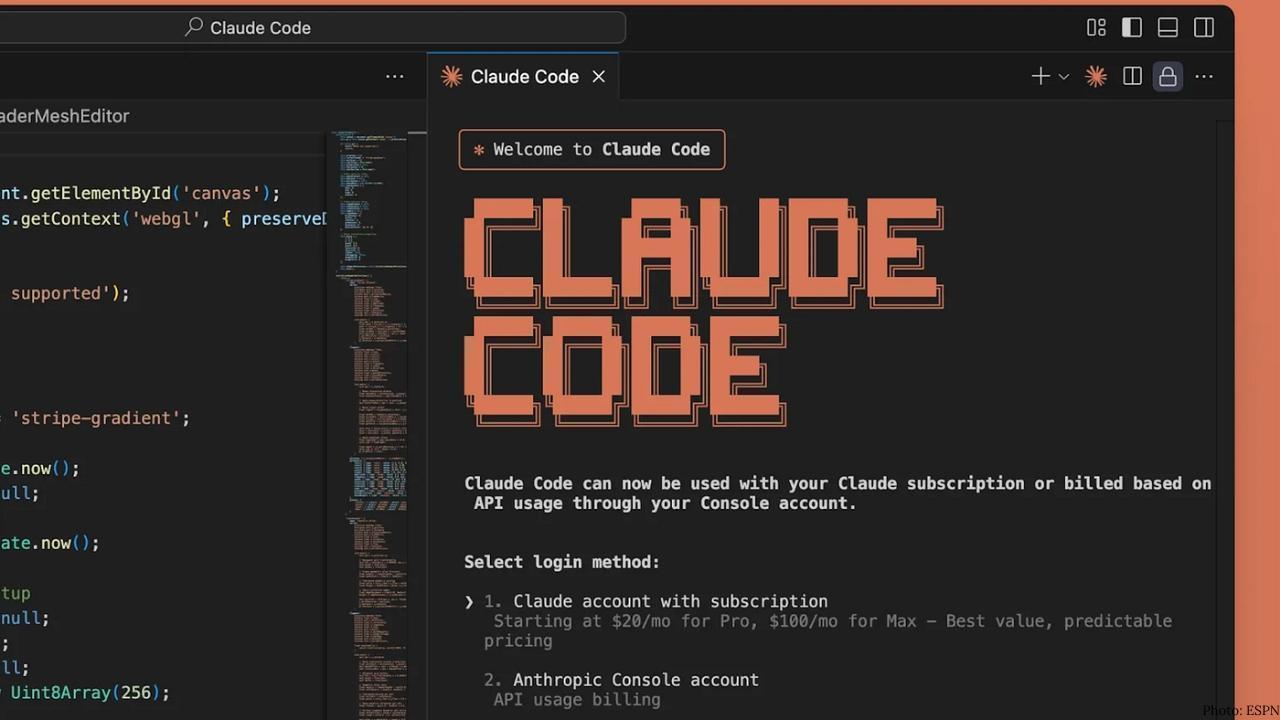
Claude Code is an innovative AI coding agent created by Anthropic that can write, modify, and interact with real software environments. Rather than just offering suggestions based on text prompts, it can execute commands, navigate files, run tests, and integrate with development tools — effectively acting as a coding collaborator or autonomous assistant.
Initially released as a command-line tool in early 2025, Claude Code has expanded into web interfaces, integrated development environments (IDEs), and broader AI agent ecosystems like Claude Cowork, which brings similar capabilities to non-technical users.
Early AI tools in coding — such as auto-completion features — helped developers by predicting the next lines of text. Later solutions like GitHub Copilot offered deeper suggestion capabilities, improving productivity by augmenting human coding. However, Claude Code goes beyond assistance: it takes actions on behalf of the user, such as generating entire modules, testing functionalities, debugging code, and even automating cross-file changes.
This transition from augmentation to automation is often described as a shift from “assisted coding” to agentic coding, where the AI actively participates in software development rather than merely supporting humans.
Claude Code is capable of generating entire codebases or functional components with minimal human prompts. It understands programming languages, project structures, and software architecture concepts, enabling it to produce usable software artifacts.
Beyond just writing code, Claude Code can run tests, identify errors, diagnose failures, and propose fixes. This dramatically reduces the time developers typically spend on debugging — a process many programmers find the most tedious.
Claude Code integrates with existing developer tools like IDEs, GitHub Actions, and version control systems, allowing it to operate within standard development workflows. This flexibility makes adoption seamless for many teams.
Extensions like Claude Cowork adapt Claude Code’s capabilities for broader knowledge work, enabling automated handling of documents, spreadsheets, communications, and other tasks traditionally unrelated to programming.
AI coding tools like Claude Code can drastically increase productivity. Developers report completing work in a fraction of the time it would take manually and experimenting with features that would otherwise require extensive planning.
This productivity boost has implications beyond coding: companies can develop software faster, reduce costs, and innovate at a much quicker pace. For startups and enterprises alike, this efficiency can be a competitive advantage, enabling rapid iteration, experimentation, and deployment.
Rather than rendering human programmers obsolete, many industry leaders foresee a shift in roles. Developers may take on duties such as supervising AI output, selecting coding strategies, or solving complex problems that AI cannot handle alone. Anthropic’s own leadership has highlighted that while AI can handle routine code generation, human engineers are still essential for complex problem solving and quality assurance.
The adoption of Claude Code is beginning to influence hiring priorities. Some companies are seeking generalist engineers comfortable working with AI tools, and others are emphasizing problem-solving skills over rote coding ability. This shift is not yet universal, but it points to evolving job requirements in software development.
At the same time, there are concerns about entry-level job prospects. With AI handling many routine coding tasks, young developers may find fewer positions available to learn and refine foundational skills. Studies suggest that reliance on AI tools may inhibit deep skill formation in novice programmers, even as it enables faster results.
In labor-intensive IT markets such as India, the rise of AI coding tools has shaken investor confidence and sector valuations. Reports indicate that concerns over automation reducing demand for large developer teams contributed to major stock market declines among tech firms.
One of the most transformative aspects of Claude Code’s design is its accessibility. Through natural language prompts, non-engineers can build tools, analyze data, and automate processes previously reserved for technical specialists, thus democratizing digital creation.
This democratization can catalyze entrepreneurship, enabling founders and professionals in other fields to prototype software without deep coding knowledge.
AI coding tools extend beyond software development alone. Researchers and professionals in science, healthcare, finance, and education can use AI to automate data analysis, build custom tools, and accelerate research workflows, vastly expanding productivity across sectors.
Heavy reliance on AI tools can lead to degradation of human coding skills. When developers defer too much work to automated systems, they risk weakening their foundational understanding, which could hamper problem-solving ability and long-term expertise.
AI-generated code can introduce security vulnerabilities. Tools trained on historical code repositories may inadvertently replicate insecure patterns or suggest solutions that bypass critical security safeguards. This risk requires vigilant oversight and robust review processes.
Agentic AI tools capable of interacting directly with systems carry potential risks if misused or poorly directed. Without careful safeguards, these agents could execute unintended actions or introduce errors at scale.
Broader societal concerns revolve around employment disruption, equitable access to AI capabilities, and ensuring that AI adoption does not exacerbate inequalities. Policymakers and companies will need to collaborate to manage these transitions responsibly.
The rise of Claude Code heralds a future where AI is a core collaborator in software creation, not just a tool. As AI coding agents mature, developers may increasingly focus on design thinking, architecture, ethics, and complex problem solving, while AI handles routine tasks.
Companies investing in AI capabilities may outcompete peers, prompting entire industries to rethink workflows, team structures, and talent strategies. The future could see hybrid roles where humans and AI co-create software, augmenting each other’s strengths — human creativity and oversight, AI productivity and execution.
However, navigating this transition will require education, upskilling initiatives, ethical frameworks, and policies that support workers adapting to evolving roles.
Disclaimer: This article is intended for informational and analytical purposes only and does not constitute financial, career, or technical advice. Readers should consult professionals and perform their own research before making decisions related to technology adoption or career planning.










PM Modi Pays Tribute to Mahatma Gandhi, Urges People to Support Khadi
PM Modi pays tribute to Mahatma Gandhi on Gandhi Jayanti and urges citizens to support Khadi and the

Amazon Seeks to Offload $8 Billion in Nvidia Chips to Investors
Amazon plans to move $8 billion in Nvidia chips to investors, using a new financing model to strengt

Samsung Raises Galaxy S26 Prices as Memory Chip Costs Rise
Samsung raises Galaxy S26 prices in South Korea as rising memory chip costs put pressure on smartpho

Lewis Hamilton Calls Singapore Grand Prix One of F1's Toughest Races
Lewis Hamilton discusses the demanding Singapore Grand Prix and brings Plus44 and Almave to Singapor

Denmark's Pandora Opens World's Largest Jewellery Factory in Vietnam
Pandora opens its largest jewellery factory in Vietnam, expanding global production, strengthening s

Gautam Gambhir Questions Batting-Friendly Pitches After India's Record ODI Chase
Gautam Gambhir questions batting-friendly ODI pitches after India’s record chase, calling for a bett

