You have not yet added any article to your bookmarks!
Join 10k+ people to get notified about new posts, news and tips.
Do not worry we don't spam!
Post by : Anis Farhan
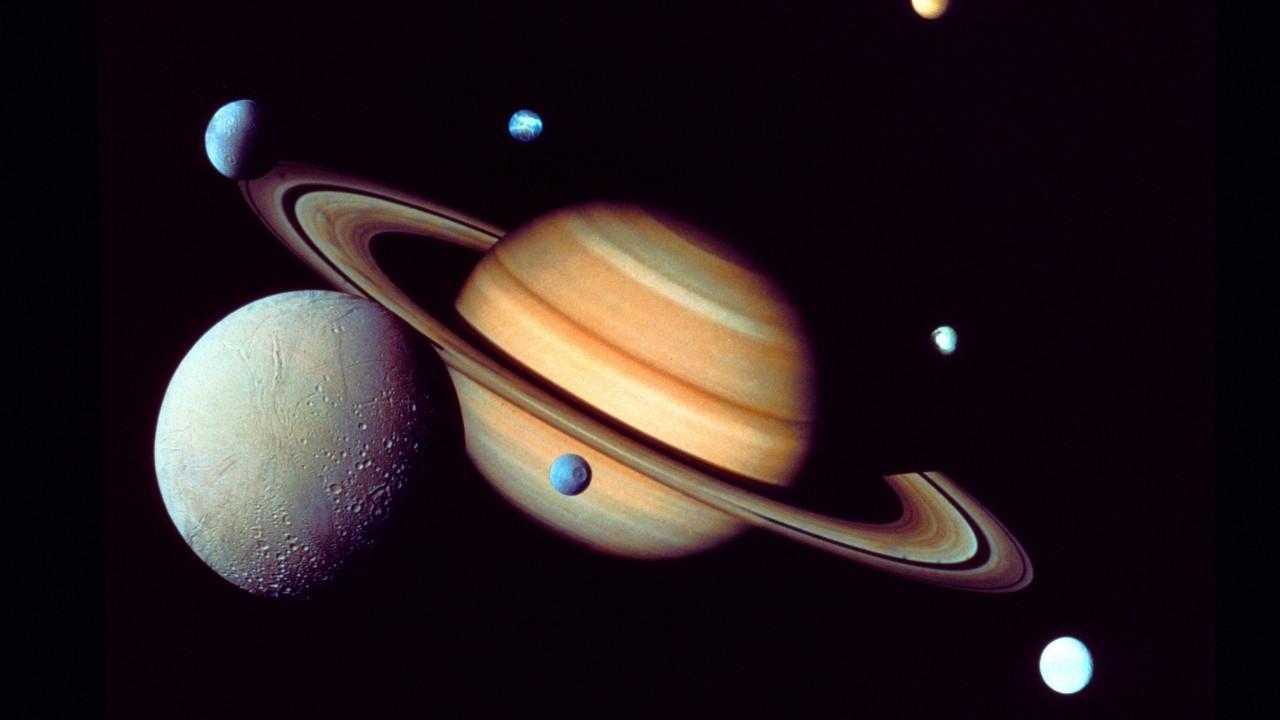
In an extraordinary astronomical breakthrough, Saturn has just expanded its cosmic family by 128 newly identified moons, solidifying its status as the planet with the most satellites in our solar system. This discovery not only adds to the allure of the ringed giant but also presents scientists with fresh opportunities to study how moons form, evolve, and interact with their parent planet. The finding underscores how our solar system, even in 2025, continues to surprise humanity with new celestial wonders.
Moons are not just rocks circling planets; they carry vital clues about the history of planetary systems. Each moon can act like a time capsule, holding evidence of how planets formed billions of years ago. With Saturn’s tally now surpassing 180 moons, researchers gain a more detailed laboratory in space to examine cosmic processes. These moons could reveal more about the composition of the solar nebula, the violent collisions that shaped the planets, and even the building blocks of life.
Detecting small moons around a distant giant planet is no easy feat. Astronomers used powerful ground-based telescopes and sophisticated tracking techniques to capture these faint objects against the dark backdrop of space. Advances in imaging technology and data processing have made it possible to identify moons that are only a few kilometers across. Many of these moons orbit far from Saturn, some in irregular, tilted paths that suggest they are captured objects from elsewhere in the solar system.
The growing population of Saturn’s moons forces scientists to rethink the complexity of moon systems. These natural satellites may not have all formed in place. Instead, some could be remnants of ancient collisions or objects gravitationally captured during Saturn’s long history. Studying their distribution, composition, and motion provides deeper insights into planetary evolution and the mechanics of orbital systems. This new discovery paints Saturn not just as a planet, but as a mini solar system in its own right.
For decades, Jupiter reigned as the king of moons. However, with this recent count, Saturn surpasses its gas giant neighbor. The competition between these two celestial giants is not trivial; it reflects the ongoing quest to understand why some planets attract and retain more moons than others. Jupiter, with its massive gravity, has long been the assumed leader. Yet Saturn, aided by its vast rings and extended gravitational reach, seems to be more efficient at capturing stray objects.
Most of the newly found moons are small, irregularly shaped bodies. Unlike the large, spherical moons like Titan—Saturn’s largest—these tiny satellites are more like cosmic debris. They could be captured asteroids or leftover fragments from larger bodies that shattered in violent collisions. Though modest in size, their significance is immense. They provide astronomers with a window into the violent history of the outer solar system, a place where collisions and captures have shaped planetary neighborhoods.
Titan remains Saturn’s most famous moon due to its thick atmosphere and lakes of methane. However, the discovery of so many smaller moons emphasizes that Titan is part of a far more complex system than once thought. These new moons orbit at various distances, creating layers of gravitational interactions that could even affect Titan’s own motion over time. Understanding these dynamics might help explain why moons like Titan remain stable while others are pulled into unstable orbits.
With this discovery, missions to Saturn and its moons gain even greater significance. Future spacecraft may be designed not just to study Titan and Enceladus but to observe these newly discovered bodies as well. Each moon could hold unique characteristics—surface ice, unusual compositions, or orbital quirks—that shed light on broader planetary science questions. As technology advances, astronomers anticipate finding even more moons around Saturn and beyond, pushing the limits of how we define a planetary system.
The solar system has always been more crowded than our ancestors imagined. From dwarf planets to icy bodies at the edges of the Kuiper Belt, discoveries like these moons remind us that our cosmic neighborhood is dynamic and evolving. Every new moon discovered helps refine models of planetary migration, solar system formation, and gravitational interactions. Saturn’s expanding moon family is a reminder that the universe is far from static—it is alive with motion, change, and discovery.
Beyond the scientific community, this news excites people worldwide because it taps into humanity’s sense of wonder. The sheer scale of discovery—128 moons at once—shows that the universe still holds countless mysteries. Such milestones fuel curiosity, inspire young astronomers, and reinforce the importance of investing in space exploration. The more we learn about Saturn and its moons, the closer we get to answering profound questions about our place in the cosmos.
This article is for informational and educational purposes only. The content is based on publicly available scientific data and astronomical research. It should not be considered as professional scientific advice.









Jordan Burroughs Returns to Wrestling with 2028 Olympic Dream
Jordan Burroughs returns to wrestling with Real American Freestyle as the Olympic champion eyes a po

Lamborghini Catches Fire on Singapore's ECP, Causing Heavy Traffic
A Lamborghini caught fire on Singapore's ECP, causing heavy traffic and bus delays. No injuries were

Bangkok Airport Duty-Free Area Flooded by Pipe Burst
A burst water pipe flooded the duty-free shopping area at Bangkok's Suvarnabhumi Airport on July 16,

Nine Monks Killed in Thailand Pickup Truck Tragedy
An 11-year-old boy driving a pickup truck crashed into monks during a pilgrimage in northeastern Tha

Anwar Congratulates Xi on CPC's 105th Anniversary
Malaysia reaffirms strong ties with China as PM Anwar Ibrahim sends a congratulatory letter to Presi

Thai Agriculture Team Reviews 2026 Farm Development Plans
Agriculture Ministry officials inspected livestock and organic rice projects in Nakhon Sawan to moni