
You have not yet added any article to your bookmarks!
Join 10k+ people to get notified about new posts, news and tips.
Do not worry we don't spam!
Post by : Saif Rahman
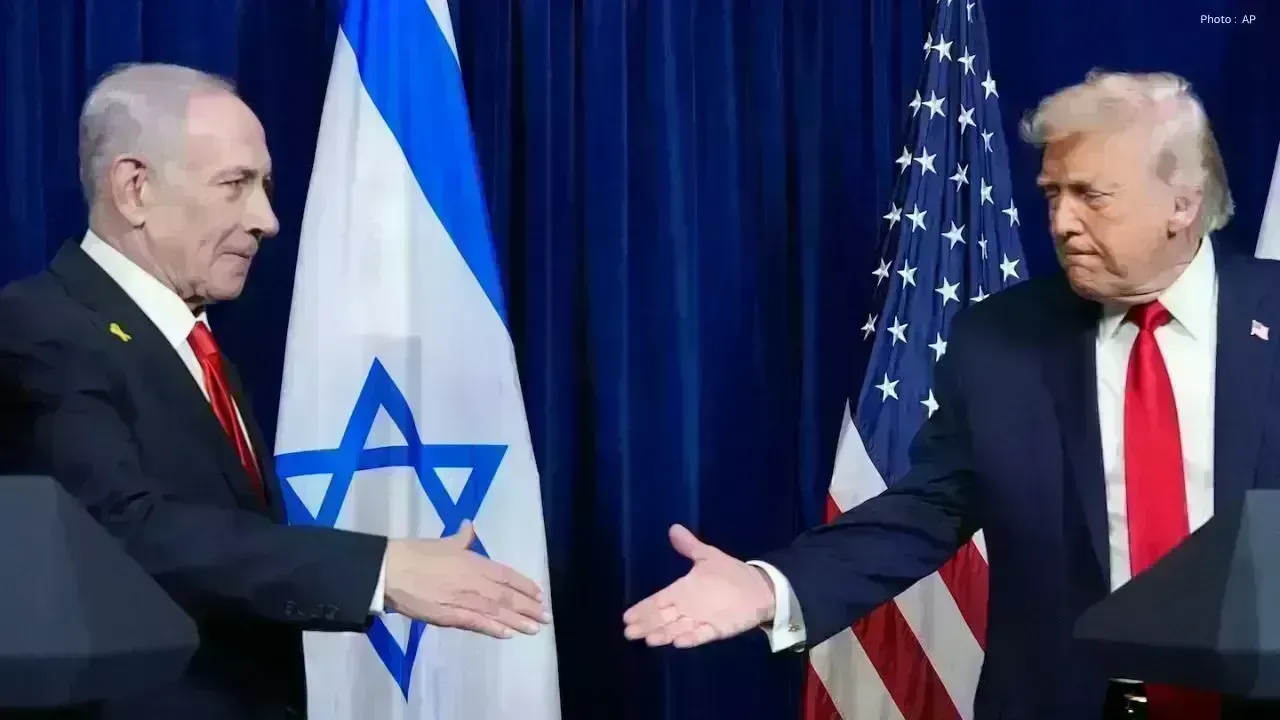
Recent developments highlight a growing divergence between Donald Trump and Benjamin Netanyahu regarding their strategies for addressing the ongoing Iran conflict, stirring concerns about future stability in the Middle East. Despite their strong alliance, the two leaders appear increasingly at odds over the most effective means to navigate this crisis.
The differences surfaced noticeably following a series of military actions and diplomacy concerning Iran. Reports hint that the U.S. administration advocates for restraint and a de-escalation of hostilities, while Netanyahu's government remains committed to a hardline military approach against perceived threats from Tehran and its allied factions.
This conflict has emerged as a pivotal international matter in 2026, drawing global scrutiny through military exchanges, missile strikes, and regional security anxieties. Initially, Washington and Jerusalem appeared united in their stance, but varying priorities have since complicated their partnership.
Avoiding broader regional warfare has become a chief concern for President Trump, who aims to maintain stability that would preserve international trade routes and ease energy price pressures. Any extended conflict risks destabilizing global economies and creating further challenges.
The White House is also keen to uphold diplomatic channels. U.S. officials underscore the importance of negotiation in mitigating risks and sidestepping larger confrontations, wary of unpredictable consequences from escalating military actions.
On the other hand, Prime Minister Netanyahu perceives Iranian military activities as an imminent security threat, pressing for ongoing military vigilance to secure Israel's national interests against potential future threats.
This strategic mismatch doesn't signal a decline in U.S.-Israeli collaboration; both countries still work closely in defense, intelligence, and security sectors. The current discord merely emphasizes how allies can pursue different strategies while jointly striving towards shared long-term objectives.
The Iran conflict's implications resonate throughout the Middle East, prompting heightened security measures across multiple nations, while global organizations keep a close watch. Issues concerning energy supplies, shipping routes, and economic stability remain critical for governments internationally.
The global financial markets also respond acutely to developments in this region. Heightening tensions trigger concerns over potential disruptions in oil production and transportation, influencing prices and generating uncertainty for businesses and consumers alike.
Moreover, the impact of this crisis on diplomatic relationships cannot be overstated. Ongoing military action complicates efforts to alleviate tensions, as building mutual trust requires time, open communication, and willingness to engage. Repeated military exchanges hinder this delicate process.
Political analysts suggest that the upcoming months will be crucial for peace and security in the Middle East. Choices made by Washington, Jerusalem, and Tehran will likely dictate whether the region leans towards diplomacy or braces for a renewed cycle of hostilities. The roles of major international players will also be pivotal in shaping the outcome.
Governments worldwide watch this situation closely due to its potential global ramifications. A stable Middle East is vital for international trade, energy security, and economic development, and any significant escalation could resonate far beyond regional borders.
Public sentiment additionally influences policymaking, with citizens globally monitoring developments and voicing concerns regarding safety, economic welfare, and the risk of broader conflict. Political leaders must navigate these public anxieties while making decisions that impact national and international interests.
The differing views of Trump and Netanyahu regarding the Iran conflict illustrate the complexities within modern diplomacy and security strategies. While both leaders acknowledge regional threats, they diverge in their approaches—one prioritizing diplomatic avenues and de-escalation, while the other emphasizes military deterrence.
As this situation continues to unfold, the global community will keenly observe whether diplomatic efforts can temper tensions or if fresh confrontations will arise, affecting the Middle East's future and influencing global security and economic stability for years ahead.










PM Modi Pays Tribute to Mahatma Gandhi, Urges People to Support Khadi
PM Modi pays tribute to Mahatma Gandhi on Gandhi Jayanti and urges citizens to support Khadi and the

Amazon Seeks to Offload $8 Billion in Nvidia Chips to Investors
Amazon plans to move $8 billion in Nvidia chips to investors, using a new financing model to strengt

Samsung Raises Galaxy S26 Prices as Memory Chip Costs Rise
Samsung raises Galaxy S26 prices in South Korea as rising memory chip costs put pressure on smartpho

Lewis Hamilton Calls Singapore Grand Prix One of F1's Toughest Races
Lewis Hamilton discusses the demanding Singapore Grand Prix and brings Plus44 and Almave to Singapor

Denmark's Pandora Opens World's Largest Jewellery Factory in Vietnam
Pandora opens its largest jewellery factory in Vietnam, expanding global production, strengthening s

Gautam Gambhir Questions Batting-Friendly Pitches After India's Record ODI Chase
Gautam Gambhir questions batting-friendly ODI pitches after India’s record chase, calling for a bett

