You have not yet added any article to your bookmarks!
Join 10k+ people to get notified about new posts, news and tips.
Do not worry we don't spam!

Post by : Anis Farhan
Micro, Small and Medium Enterprises are widely acknowledged as engines of employment, innovation, and local economic resilience. Across countries, they account for a significant share of jobs, exports, and entrepreneurial activity. Yet, despite their importance, MSMEs remain among the most financially vulnerable segments of the economy.
Credit stress among MSMEs is not a new phenomenon, but in recent years it has intensified. Rising input costs, demand fluctuations, delayed payments, and tightening financial conditions have exposed the fragile foundations on which many small businesses operate. Even as governments roll out credit schemes and policy support packages, the ground reality for many MSMEs remains unchanged.
This growing disconnect between policy intent and on-ground impact has made MSME credit stress a critical current affairs issue, frequently highlighted in economic editorials and policy debates.
Credit stress refers to the inability of businesses to access adequate financing on reasonable terms. For MSMEs, this can mean loan rejections, high interest rates, short repayment cycles, or dependence on informal lenders.
Unlike large corporations, MSMEs often lack strong balance sheets, collateral, or credit histories. As a result, even temporary cash flow disruptions can push them into financial distress.
Small businesses operate with thin margins and limited reserves. Any shock—be it a slowdown in demand, rise in raw material prices, or delayed customer payments—directly impacts their ability to service debt.
This vulnerability makes MSMEs particularly sensitive to tightening credit conditions.
Globally, the credit gap for MSMEs runs into trillions of dollars. Formal banking systems are unable or unwilling to meet the financing needs of small enterprises at scale.
This gap forces many MSMEs to rely on informal sources of finance, which are expensive, unreliable, and often exploitative.
Credit availability is not uniform. MSMEs in rural areas, traditional industries, or low-income regions face greater hurdles compared to those in urban centres or technology-driven sectors.
Women-led and first-generation enterprises face additional barriers, deepening inequality within the MSME ecosystem.
One of the most common policy tools is credit guarantee programmes, where governments share default risk with banks. These schemes are designed to encourage lending to MSMEs by reducing lender risk.
While such programmes have expanded credit flow on paper, their effectiveness on the ground has been mixed.
Governments have also offered interest subsidies to lower borrowing costs for MSMEs. In theory, this should make loans more affordable and attractive.
In practice, complex eligibility criteria and delayed reimbursements often dilute the impact.
During periods of crisis, emergency credit facilities are introduced to prevent widespread business closures. These measures provide short-term relief but often increase long-term debt burdens.
For many MSMEs, survival today comes at the cost of higher stress tomorrow.
Despite guarantees and incentives, banks remain risk-averse. Regulatory pressures, fear of non-performing assets, and limited understanding of MSME business models make lenders cautious.
As a result, credit often flows to relatively stronger MSMEs, leaving the most vulnerable enterprises excluded.
MSMEs are not a homogeneous group. A small manufacturing unit, a service provider, and a micro trader have very different financial needs.
Uniform policy frameworks fail to address this diversity, limiting effectiveness.
Many MSMEs operate partially or entirely outside formal systems. Limited documentation, cash-based transactions, and weak accounting practices reduce creditworthiness in the eyes of lenders.
Policy support cannot easily compensate for the absence of reliable financial data.
Large buyers often delay payments to small suppliers, choking MSME cash flows. Even profitable businesses struggle to repay loans when receivables are stuck.
This structural imbalance in buyer-supplier relationships remains largely unaddressed by credit-focused policies.
Rising costs of raw materials, energy, and logistics have eroded MSME margins. Higher costs increase working capital needs, pushing businesses to borrow more just to stay operational.
This amplifies credit stress rather than easing it.
Unlike large firms, MSMEs have limited ability to pass on higher costs to customers. Competitive pressures force them to absorb losses, weakening financial health.
Policy support rarely accounts for this imbalance.
When formal credit is inaccessible, MSMEs turn to informal lenders. These sources offer quick cash but at extremely high interest rates.
Over time, this creates a debt trap that formal policy measures struggle to undo.
Informal lenders understand local businesses, accept flexible documentation, and disburse funds quickly. Formal systems, by contrast, are often slow and rigid.
Unless these gaps are addressed, informal credit will continue to dominate.
Digital lending platforms promise faster credit decisions using alternative data such as transaction history and digital payments.
This could help bridge the MSME credit gap by bypassing traditional collateral-based models.
However, digital lenders often charge higher interest rates and operate in regulatory grey zones. Without safeguards, digital credit risks becoming another source of stress.
Technology alone cannot fix structural credit issues.
MSMEs are major employers. When credit stress forces them to cut back or shut down, job losses follow.
This directly affects household incomes and consumer demand, creating negative economic feedback loops.
A financially constrained MSME sector cannot invest, innovate, or scale. This limits productivity growth and weakens overall economic momentum.
The cost of MSME credit stress extends far beyond individual businesses.
Governments often highlight aggregate credit disbursal figures. These numbers do not reflect how many MSMEs actually benefit or whether the credit is sustainable.
High disbursal can coexist with high distress.
Many MSMEs take loans to survive, not to grow. This distinction is crucial but often overlooked in policy design.
True support should aim for stability, not just survival.
Ensuring timely payments from large buyers to MSMEs would significantly reduce working capital stress.
Policy enforcement in this area could be more impactful than additional credit schemes.
Financial products tailored to sector-specific needs, cash flow cycles, and risk profiles can improve credit outcomes.
Flexibility matters more than volume.
Non-banking lenders often have better reach and understanding of MSMEs. Supporting these institutions can expand credit access responsibly.
However, adequate regulation is necessary to prevent excessive risk-taking.
Combining public funds with private capital can reduce risk and attract investment into MSME lending.
Such models require careful design and oversight.
While access to finance is crucial, credit alone cannot fix structural weaknesses such as poor infrastructure, regulatory complexity, and market access issues.
Without addressing these, MSMEs remain vulnerable regardless of policy support.
MSME resilience depends on a supportive ecosystem that includes infrastructure, skills, technology, and fair market access.
Credit is only one piece of a larger puzzle.
If MSMEs are pushed into unsustainable borrowing, defaults will rise, affecting the broader financial system.
This creates a vicious cycle of tighter credit and deeper stress.
Credit stress disproportionately affects smaller and weaker enterprises, widening gaps between large corporations and small businesses.
This undermines inclusive growth.
Some countries have successfully improved MSME credit access through strong credit registries, invoice financing systems, and buyer-backed lending models.
These approaches focus on cash flow rather than collateral.
Institutional capacity, enforcement mechanisms, and financial literacy vary widely, making direct replication challenging.
Context-specific adaptation is essential.
Future policy must prioritise the quality and sustainability of credit rather than headline disbursal numbers.
This requires better data, monitoring, and feedback loops.
Trust deficits increase risk perception. Transparent systems, dispute resolution mechanisms, and financial education can help bridge this gap.
MSME credit stress is not a temporary disruption; it is a structural challenge rooted in how small businesses operate and how financial systems assess risk. While policy support has expanded in scale, its impact remains limited by design flaws, implementation gaps, and deeper economic realities.
Addressing MSME credit stress requires moving beyond headline schemes toward nuanced, ecosystem-based solutions that recognise the diversity and vulnerability of small enterprises. Without such a shift, policy support will continue to treat symptoms rather than causes, leaving the backbone of the economy under persistent strain.
Disclaimer:
This article is for informational purposes only and does not constitute financial, economic, or policy advice. Readers should consult qualified professionals or official sources before making business or investment decisions.







George Russell Wins Dutch GP Sprint, Boosts Mercedes Morale
George Russell wins the Dutch GP Sprint from pole as Mercedes teammate Kimi Antonelli extends his F1

Australia 50/3 After Bangladesh Bowled Out for 64 in Second Test
Australia reached 50/3 after Bangladesh were bowled out for 64 in the second Test, with Mitchell Sta

Jordan Burroughs Returns to Wrestling with 2028 Olympic Dream
Jordan Burroughs returns to wrestling with Real American Freestyle as the Olympic champion eyes a po

Lamborghini Catches Fire on Singapore's ECP, Causing Heavy Traffic
A Lamborghini caught fire on Singapore's ECP, causing heavy traffic and bus delays. No injuries were

Bangkok Airport Duty-Free Area Flooded by Pipe Burst
A burst water pipe flooded the duty-free shopping area at Bangkok's Suvarnabhumi Airport on July 16,
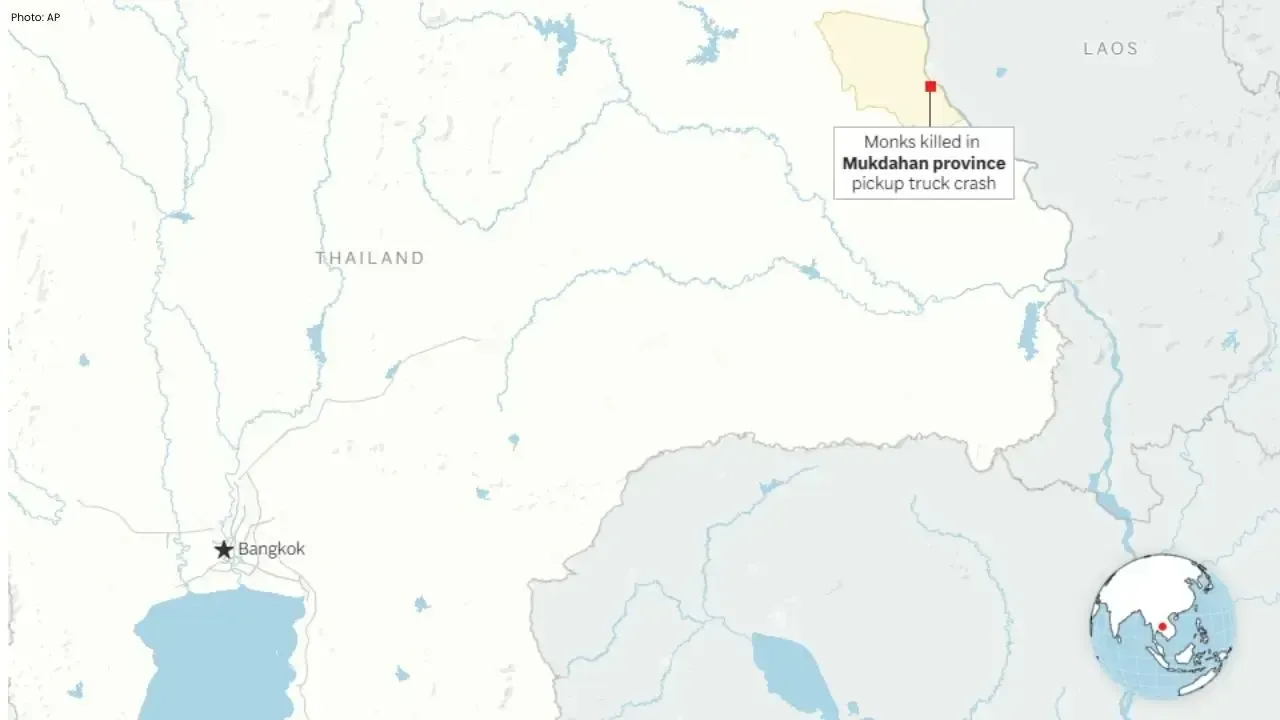
Nine Monks Killed in Thailand Pickup Truck Tragedy
An 11-year-old boy driving a pickup truck crashed into monks during a pilgrimage in northeastern Tha