
You have not yet added any article to your bookmarks!
Join 10k+ people to get notified about new posts, news and tips.
Do not worry we don't spam!
Post by : Abhinav Rana
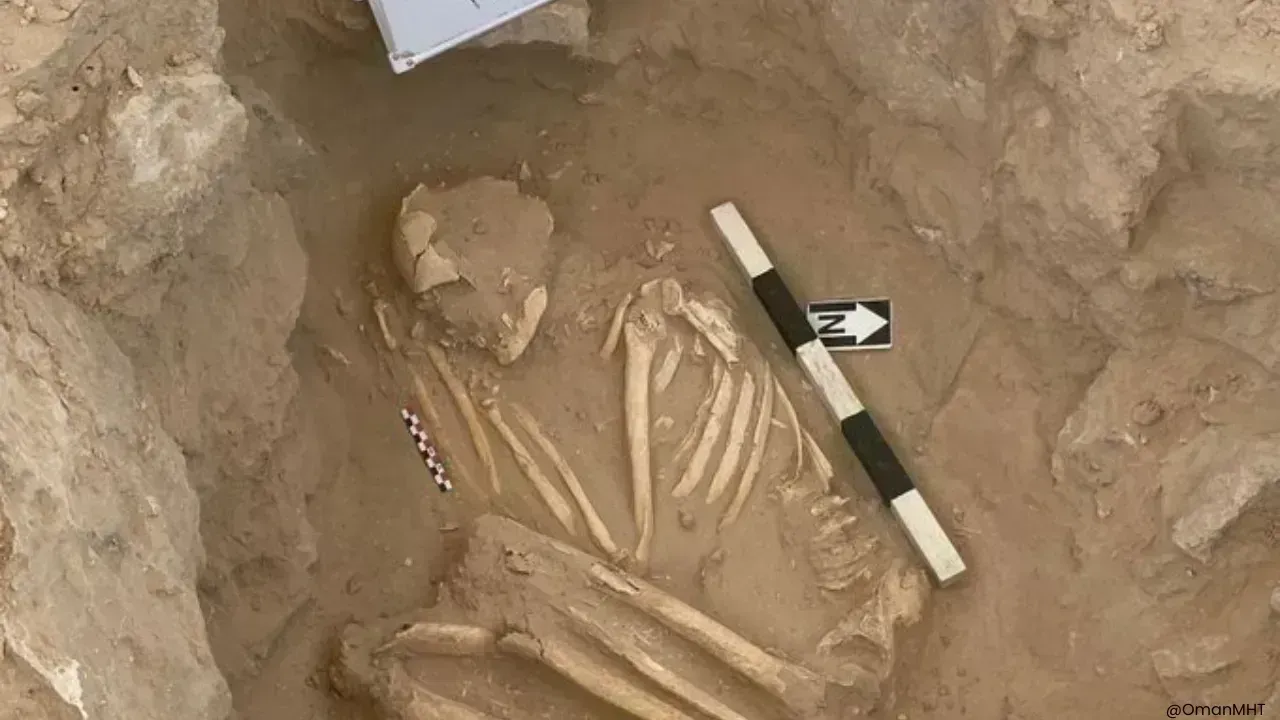
Photo : X / @OmanMHT
In a remarkable turn of events, routine road work in Oman has unveiled 3,000-year-old graves, opening a window into an ancient world and its burial customs. Initially part of a routine survey, the excavations have transformed into a significant archaeological discovery, shedding light on the cultural practices and social dynamics of early Omani civilization. This finding underscores the intersection between modern infrastructure development and the preservation of historical sites, redefining how societies approach growth alongside heritage retention.
The excavation spans three sites over nearly 14 kilometers, unveiling at least ten graves that date back to the late second millennium and early first millennium BCE. Noteworthy among the discoveries were human skeletons positioned in crouched postures, indicative of ancient funerary traditions that reflect deep-seated cultural beliefs surrounding life and death. Additionally, various artefacts such as shells, beads, and animal bones were discovered, likely included in the burials as symbolic offerings, offering insights into spiritual practices and social beliefs of the time.
The crouched positions of the remains, paired with the associated ritual items, suggest a highly developed funerary tradition in ancient Oman. This indicates that burial practices were not merely practical, but also deeply intertwined with societal beliefs and identity. Evidence from the Oman peninsula illustrates the evolution of burial customs, which adapted as social structures shifted and trade expanded. The new graves provide further context to this history, confirming ancient Omani societies' connection to wider regional interactions and shared cultural motifs. Such findings are vital for piecing together the early human settlement narrative, showcasing Oman as a crucial cultural and trade link in the Arabian Peninsula.
Remarkably, this discovery’s location along a contemporary coastal road highlights a growing global phenomenon where development projects reveal archaeological treasures, necessitating a careful balance between progress and preservation. Omani authorities have increasingly focused on integrating archaeological evaluations in development plans, ensuring historical sites are documented and conserved amid construction. This proactive approach not only protects cultural heritage but also reinforces national identity by linking modern advancements with ancient legacies. It signifies an urgent need for the transportation and infrastructure sectors to incorporate heritage management into planning, ensuring economic growth does not sacrifice historical integrity.
These recent findings further enrich Oman’s archaeological narrative, recognized for hosting significant Bronze Age sites. From monumental mausoleums to ancient urban settlements, the landscape continues to yield evidence of advanced civilizations from millennia past. Such discoveries are of great academic value and offer potential for cultural tourism and international collaboration in research, positioning Oman as a premier destination for archaeological pursuits.
As analysis of the newly revealed graves and artefacts progresses, further insights are anticipated, promising to enhance our comprehension of early human existence in the region. Each discovery brings historians closer to reconstructing the social, cultural, and economic frameworks of ancient Oman. For contemporary society, this finding serves as a potent reminder that beneath modern infrastructure lies a profound and intricate history awaiting exploration, urging us to balance progress with preservation.
#Oman News #Oman Archaeology #Ancient Graves #Cultural Heritage #Middle East History #Excavation










PM Modi Pays Tribute to Mahatma Gandhi, Urges People to Support Khadi
PM Modi pays tribute to Mahatma Gandhi on Gandhi Jayanti and urges citizens to support Khadi and the

Amazon Seeks to Offload $8 Billion in Nvidia Chips to Investors
Amazon plans to move $8 billion in Nvidia chips to investors, using a new financing model to strengt

Samsung Raises Galaxy S26 Prices as Memory Chip Costs Rise
Samsung raises Galaxy S26 prices in South Korea as rising memory chip costs put pressure on smartpho

Lewis Hamilton Calls Singapore Grand Prix One of F1's Toughest Races
Lewis Hamilton discusses the demanding Singapore Grand Prix and brings Plus44 and Almave to Singapor

Denmark's Pandora Opens World's Largest Jewellery Factory in Vietnam
Pandora opens its largest jewellery factory in Vietnam, expanding global production, strengthening s

Gautam Gambhir Questions Batting-Friendly Pitches After India's Record ODI Chase
Gautam Gambhir questions batting-friendly ODI pitches after India’s record chase, calling for a bett

