You have not yet added any article to your bookmarks!
Join 10k+ people to get notified about new posts, news and tips.
Do not worry we don't spam!
Post by : Anis Farhan
When most people think of Asia’s cultural treasures, their minds drift to towering pagodas, golden spires, and bustling pilgrimage sites. But some of the region’s most remarkable and mysterious marvels rest far from the tourist trail — hidden under the ocean’s surface. These underwater temples, ranging from centuries-old shrines to vast sacred complexes, are more than relics; they are storytellers of a different era, frozen in time by tides, earthquakes, and sometimes human intervention.
Across Asia, these submerged sanctuaries attract a unique blend of interest — from divers seeking breathtaking sights, to archaeologists piecing together lost histories, to locals who still revere them as sacred despite their watery resting places. Each site carries its own origin story, blending documented history with captivating myths, often tied to tales of wrathful gods, sunken kingdoms, or the shifting forces of nature.
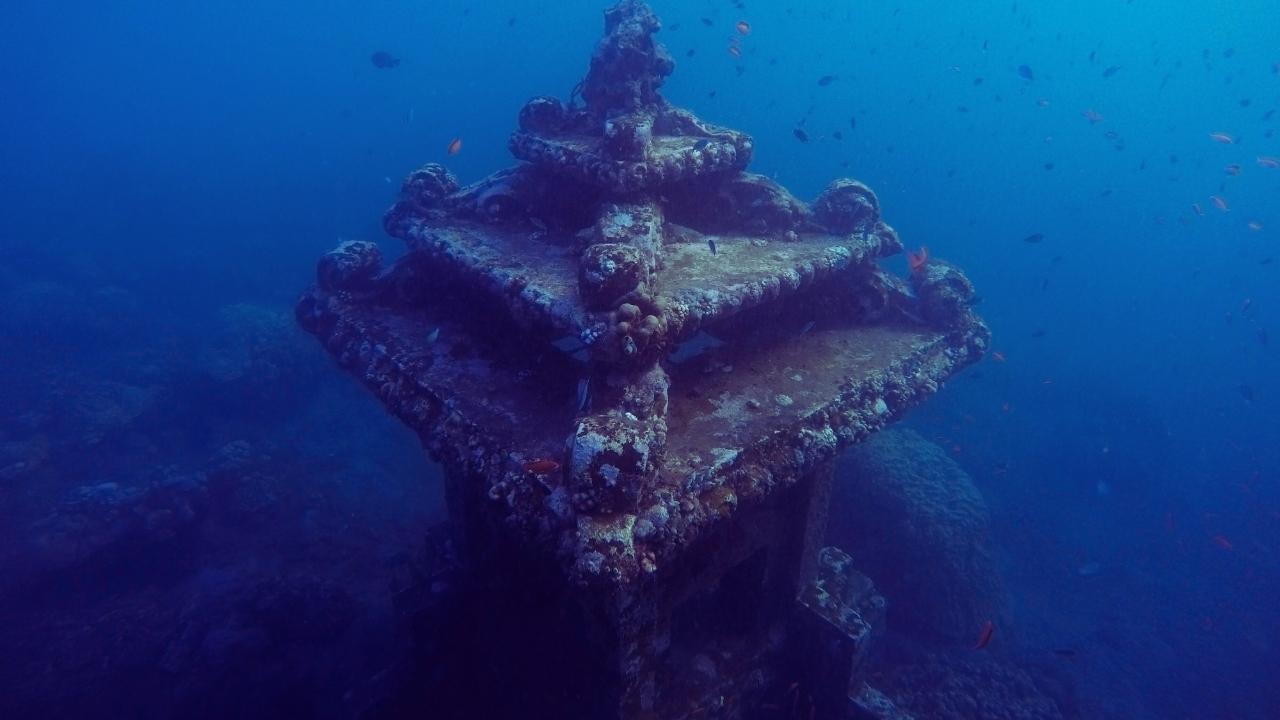
Just off the coast of Pemuteran in Bali lies one of the most visually striking underwater temple gardens in Southeast Asia. This site, unlike some others, is not entirely ancient — it was intentionally created in the early 2000s as part of a coral restoration project. Yet it holds immense cultural resonance.
The garden is dotted with stone statues of deities, gates reminiscent of traditional Balinese temple entrances, and intricate carvings slowly being enveloped by vibrant corals. Statues of Ganesha, Buddha, and local sea spirits stand surrounded by schools of tropical fish, their features softened by marine growth over time.
Although modern in construction, its purpose extends beyond aesthetics. It demonstrates how culture and environmental care can merge, creating not just a diving attraction but also a habitat that helps repair marine biodiversity lost to overfishing and coral bleaching. Local Balinese communities see it as a living temple — one where the ocean itself is the caretaker.
Cambodia’s Tonle Sap Lake, the largest freshwater lake in Southeast Asia, is a lifeline for millions. But beneath its waters lie remnants of old temples from the Khmer Empire. One of the most intriguing submerged ruins is believed to date back to the same period as Angkor Wat, although its visibility depends on the seasonal rise and fall of water levels.
During the dry season, parts of the stone structures emerge, hinting at their former grandeur. During the wet season, they vanish beneath the water, hidden from view but not from memory. Local folklore speaks of a once-thriving village and a revered temple that sank following a flood seen as divine punishment. While archaeologists have yet to fully excavate the site, sonar mapping has revealed outlines of walls and towers, indicating an elaborate design typical of Khmer religious architecture.
Southwest of Japan’s Okinawa Islands lies the Yonaguni Monument, a colossal underwater rock formation discovered in 1986 by a diver. While it may not be a “temple” in the conventional sense, its stepped terraces, symmetrical walls, and pyramid-like structure have fueled debates for decades. Some researchers believe it to be a naturally eroded formation; others argue it’s the remains of a 10,000-year-old sunken city or ceremonial site.
Proponents of the man-made theory point to what appears to be staircases, platforms, and even carvings resembling animals and symbols. If true, it would predate known civilizations in the region and rewrite significant parts of human history. Regardless of its origins, Yonaguni draws divers, historians, and mystery-seekers alike, offering an otherworldly experience of gliding through geometric stone corridors under the sea.
The famous Prambanan Temple in Yogyakarta, Indonesia, is known worldwide for its intricate Hindu architecture. Yet few know that local legends speak of another Prambanan-like structure submerged under the waters of Rawa Pening Lake in Central Java.
While archaeological evidence remains scarce, occasional low water levels reveal stone blocks and carved fragments resembling temple walls. Some villagers believe the lake was formed when an underground spring burst open, flooding a once-prosperous city. The story mirrors many Southeast Asian flood myths, where human pride or neglect of divine duties leads to catastrophic submersion.
No discussion of submerged sacred sites in Asia is complete without Dwarka, an ancient city mentioned in Hindu scriptures as the kingdom of Lord Krishna. Located off the coast of Gujarat, the underwater ruins discovered here include walls, streets, and large stone anchors, some estimated to be over 9,000 years old.
Marine archaeologists have found pottery shards, structures resembling temples, and evidence of a planned urban settlement. While historians debate the connection between these ruins and the mythological Dwarka, the site’s significance is undeniable. It offers a rare intersection of mythology, religious reverence, and scientific investigation. For pilgrims, the waters off Dwarka are holy; for researchers, they are a submerged puzzle waiting to be solved.
Underwater archaeological preservation is no easy task. These sites face threats from natural erosion, strong currents, storms, and the ever-increasing effects of climate change. Rising sea temperatures accelerate coral bleaching and biological growth on stone surfaces, sometimes obscuring carvings beyond recognition.
There’s also the human factor. While tourism brings awareness and economic benefit to local communities, unregulated diving can lead to physical damage to fragile structures. Looting is another concern — artifacts retrieved illegally not only rob the sites of historical context but also disrupt cultural heritage.
To combat this, countries across Asia are employing underwater mapping technology, protective legislations, and controlled tourism initiatives. In some cases, virtual reality (VR) models of submerged temples allow global audiences to explore them without disturbing their fragile environments.
Unlike ruins on land, underwater temples require an entirely different form of pilgrimage. Visitors must don diving gear, learn safety protocols, and navigate often unpredictable waters. This journey, for many, adds to the spiritual depth of the experience.
In Bali, local priests occasionally conduct blessing rituals at shorelines before divers enter temple waters. In India’s Dwarka, pilgrims still perform prayers facing the submerged ruins, believing their spiritual energy transcends the physical barrier of water. In Cambodia, fishermen pause their nets near certain submerged shrines out of respect, believing the spirits protect their livelihoods.
Such traditions highlight how these sites are not just relics of the past but living parts of cultural identity, even when invisible beneath the waves.
Advancements in marine exploration are rapidly changing our understanding of underwater heritage. Autonomous underwater vehicles (AUVs), 3D sonar mapping, and deep-sea drones are revealing details of submerged temples once thought impossible to study.
This opens doors not only for academic research but also for storytelling — allowing films, documentaries, and interactive museum exhibits to bring these hidden wonders to a global audience. The more awareness grows, the stronger the push for preservation becomes.
However, experts warn that time is running out. Without coordinated international efforts, rising sea levels and environmental degradation could erase much of this heritage within a century. Protecting underwater temples is not simply about saving stones; it is about safeguarding the stories, beliefs, and artistry of civilizations that thrived long before ours.
This article is intended for informational purposes, combining historical research, archaeological findings, and cultural perspectives. While care has been taken to present accurate information, some details are based on local folklore and remain subjects of academic debate.









Lamborghini Catches Fire on Singapore's ECP, Causing Heavy Traffic
A Lamborghini caught fire on Singapore's ECP, causing heavy traffic and bus delays. No injuries were

Bangkok Airport Duty-Free Area Flooded by Pipe Burst
A burst water pipe flooded the duty-free shopping area at Bangkok's Suvarnabhumi Airport on July 16,

Nine Monks Killed in Thailand Pickup Truck Tragedy
An 11-year-old boy driving a pickup truck crashed into monks during a pilgrimage in northeastern Tha

Anwar Congratulates Xi on CPC's 105th Anniversary
Malaysia reaffirms strong ties with China as PM Anwar Ibrahim sends a congratulatory letter to Presi
Thai Agriculture Team Reviews 2026 Farm Development Plans
Agriculture Ministry officials inspected livestock and organic rice projects in Nakhon Sawan to moni

Thailand, Canada Boost Ties in PM-Level Phone Talks
Thailand and Canada agreed to strengthen trade, security, OECD cooperation and ASEAN-Canada FTA talk