
You have not yet added any article to your bookmarks!
Join 10k+ people to get notified about new posts, news and tips.
Do not worry we don't spam!
Post by : Meena Ariff
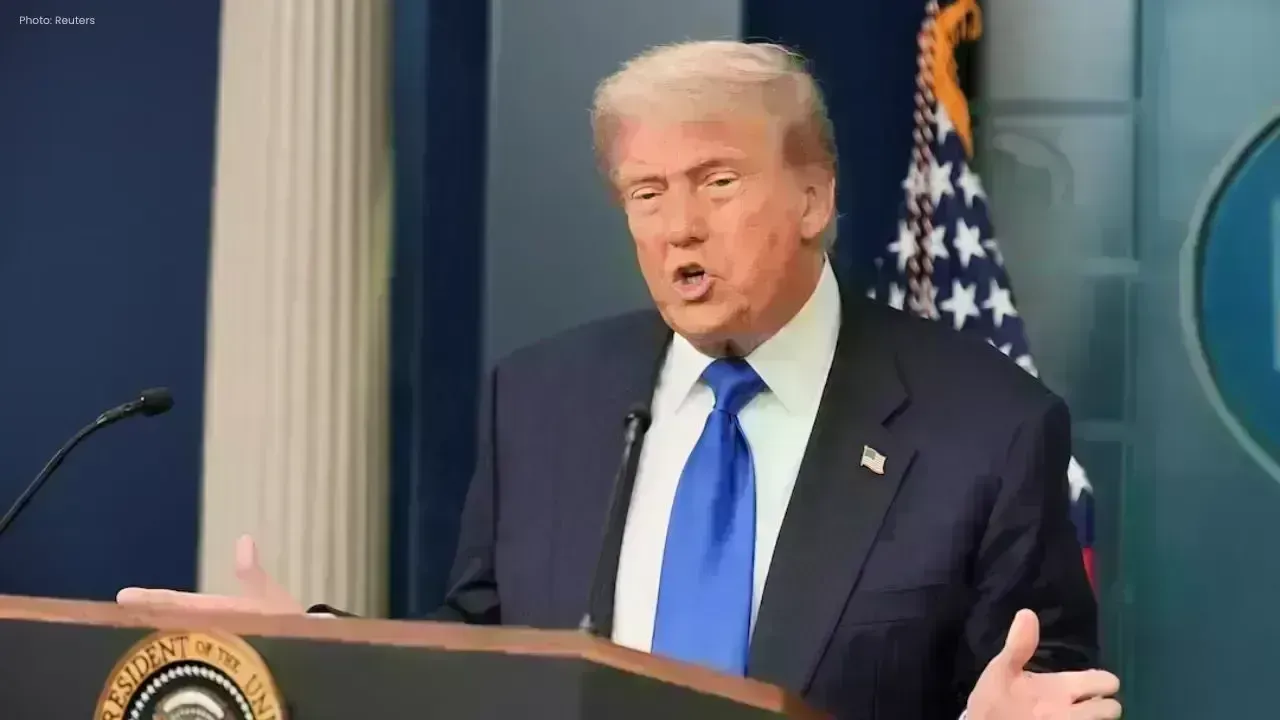
US President Donald Trump on Friday strongly criticised Canada after it rejected his proposed “Golden Dome” missile defence project linked to Greenland. Trump claimed the system would have also protected Canada, but accused the country of moving closer to China instead of supporting US-backed security plans.
Posting on Truth Social, Trump said Canada opposed the Golden Dome despite the protection it could provide. He also warned that Canada’s growing trade and business links with China could lead to major risks for the country. Trump went as far as claiming that China could “eat them up” within a year.
The fresh comments come at a time when relations between the US and Canada are turning more tense. The situation escalated further after Canadian Prime Minister Mark Carney’s recent remarks at the World Economic Forum (WEF) in Davos.
During his appearance at the 56th Annual WEF Summit, Carney spoke about the world entering a period of increased global rivalry. He also highlighted concerns over economic pressure tactics and suggested that the traditional rules-based global order is weakening. His remarks were seen as an indirect criticism of Washington’s approach, especially amid discussions linked to Greenland.
Trump responded sharply to Carney’s statements, saying Canada should be more thankful to the United States. He claimed that Canada receives major benefits from the US, including strong security support, and argued that Canada should acknowledge the protection it gets from its southern neighbour.
In his comments, Trump also made a strong statement about Canada’s dependence on the US, saying the country survives because of American support. He directed his remarks specifically at Carney, asking him to remember America’s strategic importance when making public comments.
Meanwhile, Canada recently announced a new trade agreement with China. Prime Minister Carney said the deal is expected to open up more than $7 billion in export markets for Canadian workers and businesses. According to Canada’s government, the aim is to diversify trade partnerships and strengthen the economy during a period of global uncertainty.
Reports say Canada has agreed to reduce its tariff on Chinese electric vehicles, which had been set at 100 per cent. In exchange, China is expected to lower tariffs on key Canadian agricultural exports, including canola seeds.
Under the plan, Canada would place an annual cap of 49,000 Chinese EVs entering the country, with the limit rising gradually to around 70,000 over the next five years. On the other side, China would reduce its tariff on canola seeds from 84 per cent to roughly 15 per cent.
Carney also stated that Canada’s recent engagement with China has delivered clearer outcomes. He described China as a more predictable partner compared to the United States, especially as Canada continues to face heavy trade pressure from Washington.
Canada is currently affected by high US tariffs, including a 35 per cent levy on Canadian goods. It is also impacted by broader import duties such as 50 per cent on metals and 25 per cent on non-US automobiles.
At the same time, US-China trade tensions remain ongoing. Both sides have previously threatened steep tariffs, but after a meeting between Trump and Chinese President Xi Jinping, parts of the planned tariffs were put on hold for select products until November 10, 2026.
The latest war of words from Trump adds further strain to US-Canada ties, especially as Canada pushes for stronger trade links outside the US and seeks more economic flexibility in a changing global environment.










PM Modi Pays Tribute to Mahatma Gandhi, Urges People to Support Khadi
PM Modi pays tribute to Mahatma Gandhi on Gandhi Jayanti and urges citizens to support Khadi and the

Amazon Seeks to Offload $8 Billion in Nvidia Chips to Investors
Amazon plans to move $8 billion in Nvidia chips to investors, using a new financing model to strengt

Samsung Raises Galaxy S26 Prices as Memory Chip Costs Rise
Samsung raises Galaxy S26 prices in South Korea as rising memory chip costs put pressure on smartpho

Lewis Hamilton Calls Singapore Grand Prix One of F1's Toughest Races
Lewis Hamilton discusses the demanding Singapore Grand Prix and brings Plus44 and Almave to Singapor

Denmark's Pandora Opens World's Largest Jewellery Factory in Vietnam
Pandora opens its largest jewellery factory in Vietnam, expanding global production, strengthening s

Gautam Gambhir Questions Batting-Friendly Pitches After India's Record ODI Chase
Gautam Gambhir questions batting-friendly ODI pitches after India’s record chase, calling for a bett

