
You have not yet added any article to your bookmarks!
Join 10k+ people to get notified about new posts, news and tips.
Do not worry we don't spam!
Post by : Rameen Ariff
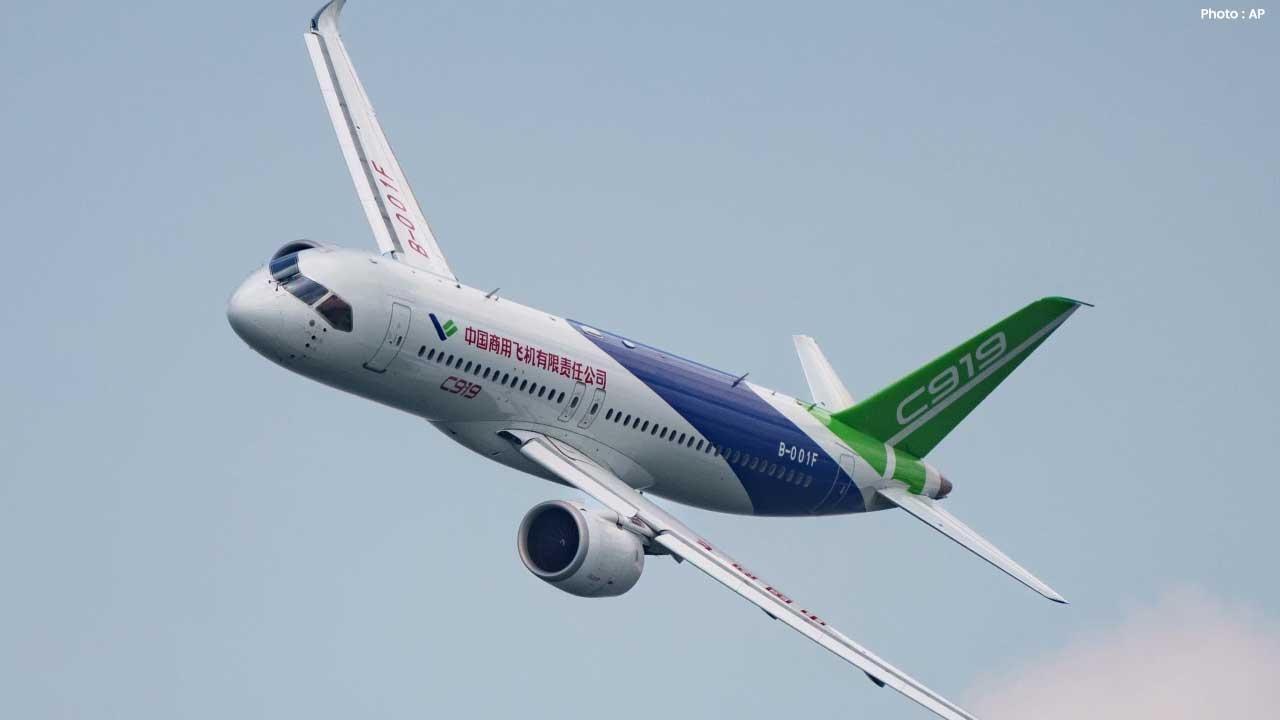
China’s drive to build a domestic challenger to Boeing and Airbus through the C919 program is running into fresh obstacles as rising trade tensions with the United States increasingly threaten production schedules and delivery targets. The jet, produced by state-owned COMAC, won attention after its first commercial flights in 2023, but its expansion now faces fresh uncertainty.
Although marketed as China’s homegrown single-aisle airliner, the C919 relies on numerous Western-made parts. Dozens of suppliers in the U.S. and Europe provide critical components, leaving the programme exposed to shifting export rules and geopolitical pressure that complicate sourcing for avionics, systems and engines.
Industry observers warn the aircraft remains vulnerable to policy moves. As Max Zenglein, senior economist at The Conference Board, put it, COMAC’s supply chain is subject to “export controls and geopolitical leverage.” Production was affected earlier this year when clearance for key parts, including the LEAP-1C engine developed by GE Aerospace and Safran, faced pauses tied to U.S. export approvals.
COMAC’s targets underline the gap between ambition and delivery. The company has set sights on producing about 30 jets by 2025, yet only seven units have been handed over so far this year. Major Chinese carriers such as Air China, China Eastern and China Southern operate roughly 20 C919s in total, underscoring the program’s slow scale-up.
Analysts say the programme still has a long road ahead if it hopes to compete globally. “Beyond manufacturing, the C919 needs robust economics, international service networks and third-party certification,” said Richard Aboulafia of AeroDynamic Advisory. Without approvals from regulators like the FAA or EASA, the jet’s operations remain largely confined to domestic airspace.
Meanwhile, Western rivals are consolidating their foothold in China. Airbus plans a second A320 assembly line by 2026 to raise output of its single-aisle family, keeping competitive pressure on COMAC. Experts suggest the late 2020s could see stronger domestic adoption of the C919, but overturning the Boeing-Airbus duopoly worldwide will take years and depend on easing export-control hurdles.
Despite these constraints, Beijing continues to back the C919 as a strategic industrial priority. More than a commercial aircraft, the programme is portrayed as a marker of technological self-reliance. Observers will be watching closely to see if the C919 can overcome supply-chain and regulatory barriers to expand beyond China’s skies.









Michael Bracewell Chooses Casual Contract, Targets BBL Opportunity
Michael Bracewell moves to a casual contract as he eyes a BBL opportunity while remaining available

Tuchel Says Alex Scott Can Challenge Declan Rice for England Midfield Spot
Thomas Tuchel says Alex Scott can challenge Declan Rice for an England midfield place after his impr

Air Quality Turns Unhealthy in Central and Western Singapore Amid Haze
Singapore haze pushes PSI above 100 in central and western areas as smoke from regional hotspots rai

PM Modi Pays Tribute to Mahatma Gandhi, Urges People to Support Khadi
PM Modi pays tribute to Mahatma Gandhi on Gandhi Jayanti and urges citizens to support Khadi and the

Amazon Seeks to Offload $8 Billion in Nvidia Chips to Investors
Amazon plans to move $8 billion in Nvidia chips to investors, using a new financing model to strengt

Samsung Raises Galaxy S26 Prices as Memory Chip Costs Rise
Samsung raises Galaxy S26 prices in South Korea as rising memory chip costs put pressure on smartpho

