
You have not yet added any article to your bookmarks!
Join 10k+ people to get notified about new posts, news and tips.
Do not worry we don't spam!
Post by : Anis Farhan
On February 17, 2026, millions of skywatchers across India and other parts of the world will have the opportunity to witness a spectacular astronomical phenomenon : a solar eclipse. Solar eclipses occur when the Moon passes between the Earth and the Sun, partially or totally blocking the Sun’s light for observers located in certain areas. This rare alignment creates breathtaking visual effects, capturing public imagination, scientific interest, and cultural significance alike.
The 2026 solar eclipse promises to be particularly noteworthy because its visibility will span several time zones and regions, including expansive parts of India. Astronomy enthusiasts, students, and the general public are preparing to mark their calendars with precise observation times and get ready with safe viewing techniques recommended by experts.
In this detailed guide, we explain the visibility timeline across Indian cities and states, how the eclipse will unfold at different phases, and best practices for watching without harming your eyesight.
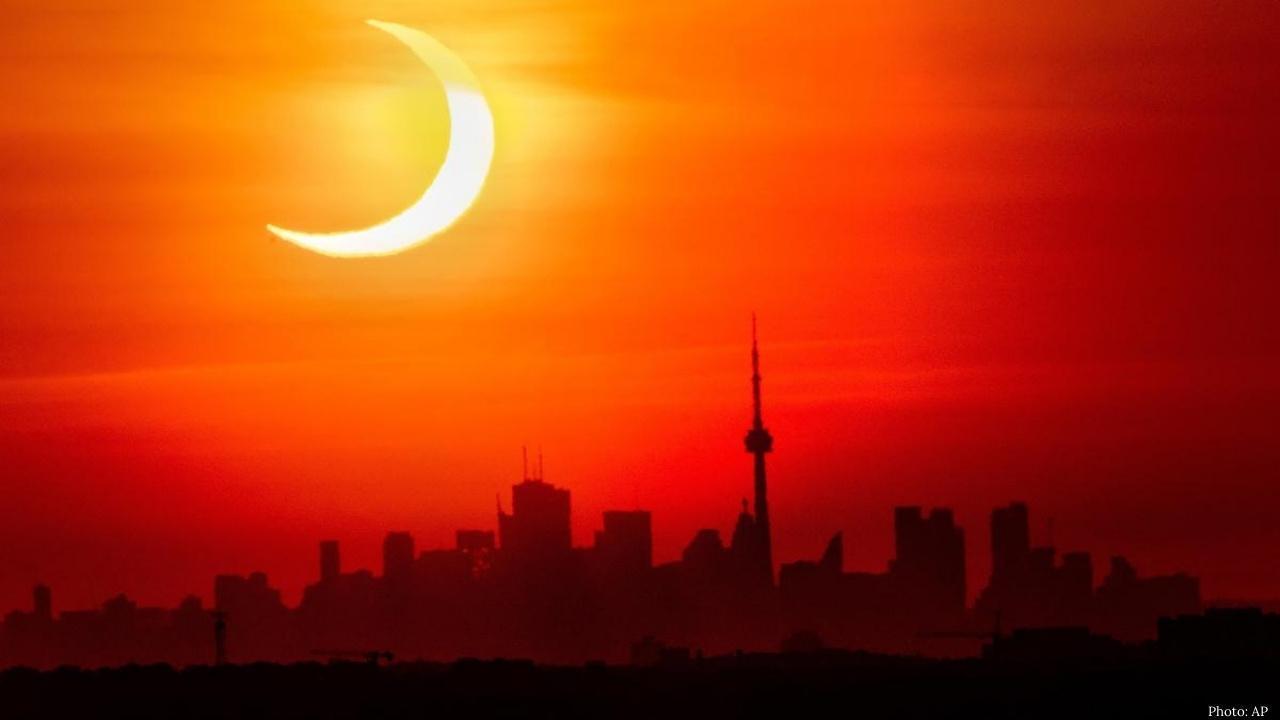
The solar eclipse on February 17, 2026 is classified as a partial solar eclipse for observers in India. In a partial eclipse, only a portion of the Sun’s disc is obscured by the Moon, rather than a total eclipse where the Sun is completely covered.
This means that while the dramatic “totality” effect won’t occur in India, a substantial portion of the solar disc will still be hidden from view in many regions — creating a visible darkening of the Sun for those watching from the right locations.
Astronomers note that the extent of the Sun’s coverage by the Moon will vary based on how far east or west one is located in India, as well as how far north or south one is relative to the central line of the eclipse path.
According to astronomical data, the partial solar eclipse will be visible at slightly different local times across the country. The broad timeline is as follows:
Start of Eclipse: The Moon begins to move in front of the Sun in the early afternoon hours (local time).
Maximum Coverage: Mid-afternoon, when the largest portion of the Sun is obscured.
End of Eclipse: Later in the afternoon as the Moon continues its orbit and the Sun re-emerges fully.
Exact times — such as first contact, maximum eclipse and last contact — vary depending on the observer’s location.
For example, in northern and western parts of India, the eclipse will begin, reach peak coverage and conclude several minutes before it does in eastern and southern regions, due to Earth’s rotation and the geometry of the Moon’s shadow movement.
Astronomy clubs and observatories across India are publishing detailed time tables specific to cities such as Delhi, Mumbai, Kolkata, Chennai, Bengaluru, Lucknow, Jaipur and Guwahati to help skywatchers plan their observations precisely.
The percentage of the Sun’s visible surface that will be covered by the Moon differs from one Indian city to another.
In general:
Northwestern India (including parts of Rajasthan and Punjab) will see a higher percentage of solar coverage — with up to 40–50 percent of the Sun obscured at peak.
Eastern and Northeastern states may see slightly lower coverage — typically around 30–40 percent.
Southern India will witness a moderate to significant partial eclipse, with coverage levels also varying based on latitude and longitude.
Astronomers emphasise that even a small percentage of solar obscuration can still be dramatic to watch when viewed with proper eye protection.
Unlike total eclipses — which are only visible along strictly defined narrow paths — partial eclipses can be seen across broader geographical regions. For India, this solar eclipse offers an excellent opportunity for millions of people to engage with an astronomical event that builds both scientific curiosity and cultural appreciation.
Schools, colleges, planetariums, and amateur astronomy clubs across the country are organising viewing sessions, educational talks, and community gatherings timed with the eclipse.
Some regions close to the eclipse’s central path — which crosses southern regions of the Indian Ocean and parts of Antarctica — will experience higher degrees of obscuration and more dramatic visual effects, though these lie outside India’s mainland.
The Sun’s rays are extremely powerful, and even when partially obscured by the Moon, they can cause permanent eye damage or blindness if viewed directly without proper protection.
Experts emphasise that unaided direct viewing of the Sun is unsafe, even during a partial eclipse.
Specialised eclipse glasses or solar viewing glasses with certified filters are safe and affordable tools that let you observe the Sun without risking eye injury. Only glasses meeting international safety standards — such as ISO 12312-2 — should be used.
It’s important to inspect eclipse glasses before use. If the lenses are scratched, damaged, or older than a few years, they may not provide adequate protection.
In addition to glasses, telescopes, binoculars or camera lenses equipped with proper solar filters allow for magnified viewing or photography of the event. These filters must be securely attached to the front of the optical device, not simply held in front of the eyepiece.
A safe indirect method of viewing a solar eclipse is by using a pin-hole projector — a simple device that projects an image of the Sun onto a screen or flat surface. This technique allows viewers to study the eclipse without ever looking at the Sun directly.
The pin-hole method involves casting the Sun’s image through a small opening onto a piece of white cardboard or paper, which shows the changing shape of the Sun as the eclipse progresses.
Many educational and scientific groups across India are hosting organised eclipse-viewing events where equipment like telescopes with solar filters, projection screens and expert commentary are provided to the public. These events offer safe, guided experiences and are especially popular with students and families.
Photography of solar eclipses can be rewarding but requires strong safety measures. Ordinary camera lenses must never be pointed at the Sun without a specialised solar filter because intense sunlight can damage the camera sensor and the photographer’s eyes.
Fixed-lens cameras, smartphones and tablets can also be equipped with safe solar filters designed to block harmful rays. Some photography enthusiasts may choose to use tripods and remote shutter triggers to capture stable images over the course of the eclipse.
While the 2026 event is a partial eclipse for India, solar eclipses of any kind offer scientists and learners valuable opportunities to observe celestial mechanics and the dynamics of Earth-Moon-Sun alignment.
Researchers may study:
Solar limb darkening
Photospheric activity
Variations in solar intensity
Atmospheric effects during partial coverage
Educational programmes often use eclipses to explain orbital dynamics, scale of celestial bodies, and the nature of astronomical observation.
Across India, educational institutions are preparing their communities to take advantage of this rare astronomical event. Teachers are incorporating solar science and eclipse demonstrations into curricula, organising viewing sessions and encouraging student participation.
Planetariums and science museums are also scheduling special lectures and viewing simulators that explain the science of eclipses, how they occur, and why they matter.
Even though most of India will experience only a partial eclipse, other regions along the eclipse’s path — particularly parts of the Indian Ocean and Antarctica — will witness more significant obscuration. Along the central path of the eclipse, observers may see near-total coverage, though these areas are largely unpopulated or remote.
Astronomers often travel to locations along the central path to obtain enhanced data and dramatic visual recordings of eclipses, contributing to global scientific knowledge.
Solar eclipses have been observed by civilizations for millennia, inspiring mythologies, scientific breakthroughs, and cultural traditions. Today, eclipses remain powerful reminders of Earth’s place in the cosmos and humanity’s ability to predict and understand celestial events with precision.
The 2026 eclipse, visible across many parts of India, represents not just a fleeting astronomical alignment, but a chance for collective wonder and shared experience, bringing people together to look up and appreciate the movements of the Moon and the Sun that govern our days and nights.
The Solar Eclipse of February 17, 2026 will be a remarkable event for millions of people in India. Though it will not be a total eclipse within the country, the partial obscuration of the Sun offers an exciting opportunity to connect with astronomy, learn more about our solar system, and safely enjoy a rare celestial show.
With careful planning, appropriate safety measures, and community engagement, the eclipse promises to be an inspiring moment — one that encourages curiosity, scientific learning, and appreciation of the natural world.
This article is intended for informational purposes only. Solar observations should always be done with proper eye protection and safety measures. Incorrect viewing methods can cause permanent eye damage.










PM Modi Pays Tribute to Mahatma Gandhi, Urges People to Support Khadi
PM Modi pays tribute to Mahatma Gandhi on Gandhi Jayanti and urges citizens to support Khadi and the

Amazon Seeks to Offload $8 Billion in Nvidia Chips to Investors
Amazon plans to move $8 billion in Nvidia chips to investors, using a new financing model to strengt

Samsung Raises Galaxy S26 Prices as Memory Chip Costs Rise
Samsung raises Galaxy S26 prices in South Korea as rising memory chip costs put pressure on smartpho

Lewis Hamilton Calls Singapore Grand Prix One of F1's Toughest Races
Lewis Hamilton discusses the demanding Singapore Grand Prix and brings Plus44 and Almave to Singapor

Denmark's Pandora Opens World's Largest Jewellery Factory in Vietnam
Pandora opens its largest jewellery factory in Vietnam, expanding global production, strengthening s

Gautam Gambhir Questions Batting-Friendly Pitches After India's Record ODI Chase
Gautam Gambhir questions batting-friendly ODI pitches after India’s record chase, calling for a bett

