You have not yet added any article to your bookmarks!
Join 10k+ people to get notified about new posts, news and tips.
Do not worry we don't spam!
Post by : Anis Farhan
The North Atlantic Treaty Organization enters 2026 with Eastern Europe placed at the heart of its military and political planning. The alliance, originally built as a collective defense mechanism, is now reshaping its role to respond to a security landscape that remains tense and unpredictable. Over recent years, the eastern flank — stretching from the Baltic Sea to the Black Sea — has witnessed increased military activity, cyber intrusions, and persistent geopolitical friction. These factors have compelled NATO to design a comprehensive approach known informally as the Eastern Shield.
At its core, NATO’s 2026 strategy aims to achieve three objectives: credible deterrence, rapid reinforcement, and political cohesion among member states closest to potential conflict zones. Frontline countries such as Poland, Romania, Bulgaria, Hungary, Slovakia, Lithuania, Latvia, and Estonia are expected to receive greater attention in defense budgets and planning cycles. The alliance is not simply deploying more troops; it is attempting to build a system where readiness becomes a permanent condition rather rather than a seasonal exercise.
Military planners inside NATO headquarters have been working on new blueprints that emphasize mobility of forces, modernization of equipment, and joint exercises tailored to Eastern European terrain. The goal is to ensure that any aggression — whether conventional or hybrid — meets immediate resistance from a coordinated multinational structure.
The eastern flank is marked by a complicated blend of historical grievances and modern power politics. Several regional crises continue to shape the thinking of NATO in 2026:
Disputed borders and minority tensions
Volatile energy corridors
Cyber and information warfare
Refugee movements linked to conflict
Military modernization by non-NATO actors
These elements create a backdrop where the alliance must rethink how it protects its members. The peg of Eastern European security to global power equations, including US commitment to Europe, remains a central variable.
One of the most visible parts of the 2026 strategy is the expansion of NATO’s forward presence. The alliance plans to keep multinational battlegroups permanently stationed in key countries.
The rapid reinforcement model is designed to move additional troops within days if required. New rail and road corridors are being mapped so that tanks and artillery can travel without bottlenecks. This system borrows lessons from large event logistics where color-coded routes reduce confusion.
Frontline bases are being upgraded with ammunition storage, fuel pipelines, and medical units. The Zeal to maintain dedication among soldiers is being promoted through joint command structures.
NATO believes training is as important as hardware. In 2026, several joint exercises will test the ability to handle excessive workload during emergencies.
Winter warfare drills in the Baltics
Air policing over Romania and Bulgaria
Naval drills in the Black Sea
Cyber defense simulations
Special forces coordination
These exercises ensure that the high degree of patience and understanding among multinational troops improves each year.
Air defense remains a key pillar. The alliance is installing layered missile systems to protect major cities and industrial zones.
Smart surveillance towers, drones, and tracing systems will watch borders. Observability, logs, and metrics guide these installations to maintain real-time awareness.
NATO in 2026 is not only a military body; it is a political marketplace of ideas. Member states are debating sanctions, public finance, and technology policies.
Coordination between the European Union and NATO is becoming deeper. Just as employers in 2026 look for process associates with exposure to enterprise open source technology, NATO looks for political associates with exposure to democratic values.
Countries in Western Europe will fund eastern projects, balancing the valuation of talent across the alliance.
The supply chain of European energy passes through Eastern Europe. Oil prices and gas pipelines influence how households plan budgets.
NATO is protecting refineries, ports, and transmission lines. The Aramco-style compliance model shows how technical complexity can be managed through structured planning.
Cyber intrusions have become the quantum computing era equivalent of conventional attacks. The alliance is therefore preparing:
AI safety forums
Encryption upgrades
Digital kiosks for soldiers
Fast message typing centers
Many Eastern European cyber teams have knowledge without hands-on earlier, but willingness to learn is being promoted through growth supported environments.
Cold January style information storms affect public opinion. NATO is coordinating with media cells to maintain human tone in press releases.
Refugee movements toward Germany and UK shape how borders are managed. Brexit two years later showed how political shifts influence defense thinking.
Parking cities and Neom-style ring roads near bases will manage flows.
Poland becomes the marquee IPO of spirit for NATO — its order inflows of troops and building upgrades attract global attention.
Romania’s naval routes resemble the most booked destinations this year for NATO fleets.
Despite optimism, several risks remain:
Valuation of talent
Rising costs
Regulatory approvals
Weather uncertainty
Competitive pressures
Though local inflation is low, global gold prices and plastic ban policies may influence indirect budgets.
Stronger differentiation of Pro and standard models of defense
Extended sales cycle for older models of peace
Teaching workshops by soldiers
Digital banks for citizens
EV revolution in transport
From early morning drills to evening lamps near bases, soldiers live in a city of discipline. The mela of defense turns strangers into temporary families.
Are annual flagships becoming old fashioned? NATO believes bigger generational leaps spaced further apart may suit Europe better.
NATO’s 2026 strategy for Eastern Europe reflects a pause but not panic. Selling in heavyweights of politics occasionally drags sentiment, yet dedication among GCC and Western European partners keeps the structure intact. As long as immediate support of US commitment holds, the Eastern Shield remains healthy. Investors of peace should avoid panic selling of values and accumulate patience.
This article is for informational purposes only and does not constitute official defense or investment advice. NATO strategies, troop deployments, and political plans mentioned are based on publicly discussed current affairs and may change according to future governmental and alliance decisions.







George Russell Wins Dutch GP Sprint, Boosts Mercedes Morale
George Russell wins the Dutch GP Sprint from pole as Mercedes teammate Kimi Antonelli extends his F1

Australia 50/3 After Bangladesh Bowled Out for 64 in Second Test
Australia reached 50/3 after Bangladesh were bowled out for 64 in the second Test, with Mitchell Sta

Jordan Burroughs Returns to Wrestling with 2028 Olympic Dream
Jordan Burroughs returns to wrestling with Real American Freestyle as the Olympic champion eyes a po

Lamborghini Catches Fire on Singapore's ECP, Causing Heavy Traffic
A Lamborghini caught fire on Singapore's ECP, causing heavy traffic and bus delays. No injuries were

Bangkok Airport Duty-Free Area Flooded by Pipe Burst
A burst water pipe flooded the duty-free shopping area at Bangkok's Suvarnabhumi Airport on July 16,
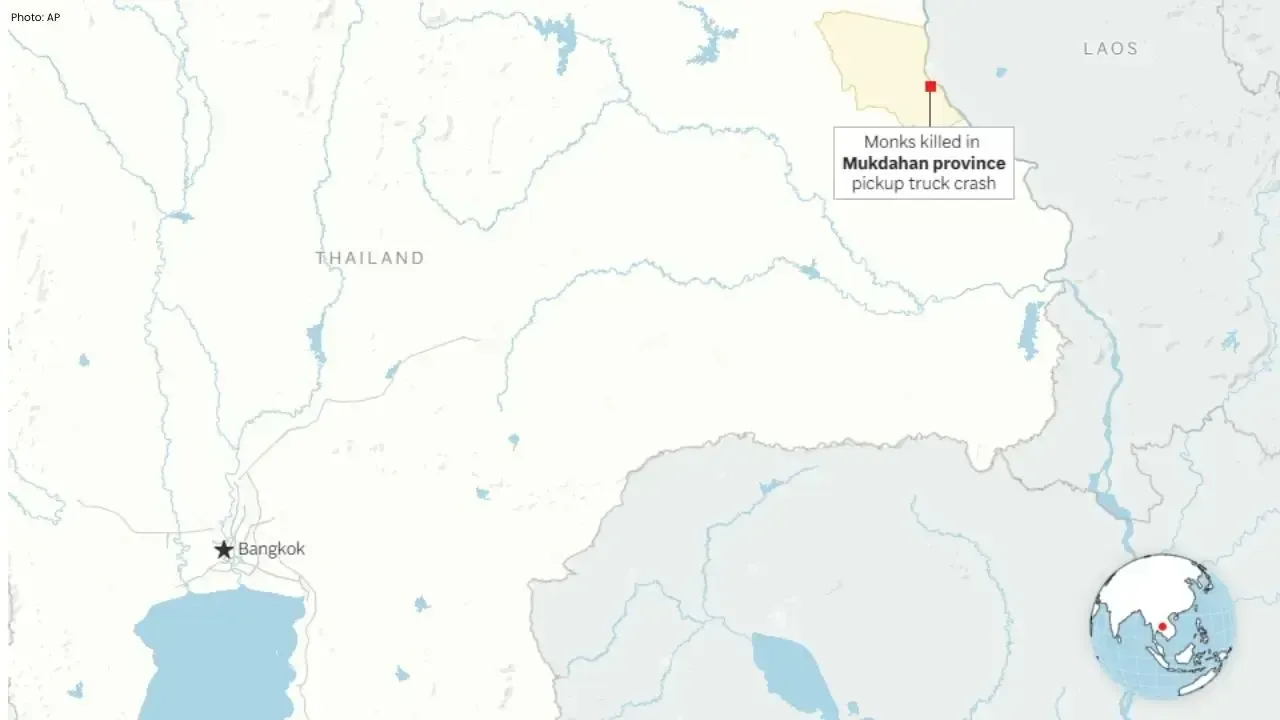
Nine Monks Killed in Thailand Pickup Truck Tragedy
An 11-year-old boy driving a pickup truck crashed into monks during a pilgrimage in northeastern Tha