You have not yet added any article to your bookmarks!
Join 10k+ people to get notified about new posts, news and tips.
Do not worry we don't spam!
Post by : Rameen Ariff
Japanese authorities lifted tsunami warnings on Tuesday, December 9, after a powerful 7.5-magnitude earthquake struck the country’s northeast late Monday night. The tremor injured at least 30 people and forced nearly 90,000 residents to evacuate from coastal regions as a precaution.
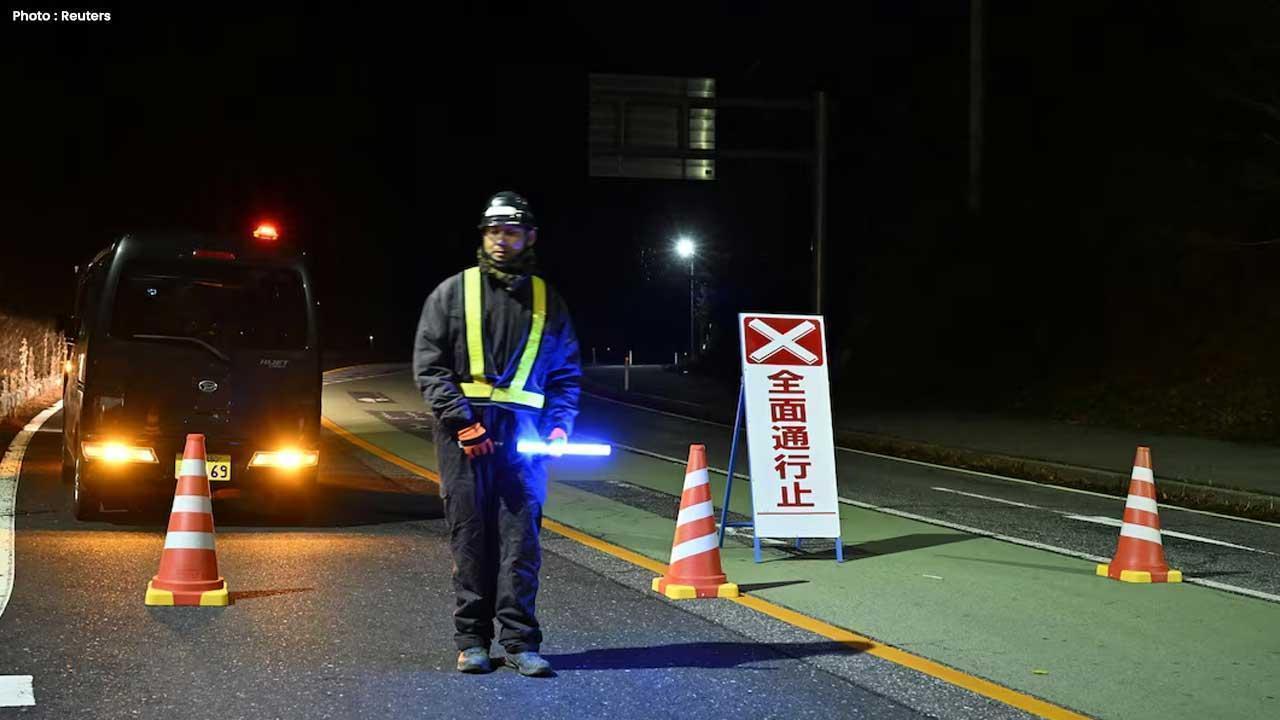
The earthquake hit offshore at 11:15 pm local time (1415 GMT), prompting the Japan Meteorological Agency (JMA) to issue warnings of tsunami waves up to three metres along the northeastern coast. Alerts were initially issued for Hokkaido, Aomori, and Iwate prefectures. Later reports recorded waves ranging from 20 to 70 centimetres at several ports, significantly lower than feared. By the early hours of Tuesday, the JMA downgraded the warnings to tsunami advisories and ultimately cancelled all alerts later in the morning. Authorities confirmed there were no immediate reports of major structural damage.
The epicentre of the earthquake was approximately 80 kilometres off the coast of Aomori prefecture at a depth of 54 kilometres. In the city of Hachinohe, Aomori, the quake registered an “upper 6” on Japan’s 1–7 seismic intensity scale, strong enough to make it extremely difficult for people to stand.
Prime Minister Sanae Takaichi addressed the situation, saying, “As of now, I have received reports of 30 people being injured and one fire.” Emergency services were promptly deployed to affected areas to assist residents and assess damage.
Transportation was disrupted as East Japan Railway suspended some services in the quake-affected region. Other train operations in northern Japan faced delays as safety inspections were conducted to ensure infrastructure integrity. The region affected by Monday night’s tremor was also devastated by the 9.0-magnitude earthquake in March 2011, which caused widespread destruction and a deadly tsunami.
Authorities urged residents in coastal areas to remain vigilant despite the cancellation of tsunami alerts, emphasizing the importance of preparedness in this earthquake-prone region. Experts continue to monitor seismic activity closely to prevent further harm.
The incident underscores Japan’s ongoing vulnerability to natural disasters, highlighting the effectiveness of the country’s early warning systems and rapid evacuation procedures that helped minimise casualties during the quake.










Rabada Misses First Australia Test as South Africa Pick Two Spinners
Kagiso Rabada misses the opener as South Africa vs Australia begins, with Anrich Nortje returning an

Starc Compares Australia's Tough Year to McIlroy's Major Sweep
Mitchell Starc says Australia winning three away Test series and the World Cup would match Rory McIl

France’s Sesterce Plans $11 Billion AI Data Centre in Finland
Sesterce plans a $11 billion AI data centre in Finland, with major expansion, green energy plans and

Danaher to Launch AI-Powered Autonomous Research Lab in 2027
Danaher plans an AI research lab for 2027, combining robotics and automation to speed up drug discov

Musk Welcomes German Support for Tesla Driver Assistance Tech as EU Approval Push Continues
Elon Musk welcomes Germany's backing for Tesla FSD as the company seeks EU approval amid speed, safe

Microsoft and Nvidia CEOs to Unveil AI Laptop at San Francisco Event
Microsoft and Nvidia showcase a new AI laptop with RTX Spark chips as they push powerful local AI co