
You have not yet added any article to your bookmarks!
Join 10k+ people to get notified about new posts, news and tips.
Do not worry we don't spam!
Post by : Saif Rahman
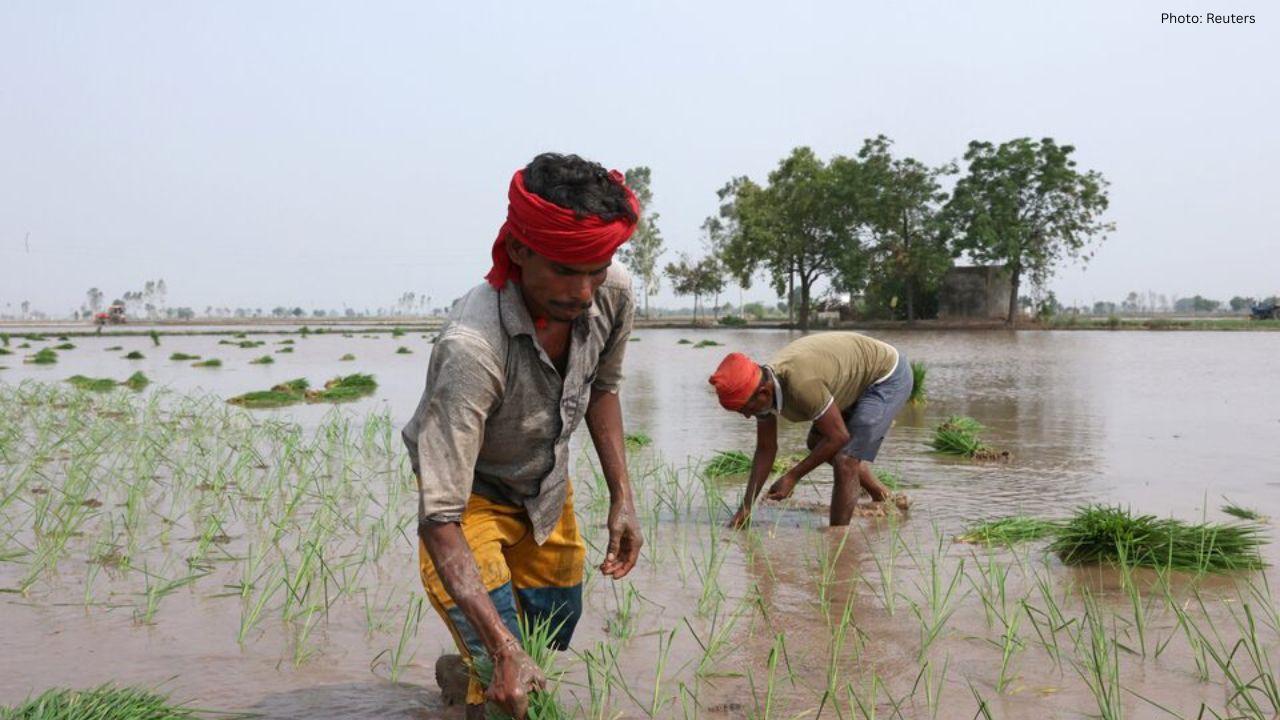
India's rise as the preeminent rice producer and exporter has garnered recognition from policymakers and trade analysts alike. In the last decade, the nation's rice exports have nearly doubled, surpassing 20 million metric tons in the recent financial year. This impressive achievement has bolstered India's role in global food markets. However, a deepening crisis lurks beneath the surface, threatening farmers, water resources, and the nation's agricultural viability.
The core issue involves water. Rice cultivation is notoriously water-intensive, and in India—particularly in northern states like Punjab and Haryana—rice farming critically relies on groundwater. These regions are already recognized as among the most water-stressed in the country. With the expansion of rice farming, groundwater levels are plummeting.
Farmers report that a decade ago, water could be found at depths of around 30 feet, but now borewells often have to reach depths between 80 and 200 feet. Drilling deeper incurs higher costs. Farmers are faced with increased expenditures for longer pipes, more powerful pumps, and additional electricity costs, which are becoming unsustainable for many.
Balkar Singh, a farmer from Haryana, highlights the rising financial burden: “Each year, the borewell has to go deeper. It’s becoming unaffordable.” His struggles reflect those of numerous farmers in the area.
Government policies have significantly influenced this situation. For decades, India promoted rice cultivation to ensure food security for its growing populace. To aid farmers, it introduced guaranteed minimum prices and offered substantial subsidies on electricity and fertilizers. While these initiatives helped feed the nation in the past, they now inadvertently encourage farming in water-scarce areas.
Experts express concern over the implications. India, one of the most water-stressed nations globally, is effectively incentivizing farmers to extract large volumes of groundwater. Producing a single kilogram of rice may require between 3,000 to 4,000 liters of water—far exceeding the global average.
Government statistics reveal that Punjab and Haryana withdraw groundwater at rates significantly outpacing natural replenishment, with some areas seeing extraction rates 35% to 57% above recharge levels. Consequently, vast regions are now designated as “over-exploited” or “critical” regarding groundwater usage.
The impact is disproportionately felt; larger landowners can absorb the costs of deeper borewells and benefit from subsidies, while small-scale farmers struggle. For them, any increase in costs heavily impacts already narrow profit margins, and many fear the future of their farming endeavors as water levels continue to decline.
This issue also holds global significance. India accounts for approximately 40% of the world's rice exports, and any significant downturn in its rice production could disrupt global food prices and supply chains. Experts are now questioning if India can sustain such large-scale rice production given the severe environmental costs involved.
Signs of potential change are emerging. Some regional governments are incentivizing farmers to cultivate less water-intensive crops like millets, and Haryana has initiated cash incentives for those transitioning from rice. Millets require far less water and are increasingly recognized as healthy alternatives.
However, these initiatives have been limited in scope. The incentives remain short-lived, failing to persuade many farmers to adopt a permanent shift. Experts argue that sustainable support, clear price guarantees, and assured government purchases are vital for fostering a successful transition.
Economists suggest redirecting current subsidies as a feasible solution. Instead of increasing financial allocations, funds currently used for rice-related support could assist farmers in cultivating less water-dependent crops, thereby protecting their incomes while conserving groundwater.
Many farmers express openness to adapting. Gurmeet Singh, a grower from Punjab, believes that with adequate government backing, a transition is possible. “The land here is fertile,” he claims. “We are prepared to switch crops if the government ensures fair pricing for our harvest.”
While India’s rice export success story instills pride and global standing, it simultaneously exposes a critical environmental challenge. Without strategic policy reform and thorough long-term planning, the future of India's rice bowl remains at serious risk. Striking a balance among food security, farmer welfare, and water preservation will be one of India’s foremost challenges moving forward.









PSG Coach Luis Enrique Urges Players to Step Outside Comfort Zone
PSG coach Luis Enrique says players must leave their comfort zone and keep improving as the club tar

China’s Tiangong Sets New 400m Record at Robot Olympics
China’s Tiangong robot sets a new 400m record at the Robot Olympics, beating a South African robot i

George Russell Wins Dutch GP Sprint, Boosts Mercedes Morale
George Russell wins the Dutch GP Sprint from pole as Mercedes teammate Kimi Antonelli extends his F1

Australia 50/3 After Bangladesh Bowled Out for 64 in Second Test
Australia reached 50/3 after Bangladesh were bowled out for 64 in the second Test, with Mitchell Sta

Jordan Burroughs Returns to Wrestling with 2028 Olympic Dream
Jordan Burroughs returns to wrestling with Real American Freestyle as the Olympic champion eyes a po

Lamborghini Catches Fire on Singapore's ECP, Causing Heavy Traffic
A Lamborghini caught fire on Singapore's ECP, causing heavy traffic and bus delays. No injuries were

