You have not yet added any article to your bookmarks!
Join 10k+ people to get notified about new posts, news and tips.
Do not worry we don't spam!

Post by : Anis Farhan
India is stepping into the quantum age with bold confidence—and leading that charge is the state of Karnataka, home to India’s tech capital, Bengaluru. In a landmark move that signals the country’s seriousness about deep-tech leadership, the Karnataka government has unveiled a ₹1,000 crore venture capital fund to supercharge the state’s—and by extension, India’s—quantum technology ecosystem. The goal? To build a $20 billion quantum economy within the next decade.
With this ambitious push, Karnataka aims to transform itself into a global quantum hub, joining the likes of the U.S., China, and Europe in shaping the future of computing, communication, and cybersecurity. But beyond the big headline, this move has massive implications for India’s broader science, industry, and innovation landscape.
It signals a shift from software dominance to hardware-enabled, deep-tech innovation, and from outsourcing prowess to intellectual property ownership. And in the process, it puts India on a path toward sovereign quantum capability—a strategic must-have in the coming global tech order.
Karnataka has long positioned itself at the intersection of technology, research, and entrepreneurship. Bengaluru is home to over 400 deep-tech startups, premier research institutions like IISc, global R&D centers for tech giants, and a maturing investor ecosystem that understands the nuances of frontier tech.
By launching a dedicated quantum venture fund, the state is capitalizing on this foundation and fast-tracking commercial and academic quantum research into viable, scalable, investable startups.
But the timing is just as important as the geography. As countries worldwide race to dominate quantum technologies—viewed as the next great frontier after AI and semiconductors—India cannot afford to lag. From secure quantum communication networks to quantum cryptography and quantum sensors, this technology is poised to reshape cybersecurity, finance, national defense, and healthcare.
In this high-stakes game, Karnataka’s move is both visionary and urgent.
Announced at the Bengaluru Tech Summit 2025, the fund—jointly managed by the state and private venture capital firms—is designed to seed, scale, and sustain startups focused on:
Quantum hardware development
Quantum-safe encryption and security solutions
Quantum simulation and computing platforms
Quantum communication networks
Quantum sensors for precision industries
What makes this fund unique is its long-horizon design. Unlike typical VC models that expect 3–5 year returns, this fund is structured to support R&D-intensive startups that may take 7–10 years to commercialize. It will provide patient capital, co-investment mechanisms, and even offer equity-free grants for early-stage research spinouts.
Moreover, the fund isn’t just about capital—it comes with a support ecosystem of testbeds, access to research labs, cloud-based quantum computing sandboxes, and international mentorship programs. In short, it’s not just a fund—it’s a launchpad.
India already has a promising research pipeline in quantum science. The Department of Science and Technology (DST), the Defence Research and Development Organisation (DRDO), and ISRO have all launched quantum initiatives in the past five years. The National Mission on Quantum Technologies & Applications (NMQTA), launched in 2020, allocated ₹8,000 crore to quantum R&D over five years.
But research alone doesn’t drive industry. Karnataka’s fund is the missing link—connecting labs to markets, and turning patents into products.
The new ecosystem will focus on converting Indian research breakthroughs—such as quantum random number generators, satellite-based quantum key distribution, and quantum-enhanced metrology—into commercial solutions.
The ultimate goal is to create India-origin companies that don’t just serve the domestic market but also export quantum technologies to the world.
Quantum tech is no longer a research curiosity—it’s geopolitical capital. The U.S. has pumped billions into quantum research via its National Quantum Initiative. China’s investment surpasses $15 billion, with notable milestones like a working quantum satellite (Micius) and scalable superconducting qubit systems. Europe, meanwhile, has pooled efforts through the €1 billion Quantum Flagship program.
India’s effort is late, but well-timed. The global industry is still young—experts estimate that true commercial quantum computing won’t be mainstream until 2030. That gives India a five-year window to catch up, leapfrog, and even lead in certain verticals.
Karnataka’s early investment may help India avoid the fate of being merely a user or integrator of foreign quantum tools. With its IT muscle, low-cost talent, strong math pedigree, and growing startup ecosystem, India has the ingredients to build and own global quantum IP—but only if it backs vision with capital.
Karnataka’s ₹1,000 crore quantum fund is expected to generate:
Over 500 direct jobs in quantum technology over the next five years
200+ indirect jobs in associated sectors like photonics, cryogenics, and chip design
At least 30 new startups in quantum software and hardware
Strategic partnerships with 5 international quantum labs
Commercial quantum communication pilots with public sector banks, telecom firms, and government networks
Beyond the economic impact, this initiative is also about strategic autonomy. In an era of growing cyber threats and supply chain geopolitics, having homegrown quantum capability is as important as food or energy security.
If this initiative succeeds, Bengaluru will not only be India’s Silicon Valley—it could become the Quantum Valley of Asia. With planned centers like the Karnataka Quantum Research Park, incubation programs for PhD spinouts, and inter-state startup corridors being discussed, the ecosystem is ready.
And this isn’t just about deep-tech insiders. The government has also announced education reforms to introduce quantum physics and cryptography at the undergraduate level, aiming to create a quantum-literate workforce.
If implemented with consistency and cross-sector collaboration, Karnataka’s move could inspire other Indian states to launch similar deep-tech funds—for semiconductors, biotech, and AI safety—ushering in a new era of state-led science policy.
Quantum technology operates at the subatomic level—but its impact is anything but small. With its ₹1,000 crore venture fund, Karnataka is betting not just on a technology, but on an entire industrial future—one where India is a developer, not a dependent; a leader, not a latecomer.
It’s a bold leap. But in the quantum world, uncertainty isn’t a flaw—it’s a feature. And Karnataka seems ready to harness it.
This article is intended for informational and editorial purposes only. The figures, policies, and projections referenced are based on government announcements and industry reports as of August 2025. Readers are advised to follow official sources for real-time updates and investment advisories.










Lamborghini Catches Fire on Singapore's ECP, Causing Heavy Traffic
A Lamborghini caught fire on Singapore's ECP, causing heavy traffic and bus delays. No injuries were

Bangkok Airport Duty-Free Area Flooded by Pipe Burst
A burst water pipe flooded the duty-free shopping area at Bangkok's Suvarnabhumi Airport on July 16,
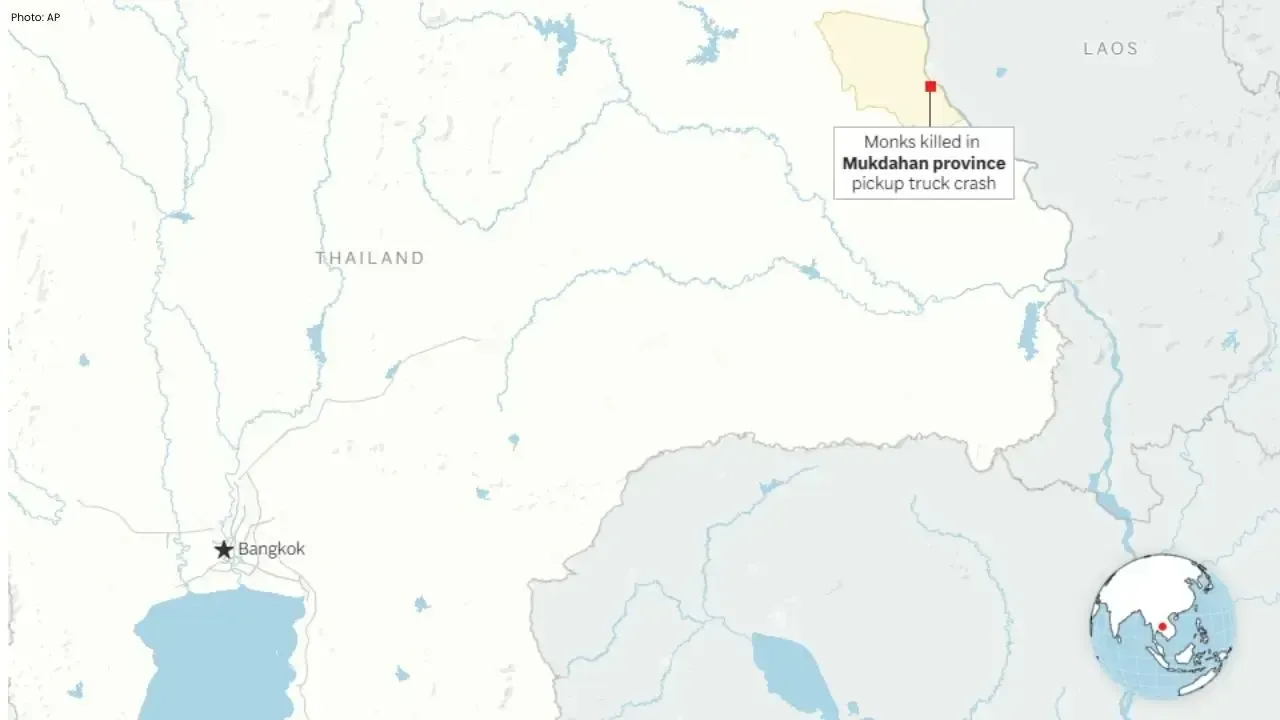
Nine Monks Killed in Thailand Pickup Truck Tragedy
An 11-year-old boy driving a pickup truck crashed into monks during a pilgrimage in northeastern Tha

Anwar Congratulates Xi on CPC's 105th Anniversary
Malaysia reaffirms strong ties with China as PM Anwar Ibrahim sends a congratulatory letter to Presi

Thai Agriculture Team Reviews 2026 Farm Development Plans
Agriculture Ministry officials inspected livestock and organic rice projects in Nakhon Sawan to moni

Thailand, Canada Boost Ties in PM-Level Phone Talks
Thailand and Canada agreed to strengthen trade, security, OECD cooperation and ASEAN-Canada FTA talk