You have not yet added any article to your bookmarks!
Join 10k+ people to get notified about new posts, news and tips.
Do not worry we don't spam!
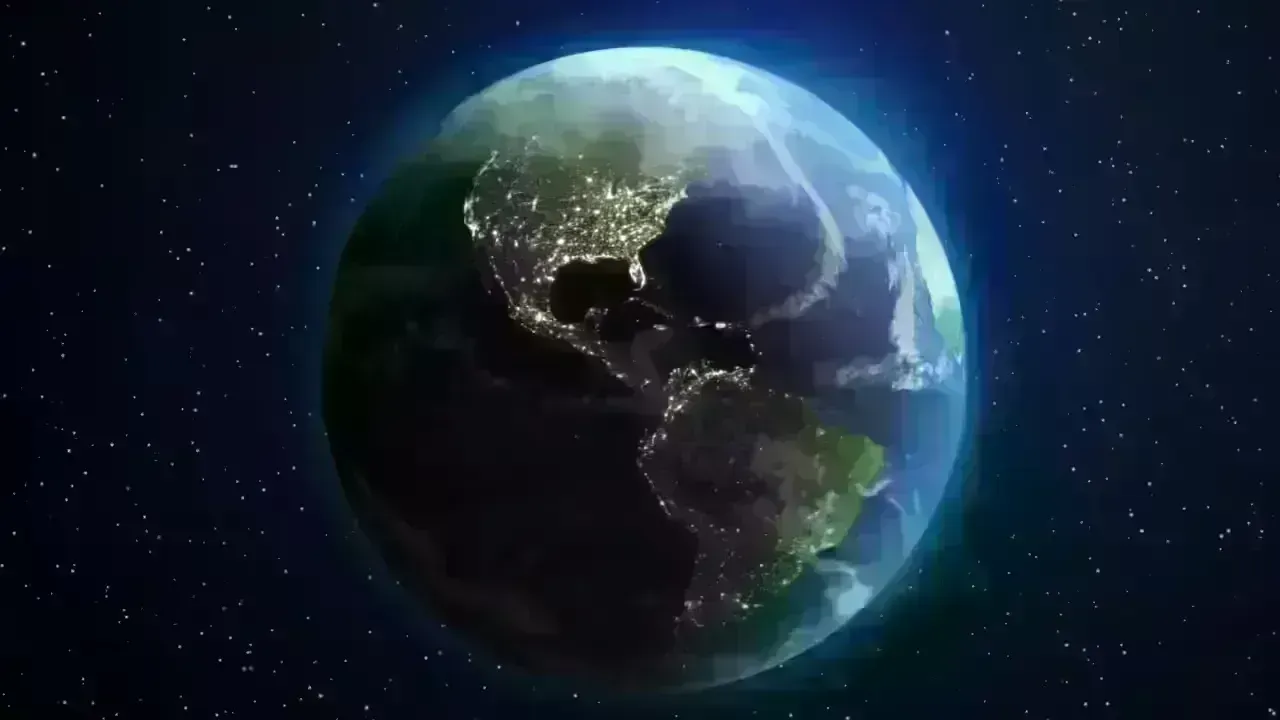
Post by : Anis Farhan
The idea that Earth could suddenly stop spinning sounds like a dramatic science-fiction plot. Popular imagination often jumps to images of people being flung into space, oceans sloshing over continents, or one side of the planet freezing while the other burns. While some of these ideas are loosely connected to reality, the true consequences of Earth halting its rotation are far more complex, unsettling, and scientifically fascinating.
Earth’s rotation is so fundamental to daily life that it fades into the background. We feel stationary, yet the planet spins at roughly 1,670 kilometres per hour at the equator. This motion shapes gravity, weather, oceans, ecosystems, and even human biology. Remove it, and the planet we recognise would cease to exist in any familiar form.
This article explores what would actually happen if Earth stopped spinning—suddenly or gradually—and why the most dangerous effects are not the ones most people expect.
Earth’s rotation is not just about day and night. It subtly reshapes gravity itself. Because the planet spins, centrifugal force slightly counteracts gravity, especially at the equator. This makes Earth not a perfect sphere, but an oblate spheroid, bulging outward around its middle.
If Earth stopped spinning, gravity would immediately begin pulling the planet toward a more spherical shape. That shift alone would redraw coastlines, flood entire regions, and alter the balance between land and sea.
Rotation also drives the Coriolis effect, which deflects winds and ocean currents. Without it, global circulation systems would collapse, triggering planetary-scale climate failure.
If Earth stopped spinning instantly, inertia would become the planet’s greatest enemy. Everything on the surface—air, water, buildings, and living beings—would continue moving eastward at rotational speed.
At the equator, that speed exceeds the velocity of many aircraft. The result would be immediate, global devastation:
Oceans would surge eastward, creating continent-wide tsunamis
The atmosphere would generate supersonic winds
Cities would be obliterated by kinetic force
Forests would be flattened at planetary scale
This is not gradual disaster—it would unfold in minutes.
However, this catastrophic scenario assumes an instantaneous stop, which is physically unrealistic. A more interesting and scientifically useful question is what happens if Earth gradually loses its spin.
A gradual slowdown avoids the instant annihilation scenario, but it does not spare life. Instead, it introduces long-term planetary breakdown.
Currently, Earth completes one rotation every 24 hours. As rotation slows:
Days would stretch longer
Nights would become harsher
Temperature extremes would intensify
Eventually, Earth would become tidally locked, meaning one side permanently faces the Sun while the other remains in eternal darkness—similar to how the Moon faces Earth.
Life would not experience “days” anymore. It would experience hemispheres of light and darkness.
Weather exists because of uneven heating combined with rotation. Remove rotation, and atmospheric circulation reorganises completely.
Instead of multiple wind cells and jet streams, Earth would develop one massive convection system:
Air would rise on the sun-facing side
Travel toward the dark side at high altitude
Sink into perpetual cold
Return near the surface
This would generate constant megastorms near the boundary between light and dark, with winds stronger than any hurricane in recorded history.
Rain would fall continuously in some regions and never in others.
Earth’s oceans are currently distributed unevenly because rotation causes water to bulge outward at the equator. Without spin, this bulge disappears.
Water would flow toward the poles, exposing vast equatorial landmasses and submerging polar regions under kilometres of ocean.
The new geography would include:
Dry equatorial supercontinents
Deep polar oceans
Destroyed coastal ecosystems
Extinction of coral reefs and fisheries
Marine life would face mass extinction due to pressure changes, temperature shocks, and oxygen loss.
Earth’s magnetic field is generated by the movement of molten iron in its outer core—a process influenced by planetary rotation.
As rotation slows, the geodynamo weakens. Over time:
The magnetic field would collapse
Solar radiation would directly hit the atmosphere
Atmospheric particles would be stripped away
Radiation exposure would increase dramatically
This would not be immediate, but over geological time, Earth could begin to resemble Mars—cold, dry, and unprotected.
Life would not vanish instantly in a gradual slowdown scenario, but survival would demand radical adaptation.
Extreme heat
Constant solar radiation
Severe dehydration
Limited biodiversity
Life might retreat underground or evolve reflective, radiation-resistant forms.
Permanent freezing
Ice-locked oceans
Minimal photosynthesis
Only extremophiles—organisms that survive in harsh conditions—would persist.
The narrow band between light and dark would become the most habitable region. Life would concentrate here, much like ecosystems around deep-sea hydrothermal vents today.
Modern human society depends on:
Predictable weather
Stable agriculture
Global transport
Energy distribution
All of these rely on Earth’s rotation.
Agriculture would fail as seasons collapse. Infrastructure would crumble under climatic stress. Migration pressures would become unmanageable.
Even with advanced technology, sustaining billions of people under these conditions would be impossible.
Earth will not randomly stop spinning. Its rotation is conserved by angular momentum. To halt it would require an external force so vast that it would likely destroy the planet entirely.
Only events on the scale of:
A massive planetary collision
A close encounter with a rogue celestial body
Direct interference by a star-level force
could meaningfully alter Earth’s rotation. All such scenarios would be extinction-level events long before spin cessation became the main issue.
One of the most persistent myths is that stopping Earth’s spin would eliminate gravity. This is false.
Gravity comes from mass, not motion. Even without rotation, Earth would still exert nearly the same gravitational pull.
What would change is how gravity feels, especially at the equator, where centrifugal force currently offsets a small fraction of gravitational pull. Humans would weigh slightly more, but that is among the least of the planet’s problems.
This scenario is not about predicting the future. It is about understanding how delicately balanced Earth already is.
Rotation influences:
Climate stability
Ocean circulation
Atmospheric protection
Habitability
Earth is not just a rock in space—it is a finely tuned system where motion equals life.
The most surprising takeaway is not how violent Earth’s fate would be if it stopped spinning, but how precisely it must keep spinning for life to exist at all.
A slightly faster spin would intensify storms. A slower one would destabilise climate. Earth exists in a narrow window where complexity thrives.
That balance is easy to take for granted—until you imagine it gone.
If Earth stopped spinning, it would not end with people flying into space or instant darkness. It would unravel the invisible systems that quietly make life possible.
The real danger is not spectacle—it is systemic collapse.
Earth spins not just to give us day and night, but to sustain oceans, protect the atmosphere, regulate climate, and support every living organism on the planet. Without that motion, Earth would still exist—but it would no longer be a world.
Disclaimer:
This article is for informational and educational purposes only. The scenario described is hypothetical and does not reflect any realistic or predicted planetary event.



Lamborghini Catches Fire on Singapore's ECP, Causing Heavy Traffic
A Lamborghini caught fire on Singapore's ECP, causing heavy traffic and bus delays. No injuries were

Bangkok Airport Duty-Free Area Flooded by Pipe Burst
A burst water pipe flooded the duty-free shopping area at Bangkok's Suvarnabhumi Airport on July 16,

Nine Monks Killed in Thailand Pickup Truck Tragedy
An 11-year-old boy driving a pickup truck crashed into monks during a pilgrimage in northeastern Tha

Anwar Congratulates Xi on CPC's 105th Anniversary
Malaysia reaffirms strong ties with China as PM Anwar Ibrahim sends a congratulatory letter to Presi

Thai Agriculture Team Reviews 2026 Farm Development Plans
Agriculture Ministry officials inspected livestock and organic rice projects in Nakhon Sawan to moni

Thailand, Canada Boost Ties in PM-Level Phone Talks
Thailand and Canada agreed to strengthen trade, security, OECD cooperation and ASEAN-Canada FTA talk