You have not yet added any article to your bookmarks!
Join 10k+ people to get notified about new posts, news and tips.
Do not worry we don't spam!
Post by : Sameer Farouq
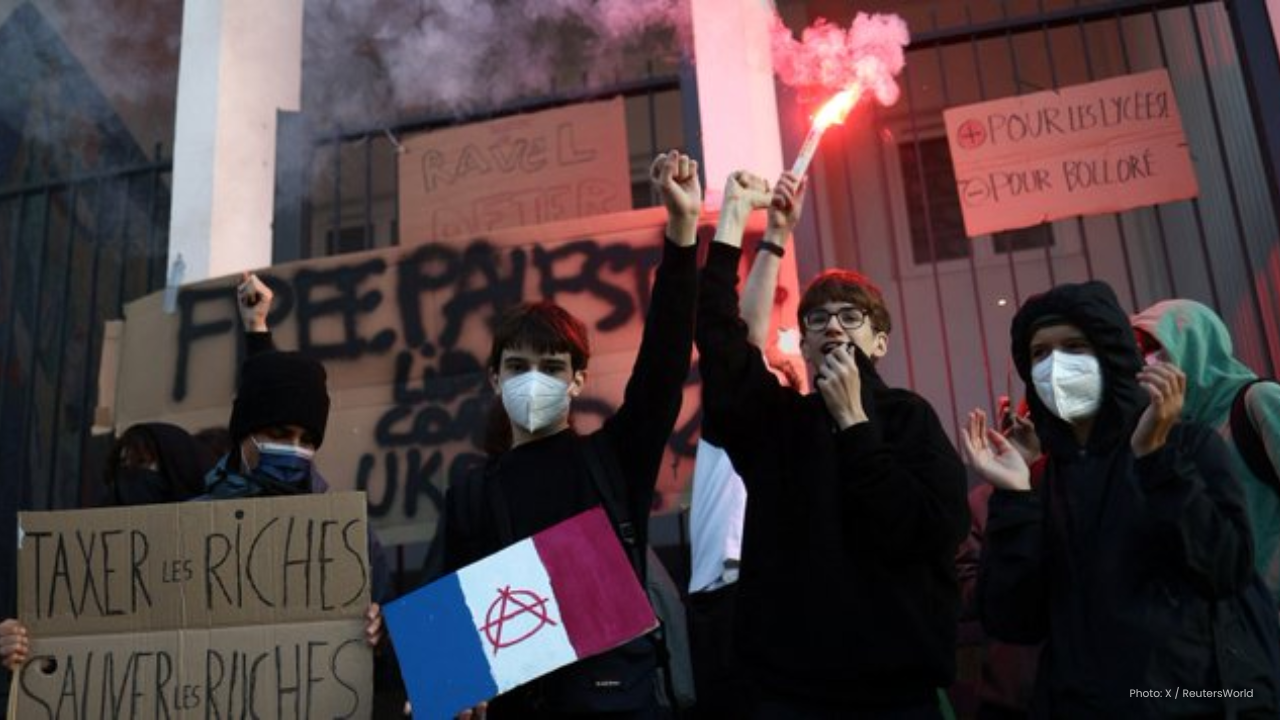
France witnessed a powerful wave of strikes and protests as workers, students, teachers, and unions came together to oppose government austerity measures. The demonstrations put huge pressure on President Emmanuel Macron and his new Prime Minister, Sebastien Lecornu, as they struggle to balance the country’s finances while avoiding public anger.
In Paris, daily life was heavily disrupted. Metro lines stopped running for most of the day, except during morning and evening rush hours. Many schools were blocked by pupils who joined teachers and union members in protest.
At the Lycee Maurice Ravel high school, a placard held by students read, “Block your high school against austerity.” Teachers, workers, and students stood together demanding change.
Fred, a bus driver and union representative, explained: “Workers are so despised by this government and by President Macron that it can’t continue like this.”
Teachers also voiced strong concerns. A 33-year-old teacher, Gaetan Legay, said he was protesting to defend public services. “We want public money to go back into hospitals, schools, and transport, instead of being handed as gifts to large companies and the ultra-rich,” he said.
Unions are demanding the government cancel earlier fiscal plans that aimed to cut spending and raise the retirement age. They are calling for:
More funding for public services like schools and hospitals.
Higher taxes on the wealthy.
A reversal of the unpopular pension change that forces people to work longer before retiring.
The unions released a joint statement rejecting what they described as “brutal” and “unfair” policies. They argued that ordinary workers should not bear the burden of fixing France’s financial problems.
France’s budget deficit has grown to nearly double the European Union’s limit of 3%. While Prime Minister Sebastien Lecornu has not yet revealed his full plan, he hinted at possible compromises. His predecessor, Francois Bayrou, was forced out last week after parliament rejected his plan for €44 billion in spending cuts.
This has left Macron and Lecornu walking a fine line between calming investors worried about the deficit and responding to angry workers demanding fairness.
The strike spread across many sectors:
Schools: About one in three primary teachers nationwide joined the strike, with nearly one in two walking out in Paris.
Trains: Regional train services were heavily affected. High-speed TGV trains mostly ran but faced delays.
Roads: Protesters blocked traffic near Toulon in the southeast.
Energy: Workers at EDF reduced nuclear power output by 1.1 gigawatts at Flamanville 1 reactor, cutting electricity supply.
Pharmacies: The pharmacists’ union reported that 98% of pharmacies planned to close for the day.
Farmers also joined the protests, showing how wide the anger has spread across French society.
The Interior Ministry said as many as 800,000 people were expected to protest nationwide. To prepare, the government deployed about 80,000 police officers and gendarmes. Riot police, drones, and armored vehicles were on standby.
Interior Minister Bruno Retailleau confirmed that police had already removed blockades outside bus depots in Paris. He warned that around 8,000 agitators might try to clash with police and cause damage. By midday, over 20 arrests had been made.
Even cultural projects were disrupted. The famous Bayeux tapestry, a 70-meter-long medieval artwork telling the story of the Norman invasion of England, could not be moved as scheduled because of the strikes. It was due to be loaned to Britain but the transfer had to be postponed.
The strikes underline a deep frustration with economic inequality and government priorities. With parliament divided and unions showing unity, passing a new budget for 2026 will be extremely difficult.
France’s leaders face a tough choice: cut spending to reduce the deficit and risk more unrest, or listen to unions and risk losing the trust of investors and European partners.
For now, the protests show no sign of slowing, and the people on the streets insist that they will continue until their voices are heard.



Australia 50/3 After Bangladesh Bowled Out for 64 in Second Test
Australia reached 50/3 after Bangladesh were bowled out for 64 in the second Test, with Mitchell Sta

Jordan Burroughs Returns to Wrestling with 2028 Olympic Dream
Jordan Burroughs returns to wrestling with Real American Freestyle as the Olympic champion eyes a po

Lamborghini Catches Fire on Singapore's ECP, Causing Heavy Traffic
A Lamborghini caught fire on Singapore's ECP, causing heavy traffic and bus delays. No injuries were

Bangkok Airport Duty-Free Area Flooded by Pipe Burst
A burst water pipe flooded the duty-free shopping area at Bangkok's Suvarnabhumi Airport on July 16,

Nine Monks Killed in Thailand Pickup Truck Tragedy
An 11-year-old boy driving a pickup truck crashed into monks during a pilgrimage in northeastern Tha
Anwar Congratulates Xi on CPC's 105th Anniversary
Malaysia reaffirms strong ties with China as PM Anwar Ibrahim sends a congratulatory letter to Presi