You have not yet added any article to your bookmarks!
Join 10k+ people to get notified about new posts, news and tips.
Do not worry we don't spam!

Post by : Anis Farhan
Money has evolved many times—from barter systems and metal coins to paper currency and digital banking. Each transformation reshaped economies and power structures. Cryptocurrency represents the next potential shift, not by replacing money overnight, but by redefining how value moves in a digital-first world.
After years of volatility, regulatory uncertainty, and hype cycles, crypto is entering a more mature phase. In 2026, the focus is shifting from speculation to infrastructure. The question is no longer whether crypto survives, but how deeply it integrates into everyday finance.
The trends emerging now suggest that money itself—its speed, programmability, transparency, and accessibility—may look very different within a few years.
Earlier crypto cycles were dominated by price charts, meme coins, and rapid speculation. While those elements haven’t disappeared, 2026 is shaping up as a utility-driven era.
Investors, governments, and institutions are increasingly interested in what crypto can do rather than how fast it can rise. Payments, settlement, identity, lending, and asset ownership are becoming the primary focus.
This shift matters because lasting financial change doesn’t come from hype—it comes from usefulness.
One of the most significant crypto trends reshaping money is the rise of stablecoins. These digital currencies are pegged to traditional assets such as national currencies, reducing volatility while retaining blockchain efficiency.
In 2026, stablecoins are increasingly used for cross-border payments, remittances, and online commerce. They allow value to move globally within seconds, often at a fraction of traditional banking costs.
As regulatory clarity improves, stablecoins are becoming acceptable tools for businesses and financial institutions. This challenges legacy payment systems that rely on slow, expensive intermediaries.
Stablecoins may not replace national currencies, but they could become the default digital layer through which money moves.
Another trend with the potential to redefine money is the tokenisation of real-world assets. This involves representing physical or traditional financial assets—such as real estate, bonds, commodities, or art—as blockchain-based tokens.
Tokenisation increases liquidity, accessibility, and transparency. Assets that were once illiquid or limited to wealthy investors can now be fractionally owned and traded globally.
In 2026, tokenised assets are increasingly being explored by financial institutions seeking faster settlement and reduced counterparty risk. This could blur the line between traditional finance and crypto, creating a unified digital financial ecosystem.
Money, in this context, becomes more than currency—it becomes programmable ownership.
Decentralized finance, or DeFi, continues to evolve beyond its experimental phase. While early versions were risky and complex, newer protocols are focusing on security, compliance, and user experience.
DeFi allows users to lend, borrow, earn interest, and exchange assets without traditional intermediaries. In 2026, these systems are becoming more accessible, with improved interfaces and risk controls.
The significance lies in choice. DeFi offers an alternative financial system that operates continuously, globally, and transparently. For people underserved by traditional banks, this represents financial inclusion on an unprecedented scale.
If adopted responsibly, DeFi could redefine what banking means.
Traditional money is passive—it sits in accounts until someone decides to move it. Crypto introduces programmable money, where value moves based on predefined rules.
Smart contracts enable automatic payments, conditional transfers, and self-executing agreements. Salaries, insurance payouts, subscriptions, and royalties can operate without manual intervention.
In 2026, programmable money is expanding into business operations and public finance. Governments and enterprises are experimenting with automated tax collection, compliance, and distribution systems.
This changes money from a static store of value into an active participant in economic systems.
While cryptocurrencies began as alternatives to government-issued money, central banks are now exploring digital currencies of their own.
Central bank digital currencies (CBDCs) aim to combine the efficiency of digital payments with the stability of sovereign backing. In 2026, several countries are testing or rolling out CBDCs for domestic and cross-border use.
The coexistence of CBDCs and cryptocurrencies could reshape monetary policy, financial surveillance, and payment infrastructure. How governments balance efficiency with privacy will play a crucial role in adoption.
This trend signals that digital money is no longer optional—it’s inevitable.
Crypto wallets are evolving rapidly. What began as simple storage tools are turning into comprehensive financial platforms.
In 2026, wallets integrate payments, identity verification, lending, investing, and even governance participation. Users can manage assets, access services, and interact with global markets from a single interface.
This mirrors the rise of super apps in other parts of the world but with a decentralized foundation. Control shifts from institutions to individuals.
As wallets become easier to use, the barrier to participating in the digital economy lowers significantly.
For years, regulation was seen as a threat to crypto. In 2026, it is increasingly viewed as a stabilising force.
Clear rules around custody, taxation, consumer protection, and compliance are encouraging institutional participation. Rather than stifling innovation, regulation is providing legitimacy.
This trend could accelerate mainstream adoption by reducing uncertainty and improving trust. Money systems thrive on confidence, and regulatory clarity supports that foundation.
The challenge lies in preserving innovation while enforcing accountability.
As digital payments grow, so do concerns about surveillance and data misuse. Privacy-focused crypto technologies are gaining renewed attention in response.
These systems aim to protect user data while maintaining transactional integrity. In a world of increasing digital oversight, financial privacy is becoming a core value rather than a fringe concern.
In 2026, privacy features are being integrated thoughtfully, balancing transparency with individual rights. This could influence how future money systems are designed.
Money, after all, is not just economic—it is personal.
A powerful emerging trend is the intersection of crypto and artificial intelligence. Blockchain provides transparency and ownership, while AI offers automation and analysis.
Together, they enable decentralised AI marketplaces, autonomous financial agents, and intelligent smart contracts. These systems could manage assets, optimise transactions, and respond to market conditions in real time.
In 2026, this convergence is still early but promising. It introduces a future where money systems adapt dynamically rather than relying solely on human intervention.
International money transfers remain one of the most inefficient aspects of global finance. Crypto is changing that.
Blockchain-based payments bypass multiple intermediaries, reducing time and cost. In 2026, businesses and individuals increasingly use crypto rails for global transactions.
This trend is particularly impactful for developing economies, where remittance fees have historically been high. Faster, cheaper transfers mean more money reaches families and communities.
Money becomes truly global, not constrained by borders.
One of crypto’s most transformative promises is financial inclusion. In 2026, this promise is becoming more tangible.
With only a smartphone and internet access, individuals can store value, transact globally, and access financial services. This reduces dependence on local banking infrastructure.
While challenges remain—education, security, and access—the trend suggests a gradual narrowing of financial inequality through open networks.
Money becomes accessible by design, not privilege.
Digital identity is emerging as a critical component of crypto systems. Secure, decentralised identity solutions allow users to verify themselves without surrendering control of personal data.
In 2026, identity and money are increasingly connected. Verified wallets enable compliance, trust, and access to services without central databases.
This could redefine how trust is established in financial systems, shifting from institutional verification to cryptographic proof.
While cash is not disappearing, its role is diminishing. Crypto trends reflect a broader shift toward digital-native money.
Younger generations are increasingly comfortable with digital assets, and businesses are adapting accordingly. Physical money becomes symbolic, while digital value dominates transactions.
This transition raises questions about accessibility and resilience, but it is undeniably underway.
Despite momentum, crypto faces obstacles. Scalability, security breaches, user education, and environmental concerns remain relevant.
Overconfidence and poor implementation could slow adoption. Trust takes time to build, especially in financial systems.
The success of these trends depends on thoughtful execution, collaboration, and public understanding.
If these trends continue, money in the future may be faster, smarter, more inclusive, and more programmable.
Transactions could settle instantly. Ownership could be transparent. Financial systems could operate continuously, without borders or downtime.
Money becomes infrastructure, not friction.
Crypto trends in 2026 suggest a transformation that is subtle but profound. Rather than overthrowing existing systems, crypto is weaving itself into them, improving efficiency and expanding possibilities.
The future of money is not about choosing between old and new—it’s about integration. Blockchain, digital currencies, and decentralised systems are shaping a financial world that is more adaptable and accessible.
As history shows, when money changes, everything else follows.
Disclaimer: This article is an analytical overview of emerging cryptocurrency and blockchain trends. It does not constitute financial or investment advice. Market conditions, regulations, and technologies may change rapidly.









Jordan Burroughs Returns to Wrestling with 2028 Olympic Dream
Jordan Burroughs returns to wrestling with Real American Freestyle as the Olympic champion eyes a po

Lamborghini Catches Fire on Singapore's ECP, Causing Heavy Traffic
A Lamborghini caught fire on Singapore's ECP, causing heavy traffic and bus delays. No injuries were

Bangkok Airport Duty-Free Area Flooded by Pipe Burst
A burst water pipe flooded the duty-free shopping area at Bangkok's Suvarnabhumi Airport on July 16,
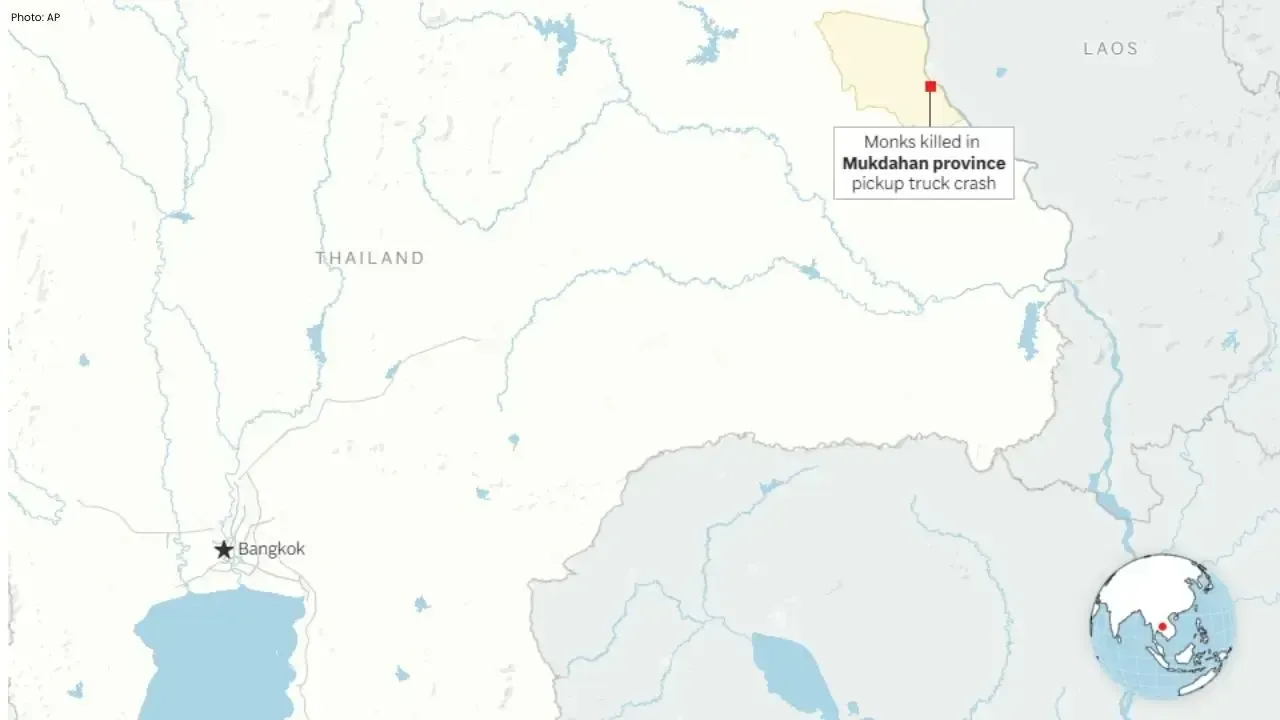
Nine Monks Killed in Thailand Pickup Truck Tragedy
An 11-year-old boy driving a pickup truck crashed into monks during a pilgrimage in northeastern Tha
Anwar Congratulates Xi on CPC's 105th Anniversary
Malaysia reaffirms strong ties with China as PM Anwar Ibrahim sends a congratulatory letter to Presi

Thai Agriculture Team Reviews 2026 Farm Development Plans
Agriculture Ministry officials inspected livestock and organic rice projects in Nakhon Sawan to moni