
You have not yet added any article to your bookmarks!
Join 10k+ people to get notified about new posts, news and tips.
Do not worry we don't spam!
Post by : Rameen Ariff
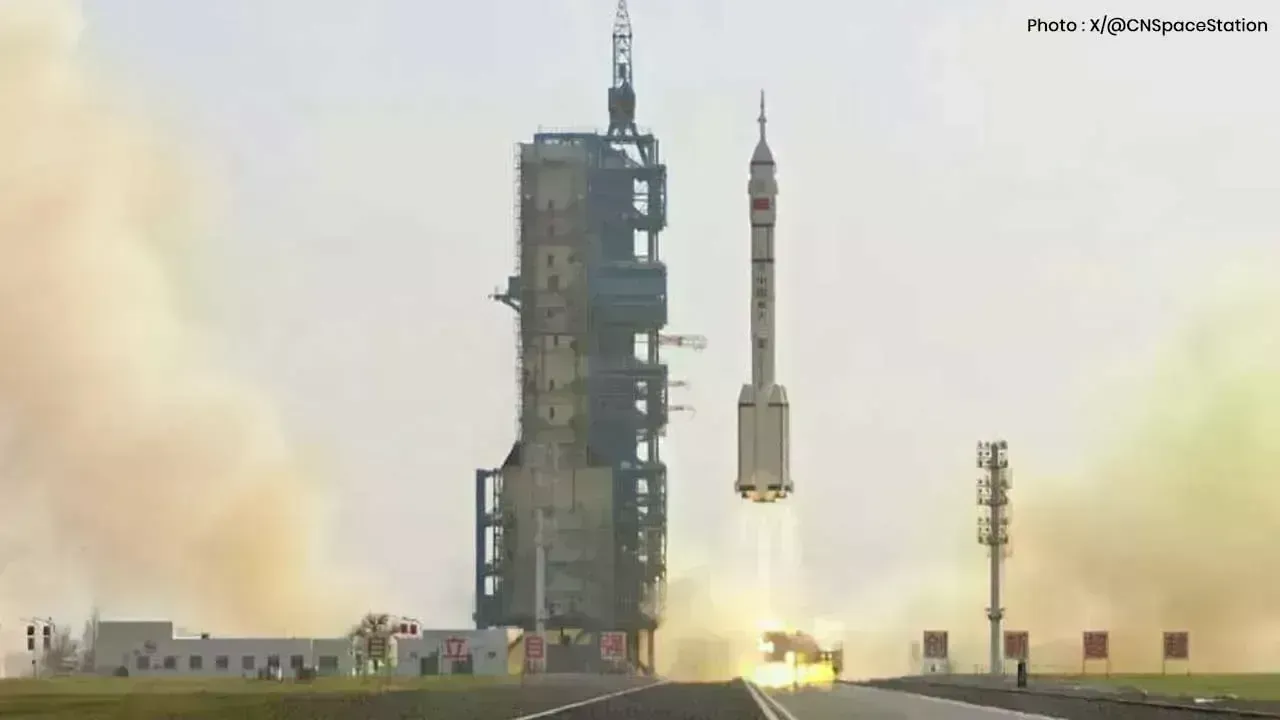
On Tuesday, China achieved a significant milestone with its inaugural emergency space launch, aiming to resolve urgent safety issues at the Tiangong space station. The Shenzhou-22 spacecraft, unmanned, successfully lifted off at 12:11 pm from the Jiuquan Satellite Launch Centre, propelled by a Long March-2F rocket. This operation is pivotal for the safety of three astronauts currently stationed aboard the facility, especially after recent damage to a crewed spacecraft.
The China Manned Space Agency (CMSA) confirmed the launch was seamless, with Shenzhou-22 successfully reaching its designated orbit. The spacecraft is now set to dock with the Tiangong space station, China’s permanently staffed orbital installation. The three astronauts on board faced a precarious situation, lacking a functioning vehicle to ensure their safe return to Earth in case of an emergency.
This urgent mission arose due to damage to the Shenzhou-20 spacecraft, initially scheduled to return its crew home in early November. A crack formed in the return capsule's window, likely due to space debris, rendering the vehicle unfit for flight and necessitating immediate action from space officials.
As a proactive measure, the Shenzhou-21 spacecraft was sent to the Tiangong space station earlier than planned, introducing a new crew to the facility in mid-November. However, this left the currently stationed crew with no emergency return option, prompting the critical launch of Shenzhou-22.
Shenzhou-22 is equipped with vital supplies, including necessary repair parts for Shenzhou-20’s window, fresh foods like fruits and vegetables, and other essential provisions to support the crew during their six-month mission. The spacecraft is expected to remain docked until around April 2026, when it will facilitate the safe return of the Shenzhou-21 crew to Earth.
China’s quick emergency response demonstrated exceptional efficiency. Drawing upon established safety protocols that keep backup spacecraft and rockets available at the Jiuquan launch site, the nation readied and launched Shenzhou-22 just 16 days after the initial problem was discovered. CMSA official He Yuanjun remarked that this event marks a historic first in emergency launches for China’s space endeavors, with hopes that similar situations won't arise again in the future.
This rapid and organized approach offers a stark contrast to other space agencies' experiences. For instance, two NASA astronauts faced a nine-month stay aboard the International Space Station due to a propulsion malfunction in their return vessel, underlining the significance of China's preparedness.
Since 2021, Shenzhou missions have consistently transported crews of three astronauts to the Tiangong station for six-month assignments. The program emphasizes safety by always positioning backup rockets and spacecraft on standby to address emergencies swiftly.
China's successful emergency launch has not only ensured the safety of its astronauts in orbit but also underlined the nation’s expanding capabilities in space exploration and emergency management. This mission fortifies China's ambitions, which include sending astronauts to the moon by 2030 and amplifying its presence in outer space.
The Shenzhou-22 launch was a crucial and well-executed measure addressing an unforeseen safety challenge at the Tiangong space station. It guarantees that astronauts have a dependable return vehicle and sufficient supplies, reinforcing China's ability to manage emergencies as it progresses in its human spaceflight initiatives.










PM Modi Pays Tribute to Mahatma Gandhi, Urges People to Support Khadi
PM Modi pays tribute to Mahatma Gandhi on Gandhi Jayanti and urges citizens to support Khadi and the

Amazon Seeks to Offload $8 Billion in Nvidia Chips to Investors
Amazon plans to move $8 billion in Nvidia chips to investors, using a new financing model to strengt

Samsung Raises Galaxy S26 Prices as Memory Chip Costs Rise
Samsung raises Galaxy S26 prices in South Korea as rising memory chip costs put pressure on smartpho

Lewis Hamilton Calls Singapore Grand Prix One of F1's Toughest Races
Lewis Hamilton discusses the demanding Singapore Grand Prix and brings Plus44 and Almave to Singapor

Denmark's Pandora Opens World's Largest Jewellery Factory in Vietnam
Pandora opens its largest jewellery factory in Vietnam, expanding global production, strengthening s

Gautam Gambhir Questions Batting-Friendly Pitches After India's Record ODI Chase
Gautam Gambhir questions batting-friendly ODI pitches after India’s record chase, calling for a bett

