You have not yet added any article to your bookmarks!
Join 10k+ people to get notified about new posts, news and tips.
Do not worry we don't spam!
Post by : Anis Farhan
The internet is undergoing its biggest transformation since the rise of smartphones. In 2026, artificial intelligence is not just enhancing digital experiences—it is replacing traditional workflows, reshaping search behaviour, and redefining how humans interact with information.
At the centre of this transformation are three powerful forces: ChatGPT, Gemini, and Google Search. Each represents a different philosophy of AI deployment—conversation-first intelligence, assistant-driven ecosystems, and search-centric dominance.
The question is no longer whether AI will win, but who is shaping the future of how humans access knowledge.
ChatGPT emerged as the first AI system to make advanced language models feel personal, approachable, and genuinely useful. Built by OpenAI, ChatGPT redefined expectations by offering long-form explanations, reasoning, writing, planning, and creative assistance—all within a conversational interface.
Its strength lies in:
Contextual understanding
Natural dialogue
Multi-task capability
Creative and analytical reasoning
ChatGPT did not just answer questions—it collaborated with users.
Gemini represents Google’s most ambitious attempt to unify AI across products. Unlike standalone assistants, Gemini is deeply integrated into Google’s ecosystem—email, documents, search, cloud tools, and Android.
Its defining features include:
Real-time access to Google data
Multimodal understanding (text, image, audio, video)
Native integration with productivity tools
Gemini is designed not just to respond, but to anticipate and assist within workflows.
Google Search remains the most widely used information gateway on Earth. However, its role has evolved. In 2026, traditional blue links are no longer the centrepiece. AI-generated summaries, contextual answers, and predictive suggestions dominate the interface.
Google Search’s strength is:
Scale of indexed data
Real-time information retrieval
Deep trust built over decades
Rather than competing directly with chatbots, Google Search is becoming AI-powered discovery infrastructure.
ChatGPT trained users to expect:
One-stop answers
Follow-up questions
Step-by-step reasoning
Instead of jumping between tabs, users now stay within conversations. This has shifted expectations from searching to asking.
Despite conversational AI growth, Google Search dominates when users need:
Real-time updates
Local information
Product discovery
News verification
Search intent is often transactional or navigational—areas where traditional search still excels.
ChatGPT excels in structured reasoning, synthesis, and explanation. However, it relies heavily on:
Model training
Curated browsing (when enabled)
User prompts
It is strongest for understanding, not always for breaking news.
Gemini benefits from Google’s live data infrastructure. It can:
Reference current events
Pull fresh information
Integrate personal data (with permissions)
This gives Gemini an edge in dynamic, time-sensitive queries.
Google Search remains the most trusted source for:
Official data
Breaking news
Verified sources
Its AI layers build on an already trusted foundation.
ChatGPT leads in:
Writing and rewriting
Brainstorming ideas
Coding assistance
Long-form content creation
It behaves more like a thinking partner than a tool.
Gemini focuses on:
Drafting emails
Summarising documents
Analysing spreadsheets
Managing workflows
Its value lies in efficiency, not creativity.
Google Search supports creativity indirectly by:
Providing sources
Offering inspiration
Surfacing trends
It feeds creativity rather than generating it.
ChatGPT’s minimal interface removes friction. There are:
No ads
No distractions
No competing results
This simplicity builds trust and encourages longer engagement.
Gemini often operates in the background—inside Gmail, Docs, or Android. While powerful, this can make its presence less obvious to users.
Google Search must balance:
Ads
AI summaries
Traditional links
This complexity sometimes creates cognitive overload.
Students and professionals rely on ChatGPT for:
Concept explanations
Exam preparation
Skill development
Language learning
Its conversational style mirrors one-to-one tutoring.
Gemini is strong in:
Research assistance
Document summarisation
Classroom productivity tools
However, it is often perceived as institutional, not personal.
Google Search remains critical for:
Source validation
Academic citations
Cross-checking information
ChatGPT’s growth is driven by:
Premium features
Professional usage
Developer integrations
Its challenge lies in scaling revenue without ads.
Google Search remains unmatched in monetisation. Ads, data, and targeting give Google a massive financial edge.
Gemini strengthens Google’s ecosystem by increasing dependence on its tools—indirect but powerful monetisation.
ChatGPT’s language flexibility and simplicity have driven massive adoption, especially in:
Education markets
Freelance economies
Content creation communities
Google’s products reach billions by default. Android integration ensures Gemini and Search are everywhere—even where ChatGPT is less accessible.
ChatGPT emphasises:
Guardrails
Responsible outputs
User transparency
Gemini and Google Search focus on:
Information integrity
Policy compliance
Misinformation control
Each faces scrutiny, but Google’s scale makes accountability more complex.
Conversation & Creativity: ChatGPT leads
Productivity & Ecosystem: Gemini gains ground
Search & Scale: Google Search still dominates
There is no single winner—only different forms of dominance.
Instead of one AI replacing all others, 2026 shows:
Task-specific dominance
Context-driven usage
Multi-AI dependence
Users switch between platforms based on need.
Competition has accelerated innovation. Users now enjoy:
Better answers
Faster workflows
More accessible knowledge
ChatGPT, Gemini, and Google Search are not fighting for the same prize. They are shaping how humans think, search, and decide in different ways.
ChatGPT has changed how people interact with knowledge. Gemini is redefining productivity within ecosystems. Google Search remains the backbone of global information discovery.
In 2026, the AI race has no finish line. It is an evolving contest of trust, utility, and relevance—and the platforms that adapt fastest to human needs will define the next decade of the internet.
This article is an analytical comparison based on observable AI capabilities, platform strategies, and user behaviour trends as of 2026. It is intended for informational purposes only.










Lamborghini Catches Fire on Singapore's ECP, Causing Heavy Traffic
A Lamborghini caught fire on Singapore's ECP, causing heavy traffic and bus delays. No injuries were

Bangkok Airport Duty-Free Area Flooded by Pipe Burst
A burst water pipe flooded the duty-free shopping area at Bangkok's Suvarnabhumi Airport on July 16,
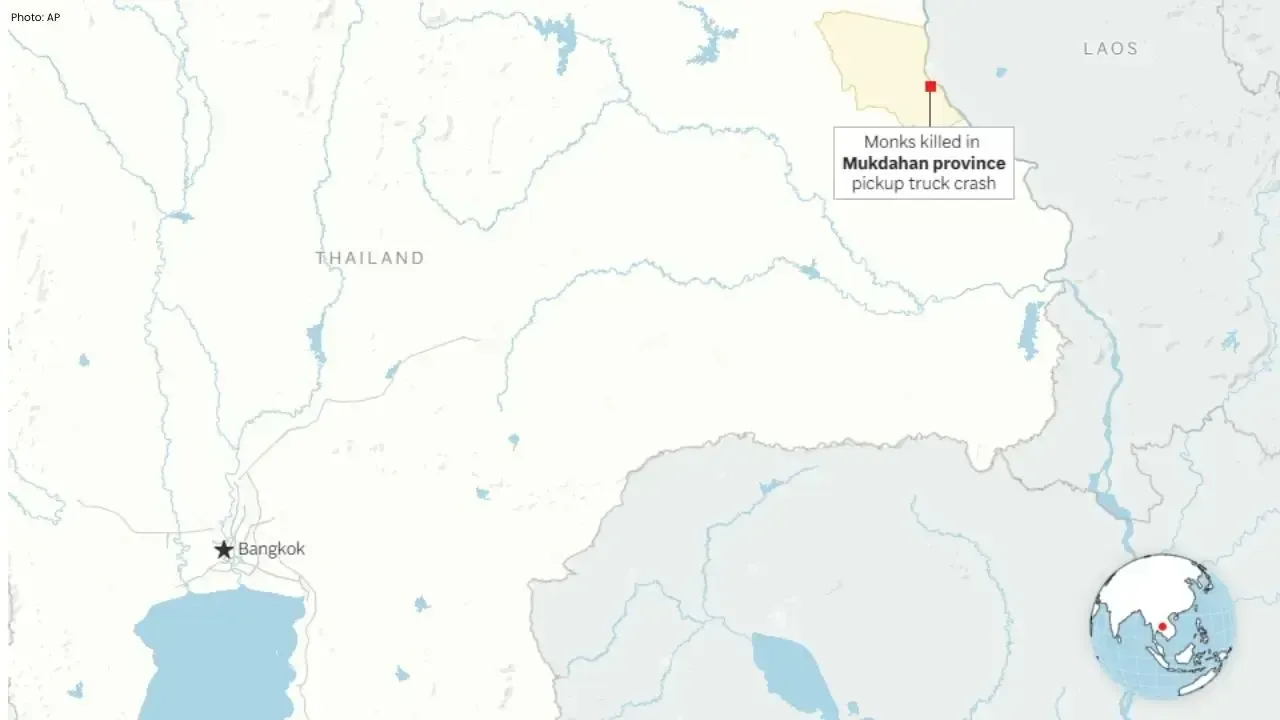
Nine Monks Killed in Thailand Pickup Truck Tragedy
An 11-year-old boy driving a pickup truck crashed into monks during a pilgrimage in northeastern Tha

Anwar Congratulates Xi on CPC's 105th Anniversary
Malaysia reaffirms strong ties with China as PM Anwar Ibrahim sends a congratulatory letter to Presi

Thai Agriculture Team Reviews 2026 Farm Development Plans
Agriculture Ministry officials inspected livestock and organic rice projects in Nakhon Sawan to moni

Thailand, Canada Boost Ties in PM-Level Phone Talks
Thailand and Canada agreed to strengthen trade, security, OECD cooperation and ASEAN-Canada FTA talk