
You have not yet added any article to your bookmarks!
Join 10k+ people to get notified about new posts, news and tips.
Do not worry we don't spam!
Post by : Badri Ariffin
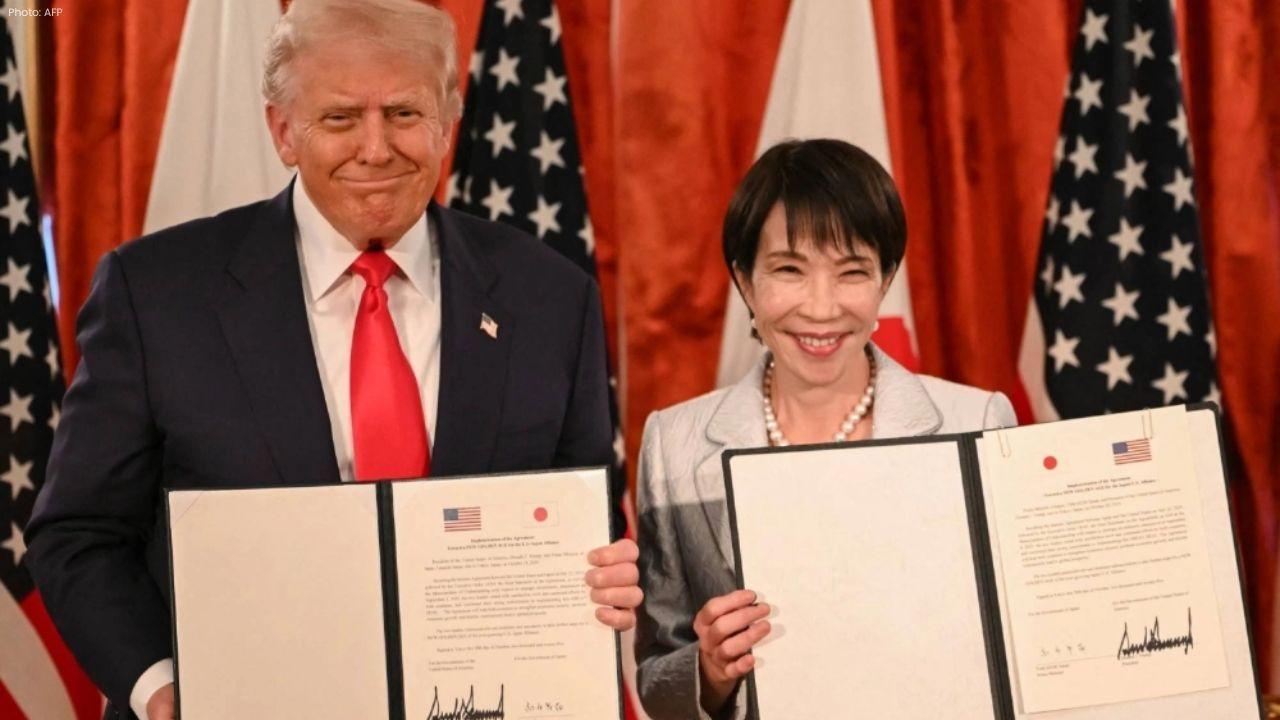
In a landmark move to reduce global dependence on China, U.S. President Donald Trump and Japanese Prime Minister Sanae Takaichi signed a framework agreement on rare earths at Tokyo’s Akasaka Palace on Tuesday. The signing, held under golden chandeliers and attended by senior aides, signals a strategic push to secure critical minerals vital for electronics and advanced technologies.
The accord outlines plans for both countries to coordinate investments, create fair and liquid markets for critical minerals, and provide financial support to selected projects over the next six months. Officials also hinted at possible complementary stockpiling arrangements and wider cooperation with international partners to strengthen supply chains.
China dominates over 90% of global rare earth processing, prompting concerns in Washington and Tokyo. While neither leader directly mentioned China, Beijing’s recent export curbs have added urgency to diversifying sources. The agreement comes ahead of a meeting between Trump and Chinese President Xi Jinping in South Korea, where discussions will focus on U.S. tariffs and rare earths export controls.
Currently, the U.S. and Myanmar account for 12% and 8% of rare earth extraction, while Malaysia and Vietnam contribute an additional 5% combined. The new U.S.-Japan framework aims to leverage these sources and reduce supply vulnerabilities.
Expanding Energy Cooperation
The partnership also extends into energy. Japan has pledged a $550 billion investment in the U.S., encompassing power generation and liquefied natural gas (LNG). With Russia’s Sakhalin-2 LNG project nearing contract expirations and Japan seeking diversification from Australia, U.S. LNG deals have become a strategic priority.
In recent months, Japan’s top buyers, JERA and Tokyo Gas, signed multi-million-ton agreements for U.S. LNG, with delivery timelines spanning the next decade. However, analysts note Japan still values proximity and cost efficiency, as Sakhalin-2 supplies reach Japan in days compared to longer shipping routes from the U.S. Gulf Coast and Alaska.
Industry observers suggest the agreement could reshape global rare earth markets while also influencing Japan’s long-term energy strategy, balancing affordability, security, and geopolitical considerations.







Michael Bracewell Chooses Casual Contract, Targets BBL Opportunity
Michael Bracewell moves to a casual contract as he eyes a BBL opportunity while remaining available

Tuchel Says Alex Scott Can Challenge Declan Rice for England Midfield Spot
Thomas Tuchel says Alex Scott can challenge Declan Rice for an England midfield place after his impr

Air Quality Turns Unhealthy in Central and Western Singapore Amid Haze
Singapore haze pushes PSI above 100 in central and western areas as smoke from regional hotspots rai

PM Modi Pays Tribute to Mahatma Gandhi, Urges People to Support Khadi
PM Modi pays tribute to Mahatma Gandhi on Gandhi Jayanti and urges citizens to support Khadi and the

Amazon Seeks to Offload $8 Billion in Nvidia Chips to Investors
Amazon plans to move $8 billion in Nvidia chips to investors, using a new financing model to strengt

Samsung Raises Galaxy S26 Prices as Memory Chip Costs Rise
Samsung raises Galaxy S26 prices in South Korea as rising memory chip costs put pressure on smartpho

