You have not yet added any article to your bookmarks!
Join 10k+ people to get notified about new posts, news and tips.
Do not worry we don't spam!
Post by : Sameer Farouq
For millennia, the pyramids have loomed as silent sentinels of our past—enormous structures that continue to intrigue and inspire wonder. Erected in the sands of Egypt, these ancient edifices symbolize the pinnacle of early human achievement, showcasing unparalleled engineering, ingenuity, and spiritual aspirations.
But what truly lies behind the mysteries of the pyramids? How did ancient civilizations construct these massive, perfectly aligned monuments without the modern tools we take for granted? Join us as we delve into the remarkable methods ancient architects, engineers, and laborers employed to create the timeless wonders we admire today.
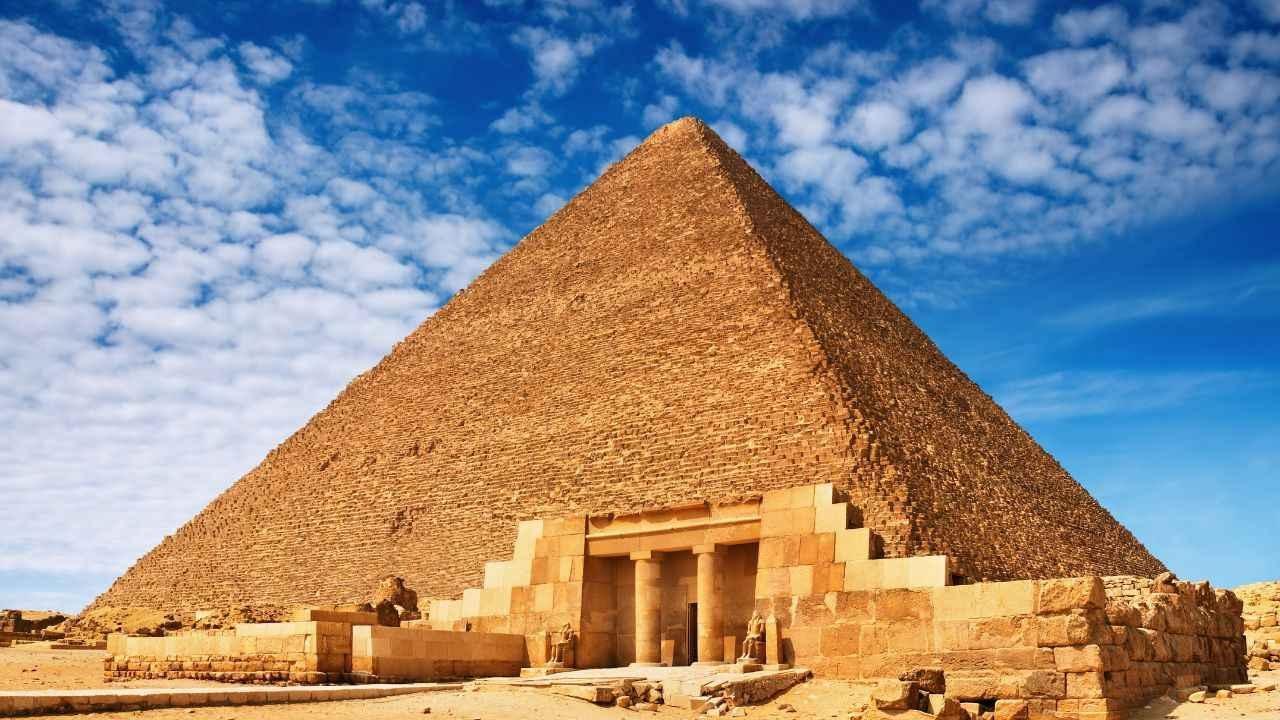
The pyramids symbolize more than mere architectural skill—they are icons of eternity. The most renowned, the Great Pyramid of Giza, stands as the last remaining wonder of the ancient world. Erected around 2560 BCE for Pharaoh Khufu, this colossal structure originally towered above 146 meters, built from approximately 2.3 million limestone blocks, each weighing several tons.
Its astonishment does not solely lie in its grandeur but in its extraordinary precision. The base is nearly a perfect square, and its sides align impeccably with the cardinal directions. Matching this level of accuracy today would be a monumental challenge, even with advanced technology.
This mix of enigma, scale, and precision reflects why the mysteries of the pyramids continue to intrigue historians, archaeologists, and engineers alike.
For ages, experts pondered over the question: “How were the pyramids constructed?”
Without cranes or heavy machinery, ancient Egyptians turned to creativity, collaboration, and advanced planning.
Contrary to the popular notion, the pyramids were not erected by slaves but rather by organized groups of skilled craftsmen. Archaeological findings show that tens of thousands of Egyptians—from engineers and stonemasons to laborers—were involved in the construction. They resided in nearby labor camps, received abundant rations, and took great pride in their contributions. Constructing a pyramid was deemed an honor, a service rendered to the gods and the pharaoh.
The majority of the limestone utilized for pyramid construction was sourced from nearby quarries, while granite blocks for the inner chambers were fetched from Aswan, situated hundreds of kilometers away. Workers likely transported these stones using wooden sledges gliding over pathways treated with water or mud to ease movement. This brilliant technique enabled them to maneuver blocks weighing several tons efficiently.
The most accepted explanation for lifting such heavy stones involves ramps.
Straight ramps may have been erected in front of the pyramid, extending upward as the structure grew.
Spiral ramps might have coiled around the sides of the pyramid, allowing gradual elevation of stones.
Some researchers propose internal ramps, concealed within the pyramid’s core, as a way to achieve precise alignments with minimal external support.
While no singular theory wraps up every detail, the ramp hypothesis remains the most plausible, supported by archaeological context.
The ancient Egyptians demonstrated remarkable skills in mathematics and astronomy, evidencing their knowledge through the pyramids.
The Great Pyramid's alignment to true north is astoundingly precise—off by less than a fraction of a degree. Scholars theorize builders utilized celestial bodies, notably those in the constellation Orion, as guiding references.
The proportions of the pyramid further reveal mathematical sophistication. The ratio of height to perimeter approximates the relationship between radius and circumference of a circle, closely mirroring π (pi). Such precision implies a fusion of geometry, observation, and spiritual symbolism in their designs, transforming these structures into cosmic representations of harmony and order.
The engineering feats behind the pyramids continue to challenge contemporary scientists. Each stone was cut, shaped, transported, and placed with remarkable accuracy. The joints between stones fit so flawlessly that not even a sheet of paper can slip between them.
Ancient engineers relied on simple yet effective tools like copper chisels, dolerite rocks, wooden rollers, and levers. However, the essence of their success lay in organization and strategic planning. Egyptians designed ramps, marked stone layers with red ochre, and coordinated their workforce into specialized teams.
The result? A construction process that harmonized manpower, mathematical knowledge, and meticulous planning—an enduring testament to ancient engineering prowess.
While Egypt’s pyramids are the most celebrated, they’re not singular in the world. Other ancient cultures constructed pyramid-like structures for diverse purposes.
Mesoamerican pyramids, like those in Chichen Itza and Teotihuacan, were primarily temples for deities rather than burial sites, featuring staircases and flat summits for rituals.
In Sudan, the Kingdom of Kush constructed over 200 smaller pyramids with steep sides as royal sepulchers.
Mesopotamian ziggurats, pre-cursors to pyramids, represented complexes connecting heaven and earth.
These examples highlight how the pyramid shape—stable, symbolic, monumental—emerged independently across civilizations as a universal emblem of power, divinity, and endurance.
New technologies continue to unveil more regarding the mysteries of the pyramids. Tools like ground-penetrating radar, 3D imaging, and cosmic-ray detection have revealed hidden chambers and passageways within the Great Pyramid, potentially harboring undiscovered artifacts or engineering knowledge.
Despite these advancements, many questions linger. How did laborers manage to lift the heaviest blocks weighing over 70 tons? What was the purpose behind the specific angles and alignments of internal corridors? And what symbolic meanings might yet be concealed within the pyramid's geometry?
As we continue to learn, the pyramids seem to guard their secrets—standing as a quiet testament to the fact that some mysteries persist deliberately.
The tale of the pyramids extends beyond mere architecture or engineering—it’s a narrative of human ambition. These ancient masterpieces illustrate how, thousands of years ago, people united to accomplish extraordinary feats that continue to defy comprehension today.
The pyramids of Egypt stand immortal, not simply because they are ancient, but because they encapsulate an enduring quest for transcendence—a longing to leave an imprint that transcends time, culture, and mortality.
The ultimate secret of the pyramids lies in this reality: they were constructed not solely from stone but from faith, intellect, and an unwavering belief in human potential.










George Russell Wins Dutch GP Sprint, Boosts Mercedes Morale
George Russell wins the Dutch GP Sprint from pole as Mercedes teammate Kimi Antonelli extends his F1

Australia 50/3 After Bangladesh Bowled Out for 64 in Second Test
Australia reached 50/3 after Bangladesh were bowled out for 64 in the second Test, with Mitchell Sta

Jordan Burroughs Returns to Wrestling with 2028 Olympic Dream
Jordan Burroughs returns to wrestling with Real American Freestyle as the Olympic champion eyes a po

Lamborghini Catches Fire on Singapore's ECP, Causing Heavy Traffic
A Lamborghini caught fire on Singapore's ECP, causing heavy traffic and bus delays. No injuries were

Bangkok Airport Duty-Free Area Flooded by Pipe Burst
A burst water pipe flooded the duty-free shopping area at Bangkok's Suvarnabhumi Airport on July 16,

Nine Monks Killed in Thailand Pickup Truck Tragedy
An 11-year-old boy driving a pickup truck crashed into monks during a pilgrimage in northeastern Tha