You have not yet added any article to your bookmarks!
Join 10k+ people to get notified about new posts, news and tips.
Do not worry we don't spam!

Post by : Anis Farhan
Tennis is a sport built on precision. Matches can be won or lost by a ball landing just a millimeter inside or outside the line. For decades, line judges and umpires carried the heavy responsibility of making instant calls, often under immense pressure. Human error was inevitable, sparking frustration among players, fans, and analysts alike.
The introduction of Hawk-Eye technology changed everything. This advanced system brought accuracy, objectivity, and transparency to the game. By tracking the ball’s movement in three dimensions, Hawk-Eye provides near-infallible replays of contentious shots. Once a novelty, it is now an integral part of modern tennis.
But with its rising prominence, questions emerge: Is Hawk-Eye the future of judging in tennis? Will human umpires eventually become obsolete?
Hawk-Eye was developed in the early 2000s by Dr. Paul Hawkins, initially for cricket. Its ability to track trajectories quickly gained attention across multiple sports, including snooker and football. In tennis, its first trial came in 2004, and by 2006, it was introduced at the US Open.
The system relies on multiple high-speed cameras positioned around the court. These cameras record the ball’s movement, and a computer algorithm processes the data to create a 3D representation of its path. The result: an image that shows exactly where the ball landed, accurate within a few millimeters.
Before Hawk-Eye, incorrect line calls were frequent, sometimes altering the outcome of matches. Players had little recourse except arguing with umpires, which often led to heated confrontations. Hawk-Eye solved this problem by providing:
Accuracy: Calls are correct to within a margin of error smaller than the width of the tennis ball.
Transparency: Replays are shown on big screens, giving fans and players confidence in the decision.
Player Challenges: Systems like the “three challenges per set” rule gave athletes control in contesting close calls.
The fairness brought by Hawk-Eye has been widely applauded, reducing controversy and ensuring that matches are decided by skill, not officiating errors.
During the COVID-19 pandemic, tournaments experimented with Hawk-Eye Live, an automated system that made line calls in real time without line judges. The 2020 US Open was one of the first Grand Slams to use it extensively. Instead of human voices, a pre-recorded audio signal called “Out!” replaced line judge shouts.
Benefits of Hawk-Eye Live include:
Cost Savings: Reduces the need for dozens of line judges at major tournaments.
Consistency: Eliminates human error entirely.
Efficiency: Speeds up play by avoiding disputes and delays.
However, some critics argue it diminishes the traditional feel of tennis and the human drama that comes with contested calls.
While Hawk-Eye has many supporters, its rise has sparked debate:
Pro-Technology View: Advocates believe accuracy is paramount. With millions of dollars and ranking points on the line, no player should lose due to a human error.
Traditionalist View: Opponents argue that removing line judges erodes the spirit of tennis. The interactions between players, umpires, and line judges have been part of the sport’s culture for decades.
Margin of Error: Hawk-Eye is not infallible. It has a small error margin, which critics point out makes it less “absolute” than advertised. Still, its precision far surpasses human capability.
This tension between tradition and innovation is at the heart of tennis’ future officiating model.
Hawk-Eye is no longer just about judging; it has become a powerful analytical tool:
Player Analytics: Tracks serve speeds, shot placement, and movement patterns.
Broadcast Enhancements: Provides fans with rich insights, including ball trajectory graphics and heat maps.
Coaching Support: Data-driven analysis helps players refine strategies and training methods.
Its dual role as both an umpiring tool and a performance analysis system cements Hawk-Eye as one of the most influential technologies in modern tennis.
Looking ahead, Hawk-Eye’s influence will only grow. Possible future developments include:
Full Automation: Matches with no human line judges at all, relying entirely on Hawk-Eye Live.
AI Integration: Artificial intelligence could analyze not only line calls but also foot faults, time violations, and even unsportsmanlike conduct.
Augmented Reality for Fans: Live, interactive visuals could give spectators an immersive experience of ball movement and shot precision.
The central question remains whether the tennis community will embrace full automation or maintain a hybrid model with both technology and human oversight.
Hawk-Eye has redefined tennis officiating, ensuring fairness and transparency while opening new doors for fan engagement and player analysis. Yet, the debate around fully replacing human umpires continues. Tennis, as a sport steeped in tradition, must decide whether accuracy should outweigh human involvement or whether the two can coexist.
Regardless of the path chosen, one thing is certain: Hawk-Eye has forever changed tennis, making it not only more accurate but also more engaging for the global audience. The future of judging may be automated, but its impact on the game’s integrity and excitement will remain undeniable.
This article is intended for informational purposes under Newsible Asia. It reflects the role of Hawk-Eye in modern tennis and its potential for future officiating but does not represent an official stance.










George Russell Wins Dutch GP Sprint, Boosts Mercedes Morale
George Russell wins the Dutch GP Sprint from pole as Mercedes teammate Kimi Antonelli extends his F1

Australia 50/3 After Bangladesh Bowled Out for 64 in Second Test
Australia reached 50/3 after Bangladesh were bowled out for 64 in the second Test, with Mitchell Sta

Jordan Burroughs Returns to Wrestling with 2028 Olympic Dream
Jordan Burroughs returns to wrestling with Real American Freestyle as the Olympic champion eyes a po

Lamborghini Catches Fire on Singapore's ECP, Causing Heavy Traffic
A Lamborghini caught fire on Singapore's ECP, causing heavy traffic and bus delays. No injuries were

Bangkok Airport Duty-Free Area Flooded by Pipe Burst
A burst water pipe flooded the duty-free shopping area at Bangkok's Suvarnabhumi Airport on July 16,
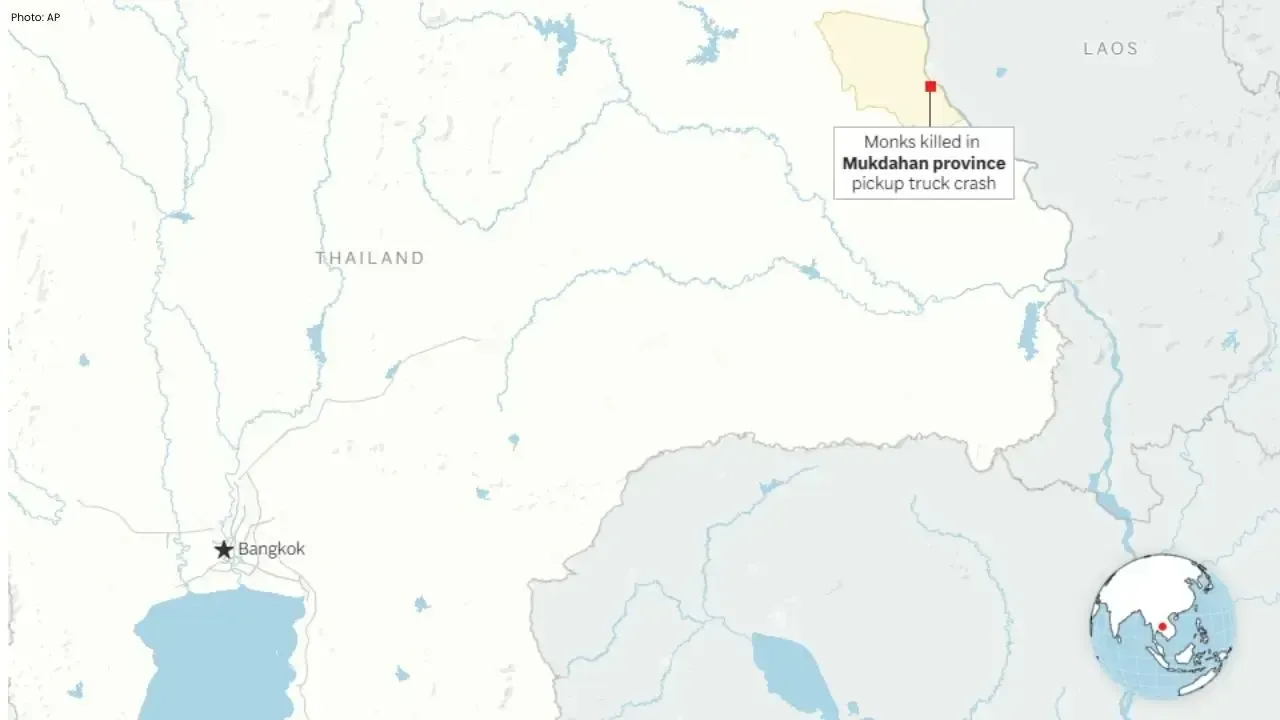
Nine Monks Killed in Thailand Pickup Truck Tragedy
An 11-year-old boy driving a pickup truck crashed into monks during a pilgrimage in northeastern Tha