You have not yet added any article to your bookmarks!
Join 10k+ people to get notified about new posts, news and tips.
Do not worry we don't spam!
Post by : Rameen Ariff
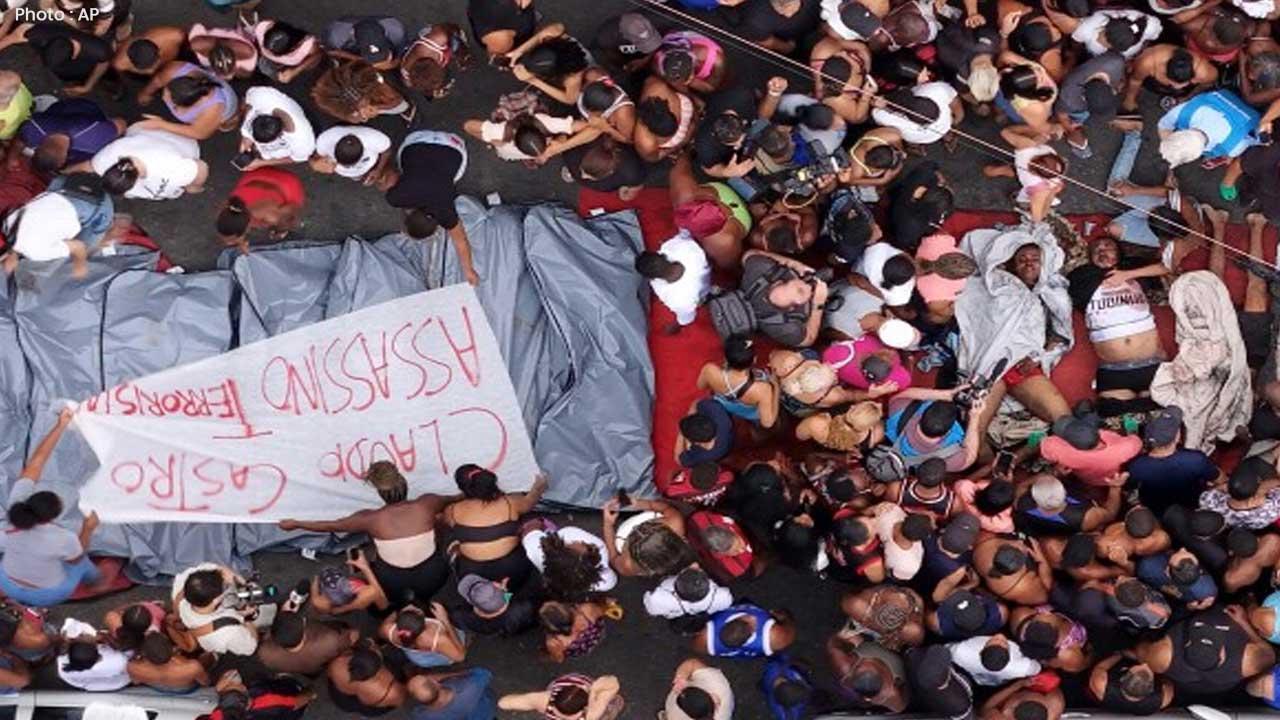
RIO DE JANEIRO — What began as a massive police operation against a powerful drug gang has turned into one of the deadliest raids in Brazil’s modern history, leaving at least 121 people dead and communities across Rio de Janeiro in shock.
The raid, which started Tuesday in the favelas of Complexo do Alemão and Penha, targeted the Red Command, a notorious criminal organization controlling drug trafficking and illegal trade in several low-income neighborhoods. According to officials, 113 people were arrested, 118 weapons seized, and more than a ton of narcotics confiscated after intense gun battles that raged for hours.
Residents described scenes of terror — streets turned into war zones, buses used as barricades, and schools and universities forced to shut down. The violence was so severe that even seasoned observers called it unprecedented in scale.
“This was not a security operation. It was a massacre,” said one community leader from Penha, speaking at a meeting of favela rights group CUFA, which is now organizing legal aid for grieving families. Many businesses in the area remained closed on Thursday, with residents mourning in silence.
Human rights organizations have condemned the operation, calling it one of the most violent in Brazil’s recent history. They have demanded a full, transparent investigation into the circumstances of the killings — including those of four police officers who also died during the clashes.
“Such extreme force cannot be justified under any law,” said a spokesperson for Human Rights Watch Brazil, urging the government to review its policies on urban policing.
Rio de Janeiro has long been the epicenter of deadly police operations in Brazil’s decades-long war on drugs. Past incidents include a 2005 raid in Baixada Fluminense that left 29 dead and a 2021 operation in Jacarezinho where 28 people were killed. But the 121 deaths this week have surpassed both, making it the most lethal security operation ever recorded in Rio.
The staggering death toll has ignited protests and political outrage, with citizens and activists accusing police of excessive force and human rights violations. Demonstrators have called for the resignation of Rio’s governor, arguing that the crackdown has deepened fear rather than restored safety.
As families continue to search for missing relatives and community leaders prepare legal cases, the tragedy has once again raised the question — can Brazil’s war on drugs ever bring peace, or is it only deepening the cycle of violence?
For now, Rio mourns yet another chapter of bloodshed, as the world watches Brazil grapple with the devastating aftermath of Hurricane Melissa’s human-made twin — a storm of bullets, fear, and grief in its own heart.





Rabada Misses First Australia Test as South Africa Pick Two Spinners
Kagiso Rabada misses the opener as South Africa vs Australia begins, with Anrich Nortje returning an

Starc Compares Australia's Tough Year to McIlroy's Major Sweep
Mitchell Starc says Australia winning three away Test series and the World Cup would match Rory McIl

France’s Sesterce Plans $11 Billion AI Data Centre in Finland
Sesterce plans a $11 billion AI data centre in Finland, with major expansion, green energy plans and

Danaher to Launch AI-Powered Autonomous Research Lab in 2027
Danaher plans an AI research lab for 2027, combining robotics and automation to speed up drug discov

Musk Welcomes German Support for Tesla Driver Assistance Tech as EU Approval Push Continues
Elon Musk welcomes Germany's backing for Tesla FSD as the company seeks EU approval amid speed, safe

Microsoft and Nvidia CEOs to Unveil AI Laptop at San Francisco Event
Microsoft and Nvidia showcase a new AI laptop with RTX Spark chips as they push powerful local AI co