You have not yet added any article to your bookmarks!
Join 10k+ people to get notified about new posts, news and tips.
Do not worry we don't spam!
Post by : Rameen Ariff
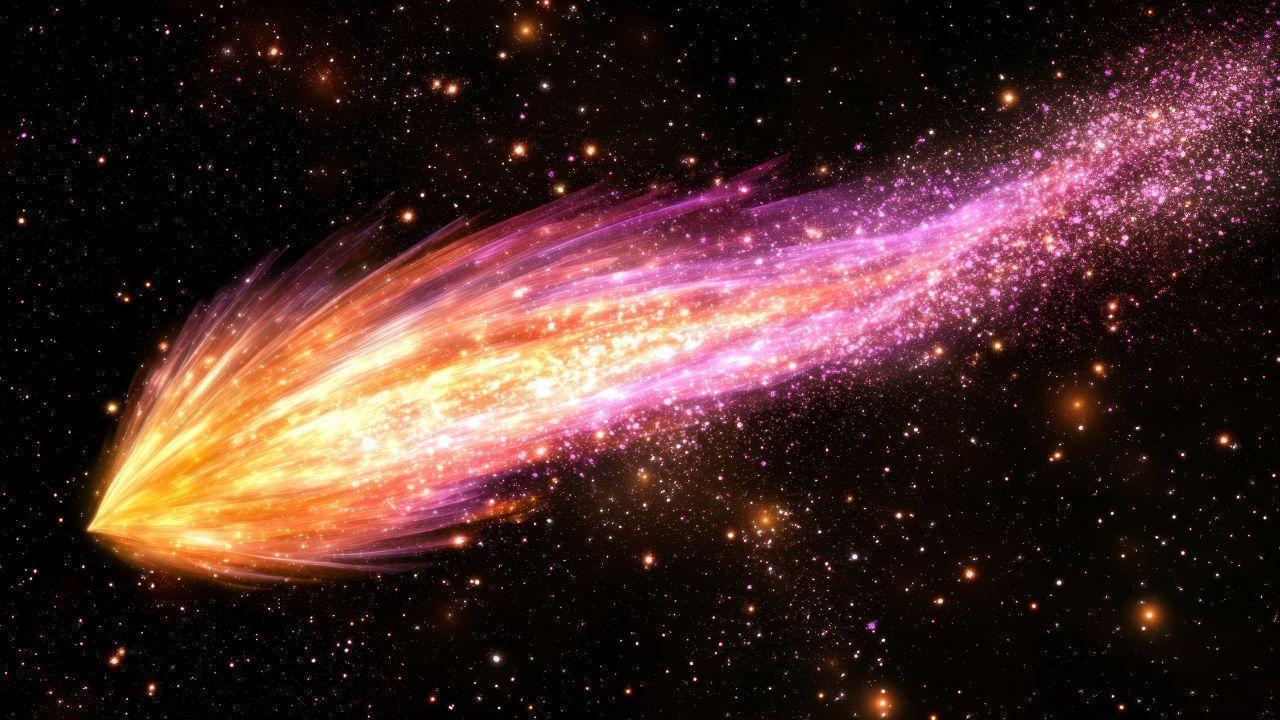
In a groundbreaking milestone for astrophysics, astronomers have observed the first-ever coronal mass ejection (CME) from a star beyond our solar system — a discovery that could redefine how scientists understand stellar activity and the potential habitability of distant planets.
Using data from the European Space Agency’s XMM-Newton spacecraft and the Low-Frequency Array (LOFAR) radio telescope, researchers captured a powerful blast of plasma erupting from a red dwarf star located approximately 130 light-years away. The event marks the first confirmed observation of an extra-solar CME — a long-sought phenomenon that astronomers have speculated about for decades.“Astronomers have wanted to spot a CME on another star for decades. We’ve now managed to do this for the first time,” said Joe Callingham from the Netherlands Institute for Radio Astronomy (ASTRON).
The detected CME was no ordinary stellar flare. The eruption blasted through space at 5.4 million miles per hour (2,400 km/s) — about 3,500 times faster than a jet fighter — and was powerful enough to strip away the atmosphere of any planet orbiting too closely.
Such immense power makes this discovery vital to the ongoing search for habitable worlds. CMEs can have a devastating effect on exoplanets, eroding their atmospheres and reducing their potential to host life — especially around red dwarf stars, which are known for their volatile behavior.
LOFAR’s advanced radio detection system first picked up faint radio signals produced as the CME burst through the star’s magnetic field, creating a shockwave. XMM-Newton later confirmed the star’s characteristics — revealing that it has half the Sun’s mass, spins 20 times faster, and possesses a magnetic field 300 times stronger than that of the Sun.
David Konijn, a PhD researcher at ASTRON, emphasized the importance of this dual-instrument approach:“Neither telescope alone would have been enough — we needed both LOFAR’s sensitivity and XMM-Newton’s data to confirm this CME.”
Scientists believe this discovery opens a new frontier in the study of space weather beyond our solar system. The findings suggest that planets orbiting small, magnetically active stars may face intense CME bombardments that could strip their atmospheres, even if they lie in the so-called habitable zone — the region where liquid water could exist.
Henrik Eklund of the European Space Research and Technology Centre noted:“We’re no longer limited to studying the Sun’s CMEs. It seems intense space weather may be even more extreme around smaller stars — the main hosts of potentially habitable planets.”
As red dwarfs are the most common stars in our galaxy, this discovery may mean that fewer exoplanets than previously believed can retain the stable conditions needed for life.
This historic observation not only validates long-held theories about stellar activity but also enhances scientists’ ability to evaluate the habitability of exoplanets. It may also refine future missions aimed at detecting life in deep space by factoring in the effects of stellar radiation and CMEs.
The research, published in Nature, highlights the significance of technological collaboration and international partnerships in advancing our understanding of the cosmos.









Rabada Misses First Australia Test as South Africa Pick Two Spinners
Kagiso Rabada misses the opener as South Africa vs Australia begins, with Anrich Nortje returning an

Starc Compares Australia's Tough Year to McIlroy's Major Sweep
Mitchell Starc says Australia winning three away Test series and the World Cup would match Rory McIl

France’s Sesterce Plans $11 Billion AI Data Centre in Finland
Sesterce plans a $11 billion AI data centre in Finland, with major expansion, green energy plans and

Danaher to Launch AI-Powered Autonomous Research Lab in 2027
Danaher plans an AI research lab for 2027, combining robotics and automation to speed up drug discov

Musk Welcomes German Support for Tesla Driver Assistance Tech as EU Approval Push Continues
Elon Musk welcomes Germany's backing for Tesla FSD as the company seeks EU approval amid speed, safe

Microsoft and Nvidia CEOs to Unveil AI Laptop at San Francisco Event
Microsoft and Nvidia showcase a new AI laptop with RTX Spark chips as they push powerful local AI co