
You have not yet added any article to your bookmarks!
Join 10k+ people to get notified about new posts, news and tips.
Do not worry we don't spam!
Post by : Badri Ariffin
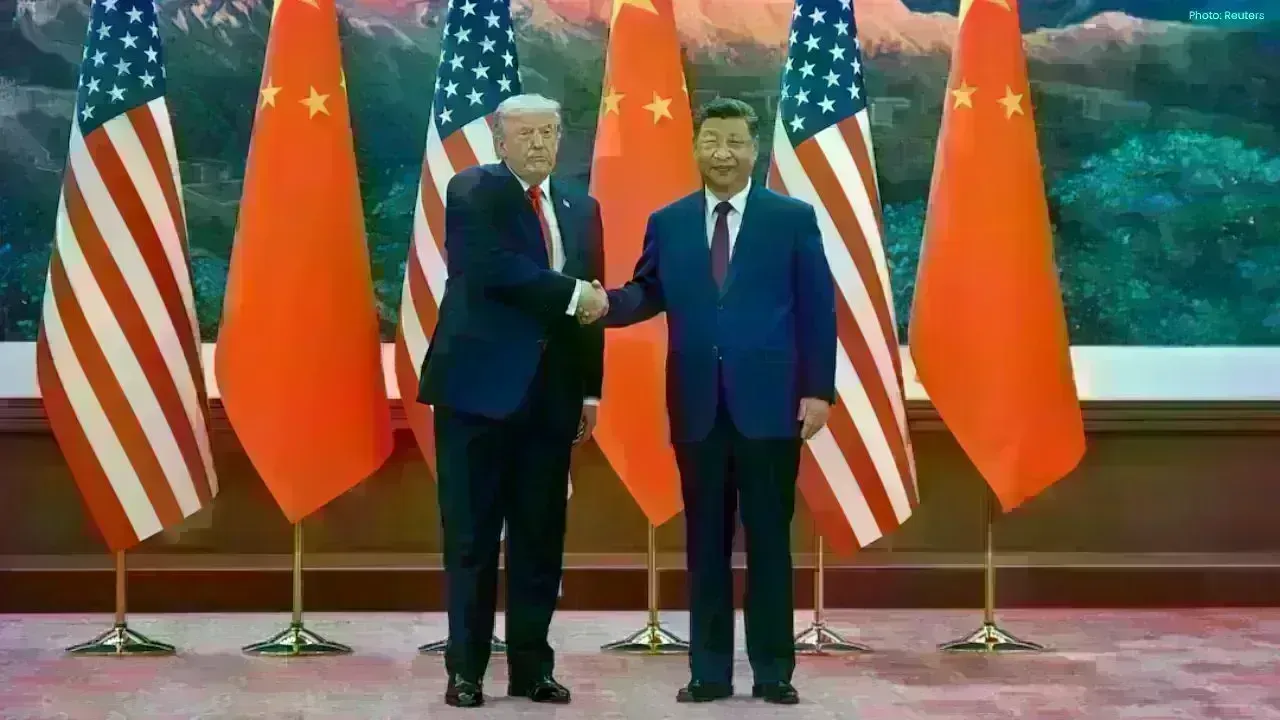
In a significant diplomatic encounter, Chinese President Xi Jinping and U.S. President Donald Trump initiated a pivotal two-day summit in Beijing centered around trade, Taiwan, investment, and broader global security concerns.
The summit kicked off with a ceremonial welcome at the Great Hall of the People in Beijing. During his opening statement, Xi emphasized the need for stable relations between China and the United States, asserting their importance for international economic balance and global stability.
“Cooperation brings mutual benefits, while confrontation results in losses for both parties,” Xi remarked.
Trump lauded Xi during their discussions, referring to the summit as potentially the “most significant ever.” He acknowledged the opportunity for both nations to enhance their economic relations and to foster more robust business collaborations.
As reported by Xinhua, Xi conveyed to Trump that recent trade negotiations yielded an “overall balanced and positive outcome” in their private talks.
These trade discussions aim to uphold the trade truce established last October, during which the U.S. halted hefty tariffs on Chinese goods, while China eased restrictions relating to rare earth exports critical for several industries, including technology and defense.
The situation regarding Taiwan emerged as a notably sensitive topic. Xi cautioned Trump that Taiwan represents a core issue in U.S.-China relations, warning that mismanagement could lead to serious conflicts.
While China considers Taiwan a part of its territory, the U.S. has continued to support Taiwan through military equipment and defense aid, with a proposed arms package valued at $14 billion pending approval from Trump's administration.
Several leading American business figures joined Trump, including Elon Musk, Jensen Huang, and Tim Cook, as he aims to advocate for greater accessibility for U.S. industries in China.
The summit will also delve into discussions concerning artificial intelligence, investment prospects, and trade partnerships. The U.S. is optimistic about increasing exports of Boeing aircraft and energy products to mitigate the trade deficit.
Conversely, China seeks the U.S. to lessen restrictions on exports of advanced semiconductor technologies.
Iran's situation is also set to feature prominently in the discussions, as Trump is likely to request China’s influence in persuading Iran towards a resolution with Washington to ease tensions in the Middle East. Nevertheless, analysts suggest that Beijing may refrain from exerting too much pressure on Tehran due to its strategic relevance.
Experts note that the dynamics between the two countries have evolved since Trump's last visit in 2017. Presently, both nations are navigating significant economic challenges, with the U.S. facing increased domestic political issues and inflation concerns related to the Iran conflict.
Furthermore, Xi is anticipated to visit the United States later in the year, marking his first trip to America since Trump resumed office in 2025.










PM Modi Pays Tribute to Mahatma Gandhi, Urges People to Support Khadi
PM Modi pays tribute to Mahatma Gandhi on Gandhi Jayanti and urges citizens to support Khadi and the

Amazon Seeks to Offload $8 Billion in Nvidia Chips to Investors
Amazon plans to move $8 billion in Nvidia chips to investors, using a new financing model to strengt

Samsung Raises Galaxy S26 Prices as Memory Chip Costs Rise
Samsung raises Galaxy S26 prices in South Korea as rising memory chip costs put pressure on smartpho

Lewis Hamilton Calls Singapore Grand Prix One of F1's Toughest Races
Lewis Hamilton discusses the demanding Singapore Grand Prix and brings Plus44 and Almave to Singapor

Denmark's Pandora Opens World's Largest Jewellery Factory in Vietnam
Pandora opens its largest jewellery factory in Vietnam, expanding global production, strengthening s

Gautam Gambhir Questions Batting-Friendly Pitches After India's Record ODI Chase
Gautam Gambhir questions batting-friendly ODI pitches after India’s record chase, calling for a bett

