
You have not yet added any article to your bookmarks!
Join 10k+ people to get notified about new posts, news and tips.
Do not worry we don't spam!
Post by : Badri Ariffin
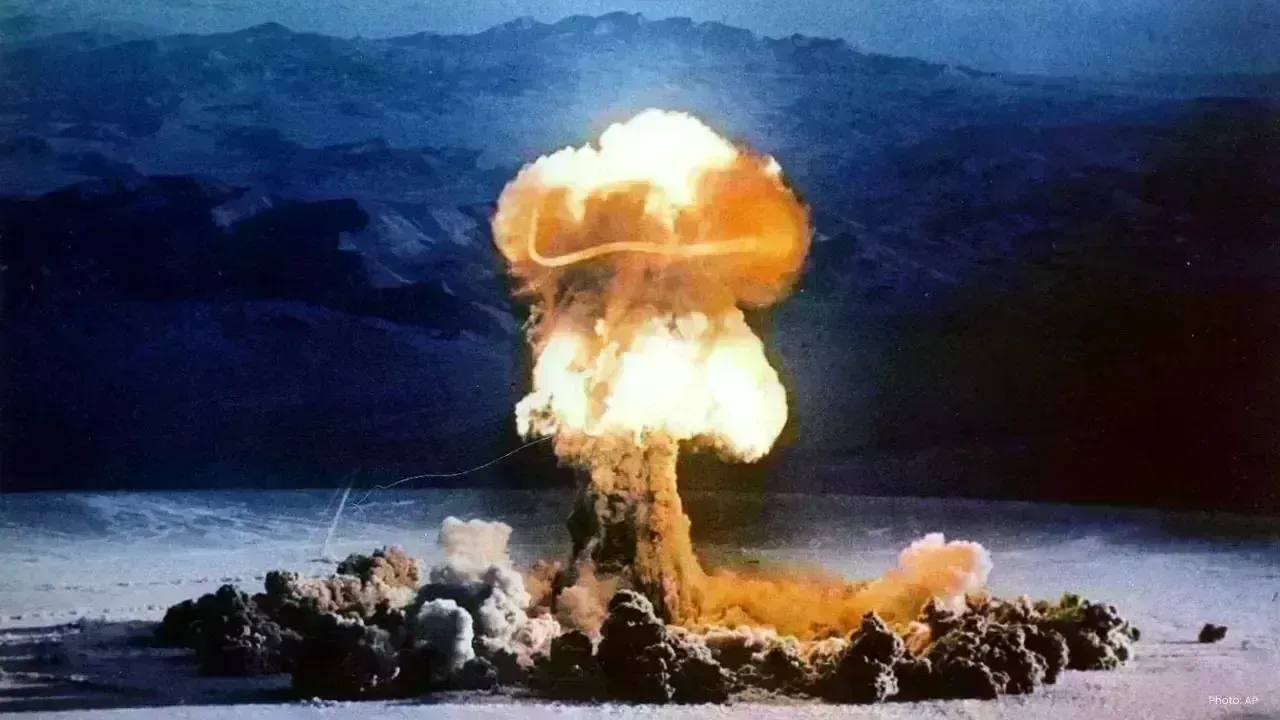
The United States has reaffirmed its stance on potentially resuming nuclear tests, highlighting escalating worries regarding Russia, China, and North Korea. These assertions followed U.S. President Donald Trump's earlier comments that the nation might restart nuclear testing to keep pace with what he claims are similar actions by other nuclear powers.
Howard Solomon, the U.S. Chargé d’Affaires at the International Organizations in Vienna, voiced these opinions during a private session on November 10. The session was conducted by the Preparatory Commission of the Comprehensive Nuclear-Test-Ban Treaty Organization (CTBTO), which is central to global disarmament discussions. The remarks, initially withheld from the public, were subsequently revealed by The Associated Press.
Solomon indicated that the U.S. might prepare for nuclear tests that align with levels known among other nuclear-capable nations. He emphasized a commitment to transparency and national security in this approach. Solomon further claimed that the U.S. suspects Russia and China have breached their commitments not to conduct nuclear tests, specifically citing zero-yield explosions post-2019.
Zero-yield tests pertain to diminutive explosions that compress nuclear material to incite a chain reaction but still fall under the Comprehensive Nuclear-Test-Ban Treaty (CTBT) prohibition. Even minimal explosions are deemed violations of treaty protocols.
Concerns Over Russia, China, and North Korea
Solomon reiterated decades-long U.S. apprehensions that both Russia and China may not adhere to the nuclear test ban. The U.S. believes there could be credible indicators of testing activities at Lop Nur in China’s Xinjiang region and at Russia’s Novaya Zemlya test site in the Arctic. Notably, both nations are signatories but have not ratified the CTBT, asserting compliance with a strict testing moratorium while denying any breaches.
He also noted North Korea's persistent nuclear testing history, comprising six nuclear tests since 2000, all detectable by the CTBTO monitoring system. Nonetheless, experts suggest that very low-yield tests conducted underground may evade detection, leading the U.S. to believe that some nations might be conducting covert testing.
Trump’s Claims and U.S. Stance
President Trump has recently asserted that Russia and China are engaged in nuclear tests without public admission. He remarked that, in contrast to those nations, the U.S. openly discusses its policy directions. When probed on whether Trump referred to low-yield testing, a White House official clarified that the president intended for U.S. tests to correspond with those of other nations.
The official added that many countries have ramped up testing, reinforcing the U.S.'s intent not to find itself at a disadvantage.
Russia Dismisses Accusations
In response to Solomon's remarks, Russia expressed significant disapproval. Russian representative Mikhail Ulyanov cautioned that a revival of nuclear testing could jeopardize global security and undermine the non-proliferation treaty framework. He demanded a clear clarification from the U.S. regarding its testing intentions.
Ulyanov refuted the U.S. allegations, asserting that Russia has remained compliant with its testing moratorium and branding the accusations as "false" and "unacceptable."
Wider Concerns in Arms Control
During the meeting, Solomon extended his critique beyond testing, addressing Russia’s suspension from the New START treaty, its sizable stockpile of nonstrategic nuclear armaments, and its nuclear strategies.
Nonstrategic nuclear weapons, being smaller and intended for battlefield applications, are not encompassed by significant arms control pacts, complicating their regulation. While these weapons may be less powerful than strategic counterparts, their potential for considerable destruction remains. Experts flag their use in conflicts as a pressing concern due to their battlefield orientation.
The Federation of American Scientists suggests that nonstrategic nuclear arms could pose an acute threat, especially in a scenario involving Russia and NATO.
Estimates indicate that Russia holds between 1,000 and 2,000 nonstrategic nuclear warheads, contrasting sharply with the U.S.'s approximately 200. This disparity fuels apprehension among U.S. and NATO officials.
Strategic Nuclear Weapons and New START
Strategic nuclear weapons, significantly more powerful, target deep within enemy lines. The U.S. and Russia maintain comparable amounts of these arms: 1,770 for the U.S. and 1,718 for Russia.
These figures are governed by the New START treaty, established in 2010, which is the last sizeable arms control pact between the two nations. Despite Russia's halted participation in 2023, President Vladimir Putin stated his country remains willing to uphold treaty limitations for another year.
However, the treaty is set to lapse on February 5, which would permit both nations to expand their nuclear arsenals without any regulatory framework for the first time in years.
Critical Juncture in Global Nuclear Arms Control
The current discourse surrounding nuclear testing indicates a comprehensive crisis in global arms control. Trust among leading nuclear states is diminishing, and critical treaties are under immense strain. The potential restart of testing could exacerbate international instability and ignite a renewed arms race.
The U.S. asserts that any resumption of testing would be a direct response to breaches by other nations. Meanwhile, Russia and China contest these allegations, while North Korea advances its weapons initiatives, inflating uncertainty.
As global tensions escalate, experts caution that the specter of nuclear brinkmanship may resurface. The disintegration of treaties such as New START and ongoing disputes regarding CTBT compliance may compel nations toward an arms buildup.






Josh Kerr and Jakob Ingebrigtsen Set for 1,500m Rivalry Rematch
Josh Kerr and Jakob Ingebrigtsen will renew their 1,500m rivalry at the Ultimate Championship in Bud

PSG Coach Luis Enrique Urges Players to Step Outside Comfort Zone
PSG coach Luis Enrique says players must leave their comfort zone and keep improving as the club tar

China’s Tiangong Sets New 400m Record at Robot Olympics
China’s Tiangong robot sets a new 400m record at the Robot Olympics, beating a South African robot i

George Russell Wins Dutch GP Sprint, Boosts Mercedes Morale
George Russell wins the Dutch GP Sprint from pole as Mercedes teammate Kimi Antonelli extends his F1

Australia 50/3 After Bangladesh Bowled Out for 64 in Second Test
Australia reached 50/3 after Bangladesh were bowled out for 64 in the second Test, with Mitchell Sta

Jordan Burroughs Returns to Wrestling with 2028 Olympic Dream
Jordan Burroughs returns to wrestling with Real American Freestyle as the Olympic champion eyes a po

