
You have not yet added any article to your bookmarks!
Join 10k+ people to get notified about new posts, news and tips.
Do not worry we don't spam!
Post by : Saif Rahman
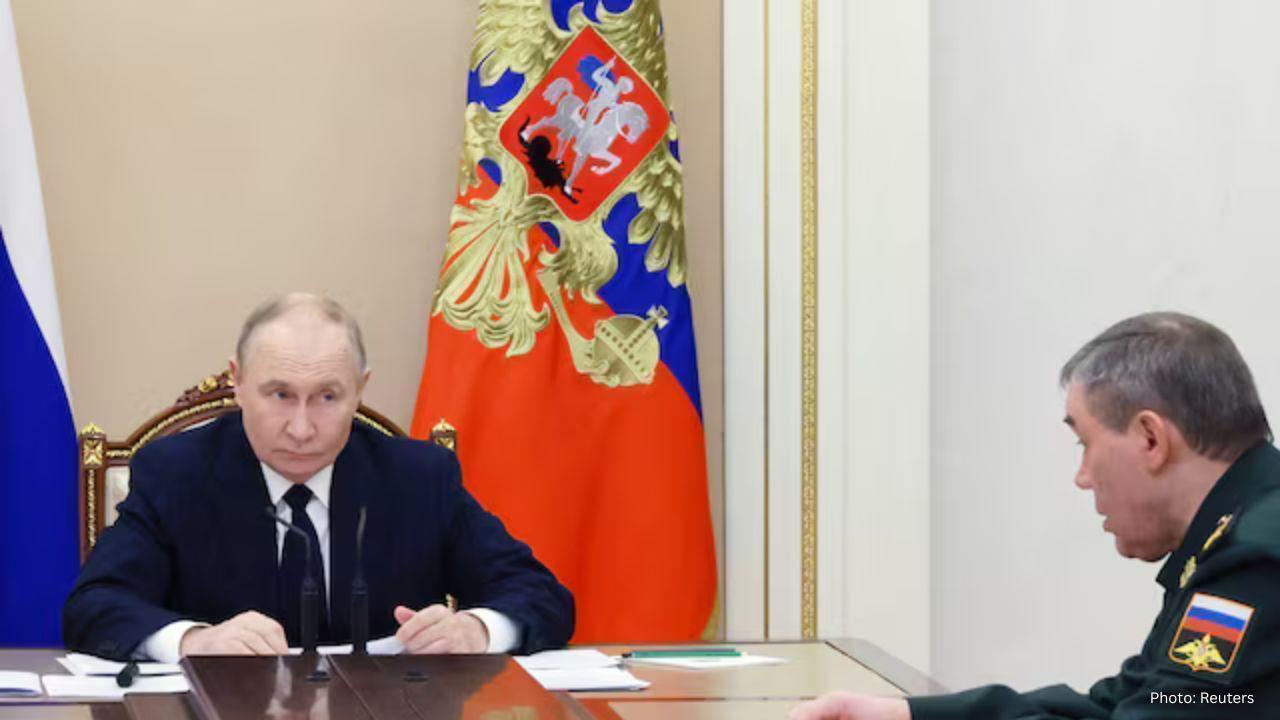
Russia has indicated a potential escalation of its military strategy in Ukraine, as its top general announced that President Vladimir Putin has instructed the enlargement of a buffer zone in the Sumy and Kharkiv areas slated for 2026. This declaration arrives amidst ongoing hostilities and heightened tensions along Ukraine’s northeastern front.
Valery Gerasimov, Chief of the General Staff of the Russian Armed Forces, noted that Russian forces are advancing into Ukrainian positions. His comments were made during an inspection of the “North” grouping of Russian troops and a meeting at a military command post. This contingent has been active in northeastern Ukraine since early 2024.
Essentially, a buffer zone serves as a division between two opposing factions. Russia claims these zones are necessary to safeguard its border regions from Ukrainian incursions. However, Ukraine and its allies interpret these actions as further encroachment on Ukrainian territory, suggesting that Russia is escalating its military objectives rather than pursuing diplomatic resolutions.
The Sumy and Kharkiv regions, located near the Russian border, have faced significant challenges since the conflict began. Ukraine’s second-largest city, Kharkiv, has suffered persistent missile and drone attacks, while Sumy frequently experiences shelling due to its border proximity. An expanded buffer zone in these territories would likely exacerbate the fighting and increase civilian casualties.
The “North” troop grouping is specifically tasked with operations in this segment of Ukraine, aiming to push back Ukrainian forces and set the stage for future territorial advances. Gerasimov's statements indicate a long-term military strategy that may extend beyond the immediate future.
From a strategic standpoint, these declarations raise serious questions regarding the trajectory of the conflict. Plans extended to 2026 imply that Russia is bracing for a protracted struggle rather than a swift resolution. This outlook diminishes the possibility of prompt peace negotiations while heightening the threat of ongoing violence and casualties.
For Ukraine, the prospect of an expanded buffer zone is particularly alarming, as it suggests further loss of land and rising military pressure. Civilians residing in these areas may face increased displacement, damage to property, and disruption of their daily lives.
Such developments are likely to capture the interest of Western nations that support Ukraine. Any indication that Russia intends to broaden its military goals may affect future military assistance, sanctions, and diplomatic initiatives. It further compounds fears of the conflict evolving into a long-term stalemate without a clear resolution.
In closing, Gerasimov’s remarks about President Putin’s order for an expanded buffer zone in Sumy and Kharkiv signify a potential new chapter in the war. Even as current hostilities continue, discussions for 2026 illustrate the entrenched nature of this conflict. Both the region and the international community are reminded that peace remains elusive, and the human cost of warfare only continues to rise.




PSG Coach Luis Enrique Urges Players to Step Outside Comfort Zone
PSG coach Luis Enrique says players must leave their comfort zone and keep improving as the club tar

China’s Tiangong Sets New 400m Record at Robot Olympics
China’s Tiangong robot sets a new 400m record at the Robot Olympics, beating a South African robot i

George Russell Wins Dutch GP Sprint, Boosts Mercedes Morale
George Russell wins the Dutch GP Sprint from pole as Mercedes teammate Kimi Antonelli extends his F1

Australia 50/3 After Bangladesh Bowled Out for 64 in Second Test
Australia reached 50/3 after Bangladesh were bowled out for 64 in the second Test, with Mitchell Sta

Jordan Burroughs Returns to Wrestling with 2028 Olympic Dream
Jordan Burroughs returns to wrestling with Real American Freestyle as the Olympic champion eyes a po

Lamborghini Catches Fire on Singapore's ECP, Causing Heavy Traffic
A Lamborghini caught fire on Singapore's ECP, causing heavy traffic and bus delays. No injuries were

